
Duct Tape AI image generator for fast text‑rich visual creation

What is Duct Tape AI
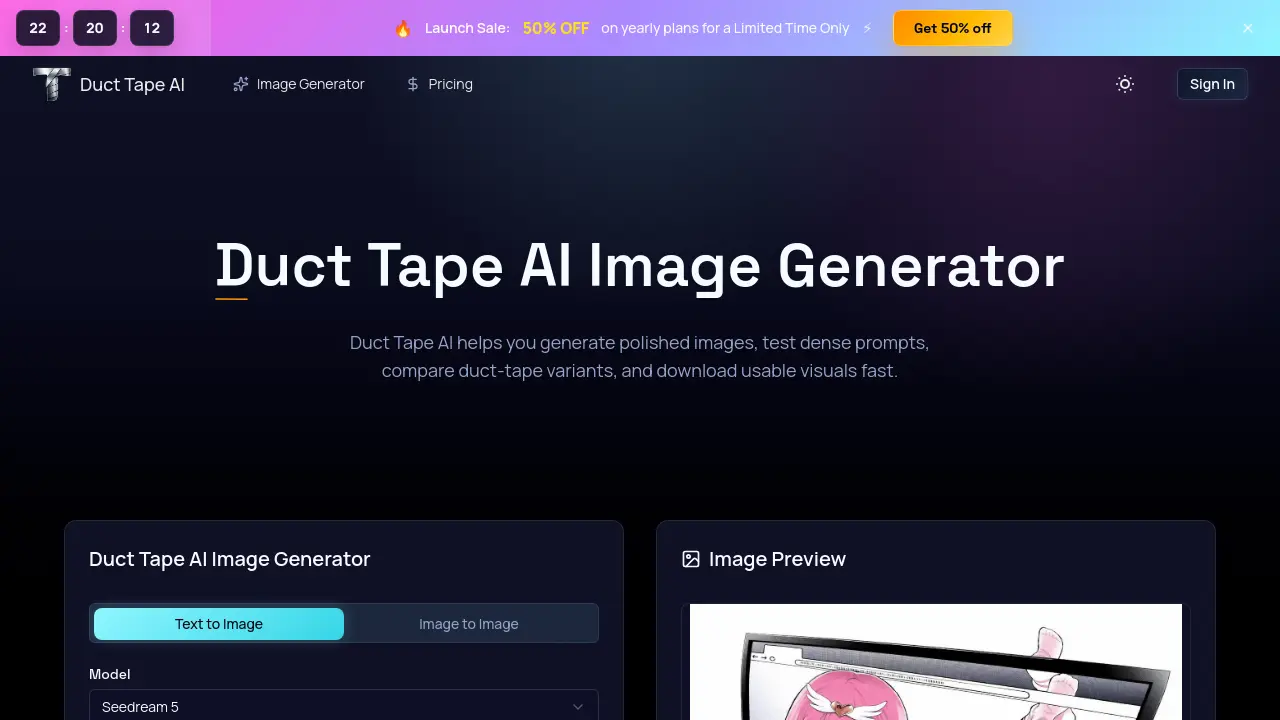
Duct Tape AI is an image‑generation platform that emphasizes sharp text rendering, structured layouts, and repeatable visual fidelity across commercial assets. Users input a detailed prompt—or upload a reference image—and select aspect ratio, quality, background, and output format before the model produces high‑resolution results in seconds. The service excels at creating readable in‑image copy for posters, menus, packaging, and advertising mockups, while also supporting image‑to‑image refinement for tighter style transfer. Three tiered credit plans (Starter, Plus, Enterprise) provide scalable access for hobbyists, professionals, and teams, each including commercial‑use licensing and priority support. By combining text‑heavy prompt handling with consistent brand‑level detail, Duct Tape AI streamlines workflows for product photography, editorial key art, and stylized illustration without the need for extensive post‑processing.
How does Duct Tape AI work
Duct Tape AI operates as a web‑based image generator that accepts natural‑language prompts or reference images, then routes the request through the “duct‑tape” model family (variants 1‑3) to produce text‑to‑image or image‑to‑image outputs. Users select settings such as aspect ratio, quality, and output format, after which the service allocates credits, processes the request on a GPU‑accelerated backend, and returns a preview for quick download. The platform emphasizes reliable in‑image text rendering, layout consistency, and batch‑style control, making it suitable for poster, packaging, and editorial mock‑ups while supporting commercial‑grade, high‑resolution exports.
Benefits of Duct Tape AI
Duct Tape AI offers a focused workflow for generating and refining images that require precise typography, structured layouts, and brand‑consistent details. Users can start with a clear text prompt or upload a reference image, then adjust aspect ratio, quality, and output format to suit posters, packaging mockups, editorial covers, or stylized illustrations. The platform delivers high‑resolution exports without watermarks and supports both text‑to‑image and image‑to‑image modes, making dense prompts and label‑heavy compositions reliable. Flexible credit‑based pricing and priority support further streamline fast, commercial‑ready visual production.
Pros and Cons of Duct Tape AI
Pros
- Sharp text rendering in image generation.
- Consistent layout and typography control.
- Supports both text‑to‑image and image‑to‑image workflows.
- High‑resolution exports without watermarks.
- Tiered credit plans for flexible pricing.
Cons
- No official model ownership, community‑run service.
- Credit usage can be costly for high‑volume projects.
- Limited free credits restrict extensive testing.
- Advanced features require higher‑priced plans.
- Dependence on internet connection for generation.
Core Features of Duct Tape AI
Text‑to‑Image Generation
Creates polished visuals from natural language prompts, emphasizing accurate typography, layout hierarchy, and realistic details for posters, packaging, ads, and editorial graphics.
Image‑to‑Image Refinement
Accepts an uploaded reference image and iteratively enhances composition, lighting, or style while preserving the original structure and brand elements.
Reference‑Based Prompt Control
Allows users to guide the model with both text and visual references, ensuring tighter adherence to desired fonts, colors, and object placement.
High‑Resolution Export with Commercial License
Delivers downloadable, watermark‑free high‑resolution files suitable for print, web, or social media, accompanied by unrestricted commercial usage rights.
Credit‑Managed Generation and Tiered Plans
Operates on a credit system tied to subscription tiers, providing flexible pricing, priority queues, and faster generation speeds for teams and power users.
Use Cases of Duct Tape AI
- Marketing teams: Generate retail shelf mockups with readable price tags and consistent product geometry for quick A/B testing.
- UI/UX designers: Refine interface screenshots using image‑to‑image workflow, preserving button labels and layout hierarchy.
- Editorial publishers: Create magazine covers and fashion posters that maintain sharp typography and balanced visual hierarchy.
- Product developers: Produce high‑resolution packaging renders that keep label spacing and bottle reflections accurate across variations.
- Illustrators: Produce stylized comic panels or concept art with strong prompt obedience while retaining detailed line work.
FAQs of Duct Tape AI
What is Duct Tape AI?
Duct Tape AI is an independent web platform that provides text‑to‑image and image‑to‑image generation using the community‑named “duct‑tape” model variants. It is designed for creators who need sharp typography, structured layouts, and commercial‑grade visuals without requiring deep AI expertise.
Is DuctTapeAI the official model owner?
No. DuctTapeAI operates as a third‑party access portal and does not claim ownership or direct development of the underlying AI model. It simply offers users a convenient interface to generate images with the duct‑tape variants.
What do duct‑tape, duct‑tape 1, and duct‑tape 2 mean?
These labels are community‑created tags that differentiate observed model versions. Duct‑tape 1 is generally lighter and less detailed, while duct‑tape 2 is considered more balanced, delivering stronger text fidelity and layout control. A duct‑tape 3 variant is occasionally referenced for even higher detail.
Why do people care so much about Duct Tape AI text rendering?
Readable in‑image text remains a challenge for most diffusion models. Duct Tape AI consistently reproduces headlines, menu items, product labels, and other copy with minimal distortion, making it valuable for advertising, packaging, and editorial workflows that depend on precise typography.
Can I start from a reference image?
Yes. Duct Tape AI supports an image‑to‑image workflow where users upload a reference photo and guide the model to refine composition, lighting, or style while preserving the original structure. This feature is useful for tightening mockups or iterating on existing designs.
What can I create with Duct Tape AI?
Creators employ Duct Tape AI for a wide range of assets, including poster concepts, retail shelf mockups, magazine covers, food menus, brand packaging studies, social‑media graphics, and stylized illustrations such as comic panels or anime‑inspired portraits.
How do credits work on DuctTapeAI?
Credits are the unit of consumption for each generation request; the amount used depends on model selection, image resolution, and quantity. Users can purchase credits via monthly, yearly, or pay‑as‑you‑go plans, and unused credits roll over until depleted.
How does Duct Tape AI handle commercial use?
All subscription tiers include a commercial‑use license, allowing generated images to be incorporated into marketing materials, product packaging, client presentations, and other revenue‑generating projects without additional royalties.
What is the difference between the Starter, Plus, and Enterprise plans?
The Starter plan offers 14,400 credits per year at $0.83 per 100 credits, suited for hobbyists. The Plus plan provides 24,000 credits at $0.75 per 100 credits and adds priority queue and support, targeting professional creators. Enterprise grants 67,200 credits at $0.71 per 100 credits, fastest generation speed, and expert team support for teams and power users.
Is there a free trial or demo available?
Duct Tape AI offers a free trial that lets new users generate a limited number of images to evaluate prompt quality, text fidelity, and layout control before committing to a paid credit plan. The trial does not require a credit purchase and is accessible from the homepage generator section.
How to use Duct Tape AI
Duct Tape AI generates high‑quality text‑to‑image and image‑to‑image visuals, emphasizing readable in‑image copy, precise layouts, and consistent brand details for commercial and editorial projects.
Open the generator page, paste a clear prompt describing the desired scene, and optionally upload a reference image to guide composition, style, or subject matter.
Select appropriate settings: aspect ratio, quality level, background option, output format, and the number of images to match the intended ad, product page, or social media requirement.
Click Generate, wait for the preview to appear, then examine the result for text fidelity, spacing, typography alignment, and overall visual coherence.
Use the built‑in comparison view to toggle between duct‑tape variants (e.g., version 1 vs. version 2) and assess which output best preserves layout and detail.
Download the high‑resolution image once satisfied; the file is ready for immediate inclusion in marketing assets, packaging mockups, or editorial layouts.
Interpret the downloaded result by checking headline legibility, label accuracy, and color consistency; adjust the prompt or settings and re‑generate if needed to meet the project’s goals.
Duct Tape AI Website Traffic Analysis
Latest traffic information
- Monthly Visits13.26K
- Bounce Rate56.6%
- Pages Per Visit1.48
- Visit Duration00:00:12
- Global Rank1.94M
- Country/Region Ranking70.78K
Visits Over Time
Traffic Sources
- Organic Search: 51.94%
- Referrals: 45.7%
- Generative AI: 1.78%
- Direct: 0.59%
Top Keywords
| Keyword | Traffic | Volume | Cost Per Click |
|---|---|---|---|
| 덕 테이프 ai 사이트 | 500 | 1.26K | -- |
| ホグワーツレガシー サイズ | 160 | 320 | -- |
| 덕 테이프 ai | 60 | 1.97K | -- |
| duct tape ai | 50 | 2.02K | -- |
| the duct tape & ai newsletter ansel from united states los angeles | 40 | 40 | -- |
Top Regions
| Region | Percentage |
|---|---|
| Japan | 43.56% |
| South Korea | 29.15% |
| United States | 27.29% |
