
reAPI Introduction
reAPI provides a single OpenAI‑compatible endpoint that aggregates leading image, video, chat, music and code models, delivering 99.96% uptime, automatic failover and zero request logging for developers.

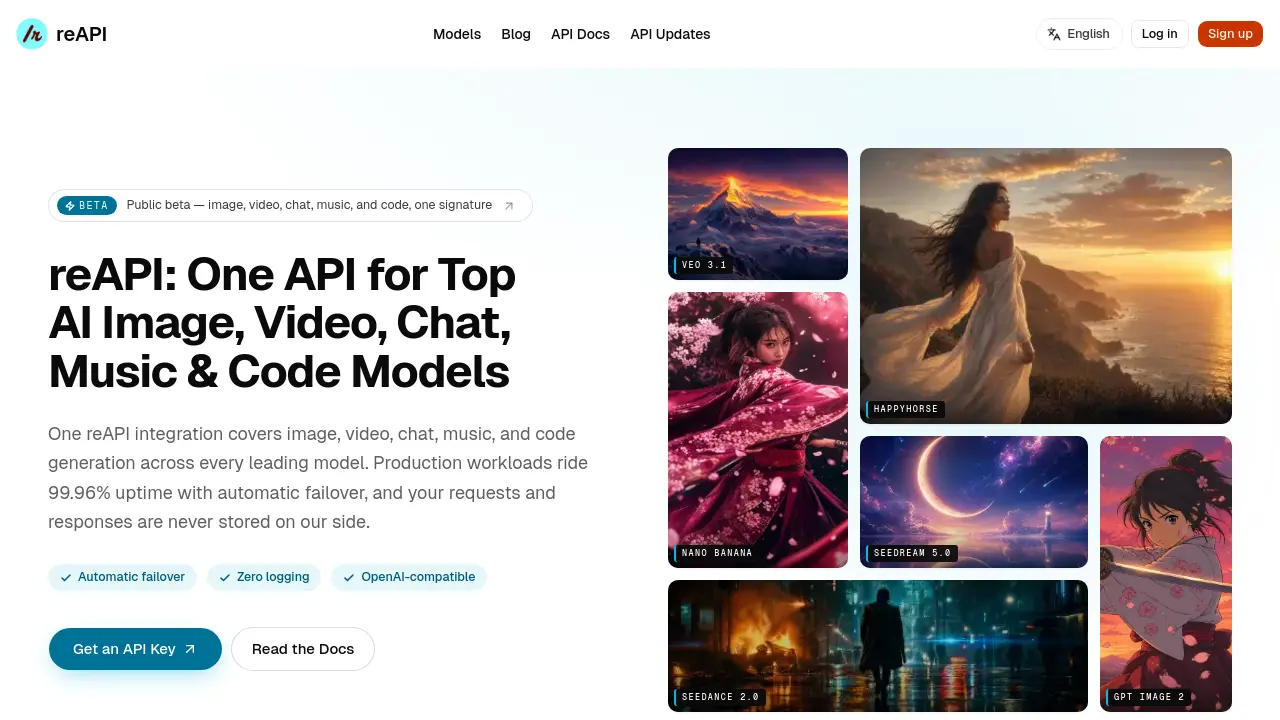
What is reAPI
reAPI is an AI‑API aggregator that unifies access to leading image, video, chat, music, and code generation models behind a single OpenAI‑compatible endpoint. The service handles vendor selection, automatic failover and routing, delivering 99.96 % uptime while keeping requests and responses off‑site for privacy. Developers obtain one API key, point their existing SDK to https://reapi.ai/v1, and can switch among models such as GPT‑5.5, Claude 4.7, Veo 3.1, Flux Pro, Suno and many others without code changes. Features include per‑key spend caps, idempotent retries, region pinning, streaming and multimodal support, and audit‑only logging. By consolidating multiple providers into one dashboard, reAPI reduces procurement complexity and improves reliability for production workloads that require diverse generative AI capabilities.
How does reAPI work
reAPI operates as a single‑endpoint aggregator that routes requests to multiple leading AI providers, handling image, video, chat, music and code models behind one base URL. When a call arrives, the platform selects the appropriate vendor, applies region‑pinning rules, and monitors health; if a provider degrades, an automatic failover redirects the request without exposing errors to the client. Requests and responses are never logged, while per‑key spend caps and idempotent retries protect cost and reliability. The service remains OpenAI‑compatible, allowing existing SDKs to switch by changing only the base URL and API key.
Benefits of reAPI
reAPI consolidates top‑tier AI models for image, video, chat, music, and code behind a single OpenAI‑compatible endpoint. The platform delivers 99.96 % uptime with automatic, sub‑second failover, while guaranteeing zero logging of requests or responses. Developers can manage all models—Flux, GPT‑5.5, Claude, Gemini, Veo, Suno, and more—through one API key and dashboard, enabling per‑key spend caps, region pinning, and idempotent retries. Streaming, tool calls, and multimodal inputs are preserved end‑to‑end, allowing seamless integration without code changes or multiple vendor contracts.
Pros and Cons of reAPI
Pros
- Single endpoint accesses multiple AI models.
- Automatic failover ensures high availability.
- Zero request logging protects data privacy.
- OpenAI‑compatible SDK integration.
- Per‑key spend caps prevent unexpected costs.
Cons
- Limited published performance benchmarks.
- Reliance on external providers may affect latency.
- Advanced features may require higher pricing tiers.
- No native model fine‑tuning support.
- Documentation depth varies across models.
