
reAPI – Unified API for Top AI Models with 99.96% Uptime

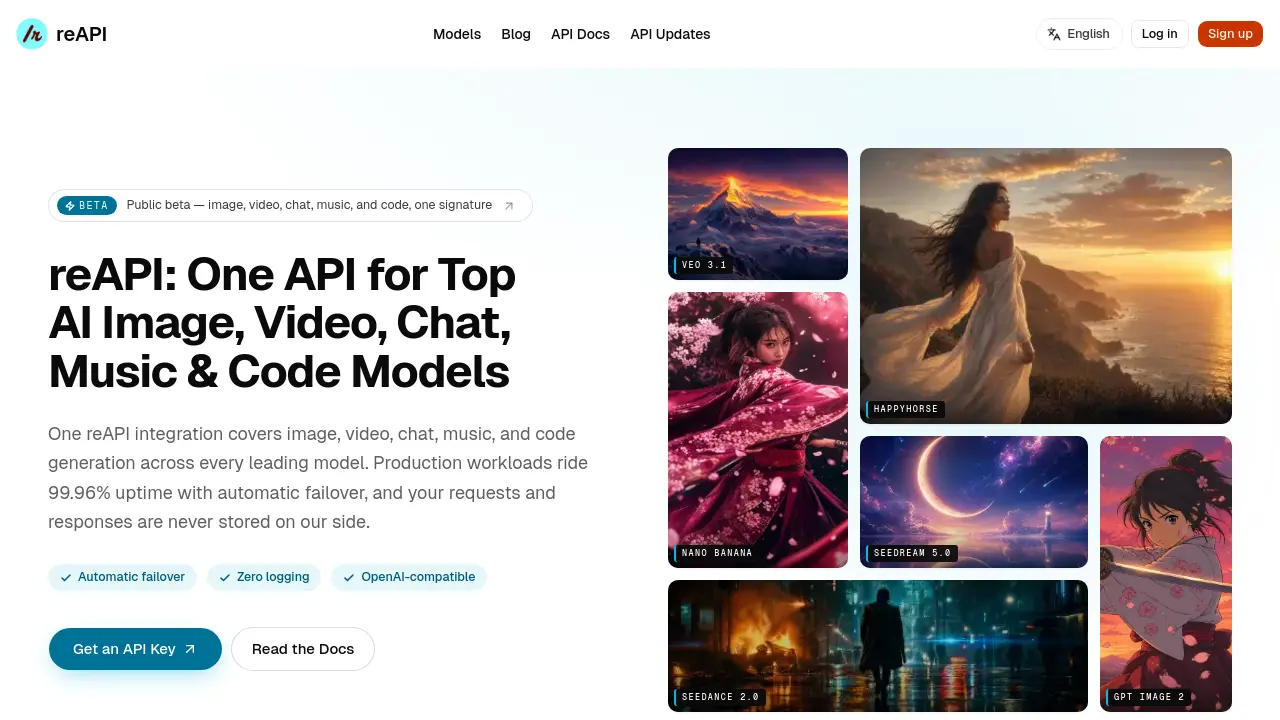
What is reAPI
reAPI is an AI‑API aggregator that unifies access to leading image, video, chat, music, and code generation models behind a single OpenAI‑compatible endpoint. The service handles vendor selection, automatic failover and routing, delivering 99.96 % uptime while keeping requests and responses off‑site for privacy. Developers obtain one API key, point their existing SDK to https://reapi.ai/v1, and can switch among models such as GPT‑5.5, Claude 4.7, Veo 3.1, Flux Pro, Suno and many others without code changes. Features include per‑key spend caps, idempotent retries, region pinning, streaming and multimodal support, and audit‑only logging. By consolidating multiple providers into one dashboard, reAPI reduces procurement complexity and improves reliability for production workloads that require diverse generative AI capabilities.
How does reAPI work
reAPI operates as a single‑endpoint aggregator that routes requests to multiple leading AI providers, handling image, video, chat, music and code models behind one base URL. When a call arrives, the platform selects the appropriate vendor, applies region‑pinning rules, and monitors health; if a provider degrades, an automatic failover redirects the request without exposing errors to the client. Requests and responses are never logged, while per‑key spend caps and idempotent retries protect cost and reliability. The service remains OpenAI‑compatible, allowing existing SDKs to switch by changing only the base URL and API key.
Benefits of reAPI
reAPI consolidates top‑tier AI models for image, video, chat, music, and code behind a single OpenAI‑compatible endpoint. The platform delivers 99.96 % uptime with automatic, sub‑second failover, while guaranteeing zero logging of requests or responses. Developers can manage all models—Flux, GPT‑5.5, Claude, Gemini, Veo, Suno, and more—through one API key and dashboard, enabling per‑key spend caps, region pinning, and idempotent retries. Streaming, tool calls, and multimodal inputs are preserved end‑to‑end, allowing seamless integration without code changes or multiple vendor contracts.
Pros and Cons of reAPI
Pros
- Single endpoint accesses multiple AI models.
- Automatic failover ensures high availability.
- Zero request logging protects data privacy.
- OpenAI‑compatible SDK integration.
- Per‑key spend caps prevent unexpected costs.
Cons
- Limited published performance benchmarks.
- Reliance on external providers may affect latency.
- Advanced features may require higher pricing tiers.
- No native model fine‑tuning support.
- Documentation depth varies across models.
Core Features of reAPI
Unified Multi‑Model API Endpoint
Provides a single OpenAI‑compatible base URL that accesses image, video, chat, music, and code models, simplifying integration and eliminating vendor‑specific SDK changes.
Automatic Failover & Redundancy
Routes requests to alternate providers when a model degrades, ensuring continuous operation with 99.96 % uptime and no client‑side errors.
Zero Request/Response Logging
Stores no user inputs or model outputs on the platform; only billing and security events are streamed, preserving data privacy by design.
Per‑Key Spend Caps & Team Limits
Allows daily spending ceilings per API key and overall team caps, preventing unexpected costs and enabling automated budget alerts.
Region Pinning for Data Residency
Directs traffic to providers within specified geographic zones (EU, US, APAC), ensuring compliance with local data‑handling regulations.
Idempotent Retries with Deduplication
Accepts an idempotency key to safely repeat failed calls; duplicate requests are ignored, avoiding double charges and redundant processing.
Streaming, Tool Calls, and Multimodal Support
Preserves server‑sent events, function calling, structured outputs, and multimodal inputs (image, audio) end‑to‑end, matching native provider capabilities.
Use Cases of reAPI
- Academic research teams: Integrate multiple top‑tier LLMs for literature review automation while maintaining zero logging of proprietary data.
- Game developers: Generate synchronized video assets and adaptive music tracks via a single API key, reducing vendor management overhead.
- E‑commerce platforms: Produce photorealistic product images and dynamic video demos using Flux and Veo models through one OpenAI‑compatible endpoint.
- DevOps monitoring tools: Implement idempotent retries and per‑key spend caps to ensure reliable AI‑driven alert generation without unexpected cost spikes.
- Multilingual chatbot services: Deploy Claude, Gemini, and Kimi models for long‑context, cross‑language conversations while pinning traffic to regional data centers.
FAQs of reAPI
What does reAPI actually do for each call?
reAPI acts as a unified routing layer that receives a request at a single OpenAI‑compatible endpoint, selects the appropriate vendor model, and forwards the request. It handles failover, region pinning, idempotent retries, and returns the response unchanged, so developers interact with many models through one consistent API.
Do you keep my requests or responses?
reAPI implements zero‑logging for content: request payloads and model outputs are never stored on the platform. Only audit‑ready metadata such as billing events and security logs are streamed to the customer’s chosen warehouse or syslog, ensuring privacy while still providing traceability.
Does my code change to use reAPI?
Minimal changes are required. Existing OpenAI, Anthropic, or Google SDK clients can point to https://reapi.ai/v1 and swap the model identifier to any catalog model. Apart from updating the base URL and using a reAPI API key, the request structure and code flow remain identical.
What does 99.96% uptime mean in practice?
A 99.96% uptime translates to roughly 3.5 hours of downtime per year. reAPI achieves this by routing each call through multiple redundant provider instances; if one instance degrades, traffic is instantly shifted to a healthy replica, keeping applications available almost continuously.
Do I need API keys from each provider, or just reAPI?
Only a single reAPI key is required. The platform contracts with the underlying model vendors and abstracts their authentication, so developers do not need to manage separate keys for OpenAI, Anthropic, Google, ByteDance, or other providers.
How does automatic failover work when a model provider experiences latency?
reAPI continuously monitors latency and health metrics for each vendor endpoint. When a provider’s response time exceeds predefined thresholds, the request is automatically rerouted to an alternative vendor offering the same model type, all within the same API call, preventing the client from seeing timeout errors.
Can I limit spending per key or per team?
Yes. reAPI provides per‑key spend caps that can be set in the dashboard, as well as hierarchical team‑level caps. When a limit is reached, further requests are rejected, protecting budgets from runaway usage while still allowing granular control over individual projects.
Is region pinning supported for compliance‑sensitive data?
reAPI allows you to pin traffic to specific geographic regions (EU, US, APAC). Requests originating from a region are processed by providers in the same region whenever possible, helping organizations meet data residency and regulatory requirements without additional configuration.
What streaming capabilities are preserved through reAPI?
All streaming features of the underlying models—including server‑sent events for token‑by‑token chat, real‑time audio/video streams, and tool‑calling messages—are passed through unchanged. Developers receive the same incremental payloads as they would from the native provider, enabling low‑latency interactive applications.
How to use reAPI
reAPI aggregates top‑tier AI models—image, video, chat, music, and code—into a single OpenAI‑compatible endpoint, offering automatic failover, zero logging, and unified key management.
Register on the reAPI dashboard, generate an API key, and copy it; this key authorizes access to every model without needing individual provider credentials.
Configure your existing SDK (OpenAI, Anthropic, or Google) by setting the base URL to https://reapi.ai/v1 and inserting the API key into the Authorization header.
Compose a request payload, specifying the desired model (e.g.,
gpt-5.5,flux-pro,veo-3.1) and appropriate input data such as prompts, images, or audio, then send the POST request.Receive the response in the standard OpenAI schema; the payload contains generated content, metadata, and usage statistics, which can be parsed directly by your application.
Analyze usage metrics (tokens, latency, cost) and model‑specific outputs to evaluate quality, adjust prompts, or switch models, enabling continuous optimization of AI‑driven workflows.
