
Wan API — Wan 3.0 and Seedance Video Generation API

What is Wan API
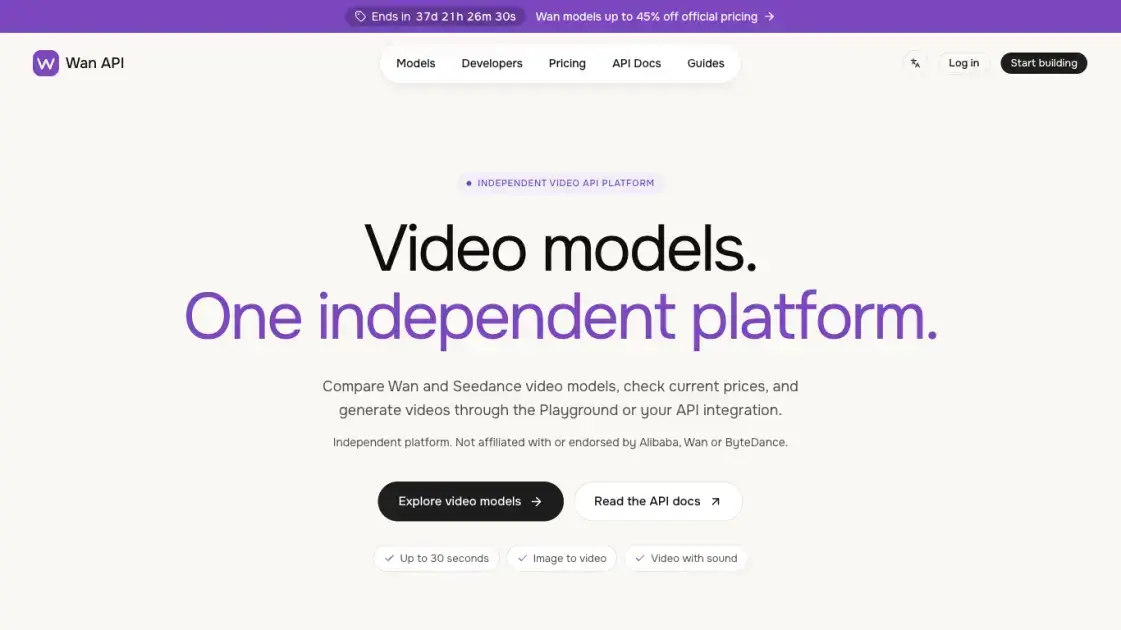
Wan API is an independent video-generation platform that serves the Wan 3.0 family and the Seedance 2.x models from a single account, one API base URL and one prepaid balance. It exists for developers and studios who want to compare model specifications, per-second rates and input limits in one place instead of reading several vendor pages, then call whichever model fits the shot. Requests go out through a browser Playground or a REST API at api.wanapi.app, with signed result URLs returned by task polling. Access requires a funded account: sign-in happens with Google, and generation is billed against the account balance rather than a monthly video package. The platform states plainly that it carries no affiliation with, or endorsement from, Alibaba, Wan or ByteDance, whose names identify the third-party models it exposes.
How does Wan API work
Requests follow one submit-poll-collect path: an account signs in with Google and holds a prepaid USD balance; a key created in API key settings authenticates server calls with Authorization: Bearer against https://api.wanapi.app. The client posts one of the 14 native generation fields — prompt, frames, references, resolution, ratio, duration, audio, seed, prompt_extend — to the endpoint of the chosen model ID, and the platform validates field combinations before a task is created. The response returns a task ID, which is the only handle needed afterwards: querying it never starts another generation, never charges twice and never extends how long the files stay available. Cost is the resolution rate multiplied by billable seconds, where reference video input and generated output both count while text, image and audio inputs add nothing; automatic duration or reference-video requests reserve up to 30 seconds, then settle to measured usage and release the difference. When a task completes, the query includes a signed CDN link for playback or download, and files follow the platform's storage retention policy, so anything worth keeping should be copied to the caller's own storage.
Benefits of Wan API
The practical advantage is a single integration surface for two model families: one base URL, one key, one prepaid balance and one task-polling pattern, so switching from a Wan 3.0 clip to Seedance 2.5 does not mean new credentials or a second client. Pricing is stated per billable second against the official list rates shown side by side on each model's table, and the Playground's native request preview removes guesswork about which of the 14 fields a model actually accepts. Model pages publish hard limits — 2–30 second output, resolution steps up to 4K on the Pro variants, reference counts, file formats and sizes — in the same layout, which makes a feasibility check fast. Operationally, read-only balance lookup, deletion of finished tasks, and explicit rules for failure handling (reservations released on failed generations, polling never re-charged, no automatic resubmission after a timeout) reduce the risk of paying twice for one idea.
Pros and Cons of Wan API
Pros
- One key and one balance across eight Wan and Seedance models
- Per-second billing with official list prices shown for comparison
- Playground previews the exact native request body per model
- Published limits for duration, resolution, formats and reference counts
- Balance check and task deletion endpoints available for every model
Cons
- No free tier — generation requires a funded account
- No monthly package, webhook, cancellation or idempotency-key contract advertised
- Reference video seconds are billable, so a 5-second clip can cost as much as 10
- Result files follow platform retention and must be copied elsewhere
- Independent reseller, not affiliated with Alibaba, Wan or ByteDance
Core Features of Wan API
Eight video models behind one key
Four Wan variants — Wan 3.0, Wan 3.0 Prime, Wan 3.0 Pro and Wan 3.0 Prime Pro — sit next to Seedance 2.5, Seedance 2.0, Seedance 2.0 Fast and Seedance 2.0 Mini. GET /v1/models lists what the current key can reach, and each model carries its own documented ID such as wan3.0-video or w3.0-video-prime-pro.
Multimodal input modes
Generation accepts a text prompt alone, a first or last frame, or a reference set of up to 10 images, 5 video clips and 5 audio clips, plus a document or a public web link. Frames and references are separate modes and cannot be mixed in one request; prompt text is capped at 20,000 characters.
Playground with native request preview
Each model page embeds a Playground that builds the flat native request body for the selected model, omits optional fields that were left empty, and checks generation availability before submitting. The same prepaid balance and website session back those runs, so no key has to be pasted into the browser.
Asynchronous task API
Submitting to a model endpoint returns a public task ID immediately; polling reports pending, processing, completed or failed, and a finished response carries a signed Bunny CDN URL that plays or downloads without an Authorization header. POST /v1/responses offers the same generation synchronously, in the background, or over server-sent events.
Rate control through content review
The optional nsfw_checker field selects strict or more permissive review on Wan 3.0 and Wan 3.0 Prime, and each setting has its own per-second rate. Pro variants accept false only. A rejected submission can be retried under the other value with the same public model ID.
Balance and cleanup endpoints
GET /v1/balance returns the spendable account balance plus any remaining limit on the calling key, and DELETE /v1/tasks/{task_id} removes one finished task together with its stored video and last-frame files. Site text is also published for machines at /llms.txt and /llms-full.txt.
Use Cases of Wan API
- Product and e-commerce teams: animate a still photograph of one product with a slow reveal or camera orbit, then inspect shape, reflections and labels before the clip enters a campaign.
- Script, storyboard and social editors: turn a written scene into a moving preview when no shoot or key artwork exists yet, then judge lighting, camera direction and pace on a short clip before committing to a longer cut.
- Agencies working from briefs: feed a concise document or a public page as input so a written idea becomes a visual starting point for a target audience and one message.
- Engineering teams integrating video: compare Wan and Seedance rates, durations and reference allowances side by side, then keep the winning model behind one key and one balance.
- Reference-driven character work: assign each uploaded asset a role — appearance, movement, sound — so a longer Seedance 2.5 scene keeps distinct characters and locations readable.
FAQs of Wan API
Is this an official Alibaba or ByteDance service?
No. Wan API operates independently at wanapi.app and is not affiliated with or endorsed by Alibaba, Wan or ByteDance; those names identify the third-party models exposed through the platform and belong to their owners.
Do I need a subscription to generate video?
There is no monthly video package listed. Access depends on an enabled account with sufficient prepaid USD balance, and each generation is billed as the resolution rate times billable seconds.
What counts as a billable second?
Reference video input seconds plus generated output seconds. Text, image and audio inputs add nothing, and turning generated audio off does not lower the rate.
Can a task be cancelled or retried automatically?
No advertised cancellation, webhook or idempotency-key contract exists, and submissions are not retried or switched to another model automatically. After a timeout or missing task ID, retrieve the existing task first instead of posting again, since a second request could create another paid job.
How long do generated videos stay available?
Completed tasks return a signed CDN URL that needs no key, and files follow the existing storage retention policy. Querying a task does not extend that availability, so copy anything important to your own storage.
Which model should a first test use?
Wan 3.0 covers 480p through 1080p at the lowest rates; Prime is a separate model with different pricing, and the Pro variants are the ones that reach 2K or 4K. Seedance pages list their own duration and reference allowances, so match the deliverable rather than assuming a higher resolution exists on a cheaper model.
Can the same request body be reused across models?
All four Wan models share the 14 native generation fields, but resolution values, model IDs and the nsfw_checker setting differ — Pro variants accept the permissive review value only. Unknown fields are rejected, so check the target model's page before resubmitting.
How to use Wan API
- Sign in with Google at wanapi.app, open account settings and add funds, since a website account alone does not grant generation access.
- Create a key under API key settings and keep it on the server side; the Playground uses the website session and the same balance instead.
- Pick a model from the overview or
GET /v1/models, then read its page for supported resolution values, duration range and reference limits. - Draft the request in that model's Playground and copy the previewed native body, or build the JSON by hand with the documented model ID.
- Submit the request, store the returned task ID right away, and poll with a five-second starting interval that grows after temporary errors.
- Download or play the signed URL from the completed response, then copy the file to your own storage before retention ends.
Wan API Alternatives
Seedance 3.0 turns text, images, video clips, and audio into videos with sound, and edits one part of a clip without regenerating the rest.
Wery is a virtual AI studio that routes one goal to specialist agents for video, images, music and documents, keeping characters and project assets consistent.

AI video and image studio with text-to-video, image-to-video and keyframe control across Seedance, Kling, Wan and Vidu — all on one credit balance.
Browser studio for AI video, image and music generation with Grok Imagine, Kling and GPT Image models. Free daily credits, no sign-up required.
SeaMove AI is an AI video and image generation platform offering Seedance 2.0 and Seedance 2.5 models for text-to-video, image-to-video, and reference-based creation. Features multi-shot continuity, director-level control, and audio-visual sync for creators and studios.
Turns two separate portraits into a 15-second vertical rap duet video on an orange stage with a shared microphone and the original soundtrack. Free 480P preview available.
Mareel is an all-in-one AI video and image generation workspace giving creators, marketers, and ecommerce teams 40+ leading models and one shared credit balance.
Kinovi is a REST API that runs published video, image, and audio AI models from one endpoint. Send a model ID to createTask, poll recordInfo, and pay per use from one shared credit balance.
An AI cartoon video generator that turns a script or prompt into an animated video with the same character in every scene, AI voiceover and soundtrack, and commercial rights included.
Gemini Omni is an online AI video generator and editor that turns a text prompt or reference image into a video, then refines each shot through conversational edits while keeping characters and the scene consistent.
Kling 4.0 turns text, images, and up to 15 Omni Reference assets into cinematic AI video, with 30-second multi-shot scenes, 10 keyframes, and 4K HDR.
Gemini Omni is a chat-based multimodal AI video generator and editor. It combines text, images, video, and audio to create cinematic clips with native audio.