
Seedance25API
Seedance 2.5 API Guide: Status, Pricing, Quickstart, API Key
| Added on: | Aug 1, 2026 |
| Monthly Visits: | -- |
| Social & Email: | -- |

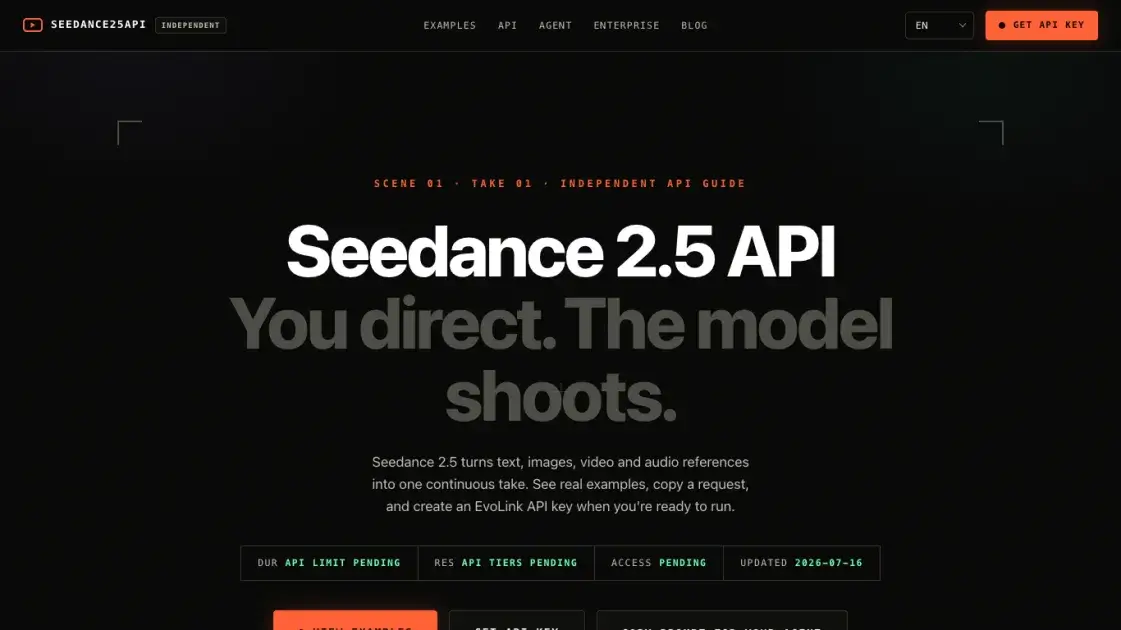
What is Seedance25API
Seedance25API is an independent guide site that tracks the Seedance 2.5 video generation API from ByteDance. The site explains the current access status of the 2.5 model, which is still in pre-release: the model ID, request parameters, launch limits, and billing rules have not been confirmed by the provider yet. It provides a practical reference for developers and AI agents, including a request builder, real curl and fetch examples, and a clear path to obtaining an EvoLink API key. For live calls today, the site directs users to the documented Seedance 2.0 route through EvoLink, with the future 2.5 model kept as a configurable parameter. The content is organized for two audiences: human developers who want to copy a working request, and coding agents that need machine-readable context such as llms.txt, OpenAPI schema, and agent checklists.
How does Seedance25API work
Seedance 2.5 works as a reference-to-video generation pipeline. A user composes a prompt describing subject, motion, style, and constraints, then optionally attaches image, video, or audio references. The request is submitted asynchronously to the video generations endpoint with duration, resolution, and generate_audio parameters. The provider returns a task ID, polled through GET /v1/tasks/{task_id} until the video is ready. Because the 2.5 model ID and route are unconfirmed, the site demonstrates this flow with the Seedance 2.0 baseline and recommends a configurable model parameter, so the same code can switch once EvoLink publishes the API reference and billing rules.
Benefits of Seedance25API
The main advantage of Seedance25API is its honest, status-first presentation of a pre-release product. Every unconfirmed field, from pricing to model IDs, is clearly labeled, so developers do not build on false assumptions. The request builder and copy-ready curl and fetch examples reduce integration friction, while separate paths for humans and AI agents save time. Machine-readable files like the OpenAPI schema and llms.txt give agents the right context before writing code. The EvoLink handoff is explicit: create a key only when a live route exists. One shortcoming: the 2.5 model cannot run live yet, so generation relies on Seedance 2.0.
Pros and Cons of Seedance25API
Pros
- Honest status-first presentation of a pre-release API
- Request builder with copy-ready JSON payloads
- Real curl and fetch examples for quick integration
- Agent-ready files for Cursor, Claude Code, and Codex
- Clear EvoLink key handoff and environment setup
Cons
- Seedance 2.5 cannot be used live yet
- No confirmed pricing, billing unit, or rate card
- 2.5 model ID and limits are still unconfirmed
- Native audio billing rules remain unknown
Core Features of Seedance25API
Multi-reference video generation
Seedance 2.5 turns text, images, video, and audio references into one continuous take, combining multiple inputs into a single coherent shot.
Request builder
A step-by-step request builder lets users shape a payload first, with duration options of 4, 8, 10, 15, or 30 seconds and resolution tiers of 480p or 720p.
Native audio generation
The API supports a generate_audio option that adds native audio to generated videos, with billing for this feature still unconfirmed for the 2.5 route.
Launch example library
Official launch cases are documented with their exact prompts attached, each showing master specs like T2V, 30 seconds, and 4K output for reference.
Agent-ready integration files
Machine-readable resources, including llms.txt, llms-full.txt, an OpenAPI schema, and an agent checklist, are provided for coding agents like Cursor, Claude Code, and Codex.
Use Cases of Seedance25API
- Developers preparing a Seedance 2.5 integration: the quickstart validates adapter code before the provider route is live.
- AI coding agents: llms.txt and the OpenAPI schema give correct context and key-handoff rules before writing code.
- Video teams scoping prompts: launch cases like the steampunk odyssey show structure for 30-second 4K output.
- Budget planners: the pricing page keeps billing variables explicit until provider documentation confirms them.
- Agencies testing EvoLink: the Seedance 2.0 baseline offers a runnable path while 2.5 access stays pending.
FAQs of Seedance25API
What is Seedance25API and who is it for?
Seedance25API is an independent guide site for the Seedance 2.5 video generation API, not an official ByteDance or EvoLink page. It is written for developers and AI coding agents who want to integrate the API before official documentation is complete. The site tracks access status, shows a request builder, and explains how to obtain an EvoLink API key through evolink.ai.
Is Seedance 2.5 available for live calls right now?
No. Seedance 2.5 is in pre-release. The provider has not confirmed the route, model ID, request parameters, limits, or pricing. The site recommends using the documented Seedance 2.0 baseline through EvoLink for live calls, and keeping the model parameter configurable so the same code can switch to 2.5 after the provider publishes its API reference.
How do I get an API key?
Create an EvoLink API key at evolink.ai/dashboard/keys, which the site links from every page. The recommended flow is to prepare your request or agent prompt first, then create the key only when you are ready for live calls. Set it as the EVOLINK_API_KEY environment variable before running a test request.
What request parameters does the API accept?
The documented example payload includes model, prompt, duration, quality, and generate_audio. Duration options in the builder range from 4 to 30 seconds, resolution supports 480p and 720p, and generate_audio enables native audio. Optional fields such as image_urls, video_urls, and callback_url are listed as provider fields whose 2.5 behavior is not yet confirmed.
How does Seedance 2.5 compare with similar video generation APIs?
The main differentiator is its reference-to-video capability, which combines text, images, video, and audio references into one continuous take. The site also emphasizes multi-reference input and native audio generation. Since pricing and limits are not public, direct cost comparisons with other providers are not possible yet.
How much does Seedance 2.5 cost?
Pricing is not confirmed. The site explicitly warns against copying Seedance 2.0 billing rules into a 2.5 budget. Billing unit, native audio billing, option multipliers, and the public rate card are all marked as pending, and the site recommends treating rate, billing unit, multipliers, and failure billing as variables until provider documentation and billing records agree.
Can I use Seedance25API with my coding agent?
Yes. The agent guide provides a copy-ready instruction block for Cursor, Claude Code, Codex, and ChatGPT. The agent is told to read llms-full.txt and the OpenAPI schema, never hardcode an API key, keep the model parameter configurable, and ask the human to create EVOLINK_API_KEY only for a documented live route.
How to use Seedance25API
- Visit the Seedance 2.5 API site and open the request builder on the homepage to shape a payload with your prompt, duration, and resolution.
- Copy the prepared JSON or an agent prompt, and review the launch example library to model your prompt structure after the official cases.
- Go to the API quickstart page and study the documented curl and fetch examples, which currently use the Seedance 2.0 reference-to-video baseline.
- Create an EvoLink API key at evolink.ai/dashboard/keys only when you are ready for live calls on a documented route.
- Set the key as the EVOLINK_API_KEY environment variable, then run a short low-cost test call before any production traffic.
- Poll GET /v1/tasks/{task_id} to check job status, and keep the model parameter configurable for the future 2.5 route when it launches.
Seedance25API Alternatives
Seedance 3.0 preview page: planned multi-shot continuity, scene editing and audio-visual sync for AI video, while the on-page generator runs Seedance 2.5.
Browser workspace for AI image generation, reference photo editing, and short video drafts, aimed at creators, marketers, and product teams.
Black Forest Labs' multimodal model with a web generator for text-to-video, image-to-video and image editing with native audio, for creators and marketers.
SeedRouter puts image, video, language and audio models from OpenAI, Google and Anthropic behind one key, billing per request and never for failed calls.
Wan API is an independent platform for Wan and Seedance video models. Compare specs and rates, generate clips in the Playground, or call them through one API.
Seedance 3.0 turns text, images, video clips, and audio into videos with sound, and edits one part of a clip without regenerating the rest.
Wery is a virtual AI studio that routes one goal to specialist agents for video, images, music and documents, keeping characters and project assets consistent.

AI video and image studio with text-to-video, image-to-video and keyframe control across Seedance, Kling, Wan and Vidu — all on one credit balance.
Browser studio for AI video, image and music generation with Grok Imagine, Kling and GPT Image models. Free daily credits, no sign-up required.
SeaMove AI is an AI video and image generation platform offering Seedance 2.0 and Seedance 2.5 models for text-to-video, image-to-video, and reference-based creation. Features multi-shot continuity, director-level control, and audio-visual sync for creators and studios.
Turns two separate portraits into a 15-second vertical rap duet video on an orange stage with a shared microphone and the original soundtrack. Free 480P preview available.
Mareel is an all-in-one AI video and image generation workspace giving creators, marketers, and ecommerce teams 40+ leading models and one shared credit balance.