
SeedRouter — One API for Image, Video, LLM and Audio Models

What is SeedRouter
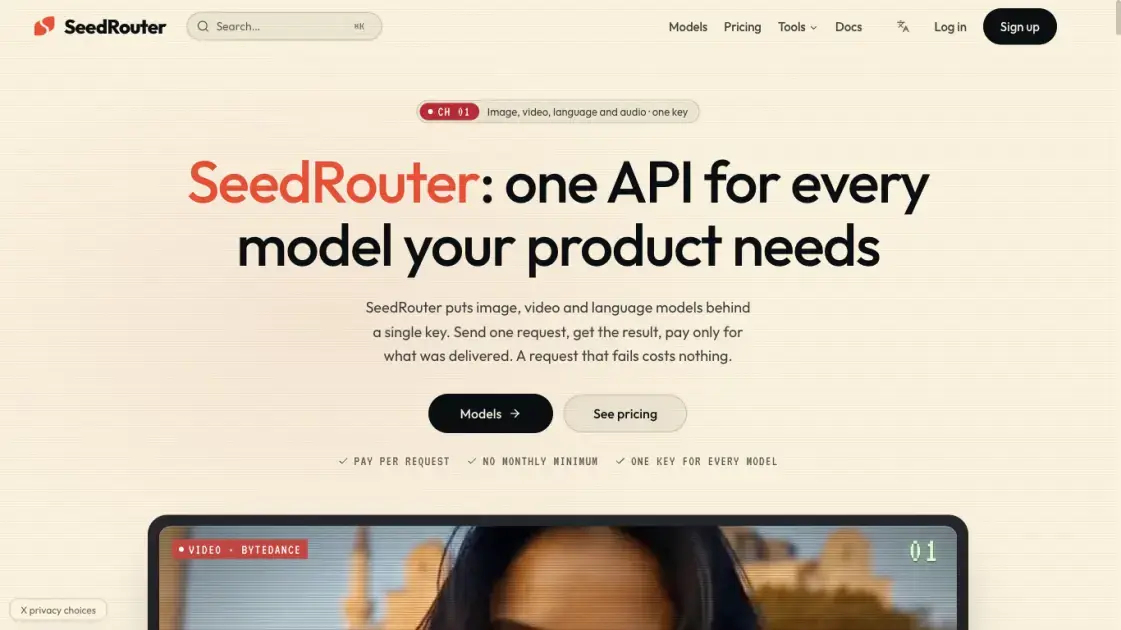
SeedRouter is a single API entry point in front of image, video, language and audio models, letting a product call any of them with one key and one request shape. It removes the need to manage separate accounts, keys and invoices for each model vendor. Billing runs per request against a prepaid USD balance, and requests that fail are not charged. It suits teams shipping AI features into production, where switching between model families should be a configuration change rather than a rewrite. The catalogue currently lists 41 models from providers including OpenAI, Google, Anthropic, ByteDance, Kuaishou, MiniMax and xAI.
How does SeedRouter work
Calls go to a single endpoint at api.seedrouter.ai with a SeedRouter key in the Authorization header. An image or video request comes back with a task id, and that identifier is used to poll status until the result is available on a CDN link. Language traffic follows the OpenAI chat-completions format, so only the base URL and the key differ from a direct vendor integration. Billing looks up the price attached to the chosen model and deducts it from the prepaid balance once output is delivered; a run that fails deducts nothing. Changing model family means changing the model id, not the client code around it.
Benefits of SeedRouter
Cost behaviour stays predictable because every model carries a listed rate and failed calls are not billed, so a team never pays for output that never arrived. Where a vendor publishes its own price, that figure appears beside the SeedRouter rate with the percentage saved, which makes the comparison auditable instead of implied. Sharing one request shape lets a team move between GPT, Claude and Gemini, or between video families, without touching client code. The prepaid balance is denominated in USD, carries no expiry date and requires no subscription, so spend tracks real usage. Long renders stay out of the request path through task ids and webhooks.
Pros and Cons of SeedRouter
Pros
- Image, video, LLM and audio behind one key
- Published rates per model, including resolution tiers
- No charge for failed requests
- OpenAI SDK compatibility for language models
- Prepaid balance with no expiry or subscription
Cons
- Balance must be funded before the first paid call
- Card top-ups start at $20
- Savings shown only where a vendor price is published
- A model can be temporarily unavailable, returning an error
Core Features of SeedRouter
One key across every model
A single API key reaches the image, video, language and audio families, and the surrounding request structure stays constant when a team switches between them.
OpenAI-compatible language endpoint
Language models are served through an endpoint that speaks the OpenAI format, so existing SDK code keeps working once the base URL and key are swapped.
Async tasks with webhooks
Video jobs and long image jobs hand back a task id that can be polled, or pushed to a registered webhook as a CDN link when the output is ready.
Live price list
Each model carries its own listed rate, image model pages include a price calculator, and the public pricing table is read from the same list that billing uses.
Unified dashboard
Balance, keys and usage sit in one account view, with the cost of each request visible as it happens and top-ups made in USD.
Playground and docs per model
Every model page ships its parameters, documentation and a live playground for trying requests before they are wired into an application.
Use Cases of SeedRouter
- Product and advertising teams: turn product references into reviewable campaign variants with fidelity checks before publication.
- Video producers: run a shot-based workflow with acceptance criteria, selective revisions and a delivery budget.
- Comic and series studios: link scripts, character references and reusable shots into serialized visual storytelling.
- Ecommerce operators: draft reviewable product copy and campaign material from approved business information.
- Finance teams: pull invoice fields and line items, then verify quantities and totals against source evidence.
FAQs of SeedRouter
Do I need a subscription?
No. There are no plans and no recurring fee; a prepaid USD balance is spent across whichever models are called, and unused funds stay available.
Can I keep using the OpenAI SDK?
Yes. Language traffic is served through an OpenAI-compatible endpoint, so the base URL and the key are the only details that change.
How is a failed request billed?
It is not billed at all. An error comes back instead of a result, and nothing is deducted from the balance.
How do video jobs return their output?
The call hands back a task id; polling it or attaching a webhook delivers the finished file as a CDN link once the render completes.
How can I estimate cost before running a job?
Image model pages include a calculator for count and settings, video pages list per-second rates at every resolution, and Task logs show the settled cost after a run.
Which payment methods are supported?
Cards through Stripe, PayPal, BTC/USDT/USDC and, for some regions, Alipay and WeChat Pay; crypto top-ups carry a small bonus.
Can I top up automatically?
Yes. Set a threshold of at least $10 and an amount between $20 and $10,000, and a saved card is charged whenever the balance drops below that line.
How to use SeedRouter
- Create an account at seedrouter.ai; new accounts open with a small free balance for test calls.
- Generate an API key in the dashboard, where keys can also be reviewed and revoked.
- Add funds to the USD balance by card, crypto, PayPal, Alipay or WeChat Pay, or turn on Auto Top-Up.
- Choose the integration path: the OpenAI SDK for language models, or the SeedRouter task API for image, video and audio.
- Point the base URL at SeedRouter and send a first call, such as POST /v1/images/generations with a model id and a prompt.
- Watch spend per request in the dashboard and in Task logs.
SeedRouter Alternatives
Open-source AI coworker for Slack and Lark that runs Claude Code, Codex or Pi on your own machine with the plan or API key you already pay for.
AtAt runs Claude Code, Codex, or local models in the text field you are typing in, no app-switching. It adds TabTab autocomplete, screenshots, and clipboard history.
Play HT is a free AI voice generator that turns text into speech with 200+ public voices, streams previews in the browser, and exports MP3 files.

Jev is TypeSafe AI's System One model that returns typed decisions with calibrated confidence for automation. Fast, cheap, zero hallucinations.
Use GPT, Claude, Gemini and Grok through one OpenAI-compatible API. Compare model rates, create a key, and make your first request in minutes.
Git-native task management for AI coding agents: track intent, status, blockers, dependencies, history, and commit evidence in Git.
SJolt is an AI model API platform aggregating top image, video, and audio generation models behind one unified request flow for developers and teams.
Tokenhot is a unified LLM API gateway delivering OpenAI, Claude, Gemini and DeepSeek models through a single endpoint, cutting API costs by up to 90%.
DSH Hub catalogs verified DeepSeek Harness plugins and clients. Browse open-source repositories with source inspection before installation.
Always free browser that shares your logged-in Chrome state with AI agents like Claude Code and Codex, running browser automation up to 3.45x faster.
Formpost is a free contact form to email API delivering submissions to your inbox with AI spam filtering, webhooks, file uploads and a REST API.
Independent guide to the Seedance 2.5 video generation API: access status, billing model, request builder, real code examples, and EvoLink API key handoff.