
Automate Academic Illustration Generation Using PaperBanana

What is PaperBanana
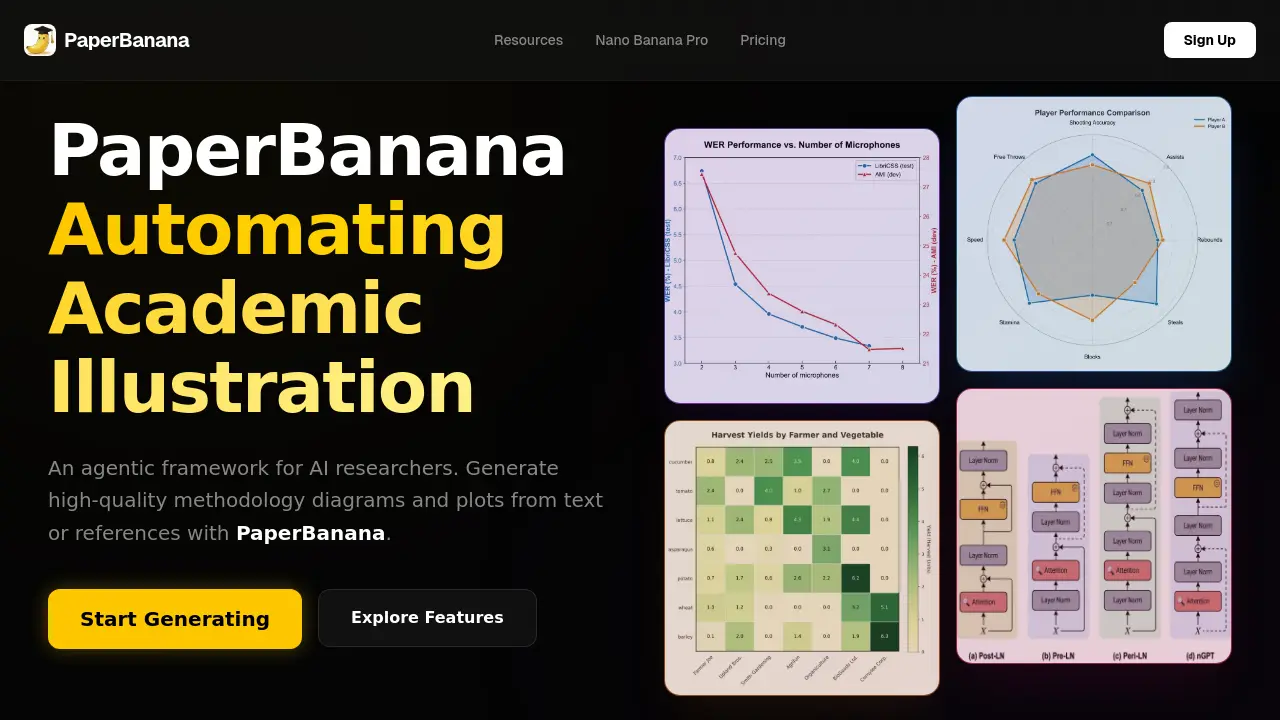
PaperBanana is an agentic framework designed to automate the creation of academic illustrations for AI researchers. The system employs a multi-agent workflow—Retriever, Planner, Renderer, and Critic—to transform textual descriptions or rough sketches into publication-ready methodology diagrams and statistical plots. Users can generate figures from scratch by providing context and captions, or upload hand-drawn sketches for digital polishing. The framework emphasizes academic precision, using iterative self-critique to enhance faithfulness, conciseness, and aesthetics. Benchmarking against standards from top conferences like NeurIPS, PaperBanana aims to reduce the time spent on figure generation. As an open-source project, it provides code, data, and a benchmark (PaperBananaBench) to support the research community.
How does PaperBanana work
PaperBanana operates as an agentic framework that automates academic illustration for researchers. Its workflow orchestrates specialized agents: a Retriever gathers source context, a Planner designs the layout, a Renderer generates the initial image using vision-language models, and a Critic performs iterative self-critique to refine outputs. The system accepts textual descriptions or rough sketches, producing publication-ready methodology diagrams and statistical plots. This process emphasizes faithfulness, conciseness, and aesthetic standards suitable for top-tier conferences. By automating the figure creation bottleneck, PaperBanana allows researchers to focus on content while ensuring vector-quality, standardized visual assets.
Benefits of PaperBanana
PaperBanana is an agentic framework designed to automate the creation of academic illustrations for AI researchers. It generates publication-ready methodology diagrams and statistical plots directly from text descriptions or rough sketches. The system employs a multi-agent workflow—Retriever, Planner, Renderer, and Critic—to iteratively refine outputs, ensuring high fidelity, conciseness, and adherence to conference standards. By handling both text-to-diagram generation and sketch polishing, PaperBanana addresses the time-intensive bottleneck of figure production. It is open-source, includes the PaperBananaBench benchmark (292 NeurIPS 2025 test cases), and integrates state-of-the-art vision-language models for reliable, vector-quality visuals.
Pros and Cons of PaperBanana
Pros
- Automates academic illustration creation efficiently.
- Agentic framework improves diagram reliability.
- Supports both text and sketch inputs.
- Benchmarked for publication standards.
Cons
- Credit-based pricing may increase costs.
- Configuration parameters require user expertise.
- Output accuracy depends on input quality.
- Limited to methodology diagrams and plots.
Core Features of PaperBanana
Agentic Framework Orchestration
Employs a multi-agent system (Retriever, Planner, Renderer, Critic) to autonomously manage the end-to-end workflow of academic illustration generation.
Text-to-Diagram Generation
Accepts textual descriptions or methodology context as input to automatically plan layouts and render publication-quality methodology diagrams and flowcharts.
Sketch Polishing and Refinement
Uploads rough hand-drawn sketches, using multimodal AI to interpret and transform them into polished, professional, and consistent diagram styles.
Statistical Plot Visualization
Generates accurate, publication-style statistical plots and charts from data, ensuring vector-quality output for academic papers and presentations.
Iterative Self-Critique Refinement
Incorporates a feedback loop where agents evaluate outputs against metrics like faithfulness and aesthetics, iteratively refining results to meet publication standards.
Use Cases of PaperBanana
- AI researchers: Generate complex model architecture diagrams from textual descriptions using PaperBanana's agentic framework for publication-ready methodology illustrations.
- Graduate students: Convert hand-drawn research sketches into polished academic illustrations with multimodal refinement and style consistency.
- Data analysts: Create accurate statistical plots and publication-style charts directly from data descriptions for research papers.
- Academic labs: Standardize diagram aesthetics and ensure conference compliance through iterative self-critique refinement loops.
FAQs of PaperBanana
What is PaperBanana?
PaperBanana is an open-source agentic framework designed to automate the creation of publication-ready academic illustrations for researchers. It generates high-quality methodology diagrams and statistical plots from textual descriptions or rough sketches, bridging the gap between research ideas and visual communication.
How does the agentic workflow operate?
PaperBanana employs a multi-agent system with four core stages: Retrieve gathers relevant context, Plan designs the layout, Render produces an initial image using advanced models, and Refine iteratively critiques and improves the output for enhanced faithfulness, conciseness, and aesthetics.
What kind of diagrams can I generate?
The framework is versatile, capable of producing complex methodology diagrams such as model architectures and flowcharts, as well as precise statistical plots. It handles both text-to-image generation and sketch polishing, covering most visual needs for academic papers.
Can I use it to polish my existing sketches?
Yes, PaperBanana's multimodal capabilities allow users to upload rough hand-drawn sketches. The system interprets the visual intent and refines it into a polished, professional diagram while preserving the original layout and ensuring style consistency.
Is this tool suitable for top-tier conferences?
PaperBanana is benchmarked against standards from leading AI conferences like NeurIPS. Its evaluation metrics focus on faithfulness, conciseness, readability, and aesthetics, demonstrating consistent performance that meets the rigorous requirements for publication in prestigious venues.
Is PaperBanana open source?
Yes, PaperBanana is an open-source project. The code, data, and models are publicly available on GitHub, and the research is detailed in an ArXiv paper. This openness encourages community collaboration and innovation in automated scientific illustration.
Do I need to be an expert in design?
No, PaperBanana is specifically designed for researchers without design expertise. Users only need to provide scientific context or sketches; the agentic framework handles layout planning, rendering, and aesthetic refinement to produce professional-quality figures.
How does the credit system work for generating illustrations?
PaperBanana uses a credit-based model where each illustration generation task consumes 29 credits. If the framework completes the task before exhausting all allocated iterations, unused credits are automatically refunded. Detailed pricing structures and credit packages are available on the official Pricing page.
What is PaperBananaBench and why is it important?
PaperBananaBench is a comprehensive benchmark dataset containing 292 curated test cases extracted from NeurIPS 2025 papers. It provides a standardized evaluation suite for automated illustration tools, enabling objective comparisons of faithfulness, conciseness, and aesthetics across different systems.
How does PaperBanana ensure the accuracy of generated diagrams?
Accuracy is ensured through a self-critique mechanism where specialized agents rigorously evaluate outputs against the source context. The iterative refinement process continuously improves faithfulness to the input data and adherence to academic standards, minimizing hallucinations or errors.
Can PaperBanana be applied to non-AI research fields?
While PaperBanana is optimized for AI research and benchmarked on AI conference papers, its core functionality for generating methodology diagrams and statistical plots is adaptable to other scientific disciplines. Effectiveness may vary depending on domain-specific visualization conventions.
How can I access support or contribute to the project?
Support is available via email at connect@paperbanana.org. To contribute, users can explore the open-source code on GitHub, report issues, or submit pull requests. The project also encourages community engagement through its ArXiv paper and project page resources.
How to use PaperBanana
- PaperBanana is an agentic framework for AI researchers, automating the creation of publication-ready academic illustrations, including methodology diagrams and statistical plots, from textual descriptions or reference sketches.
- Access the tool via the official PaperBanana website at paperbanana.org or deploy the open-source code from the GitHub repository for local or server-based use.
- For diagram generation from text, enter the methodology context and figure caption into the designated input fields; these describe the components and narrative of the desired illustration.
- Configure generation parameters such as aspect ratio (e.g., 16:9) and maximum iterations to tailor output dimensions and the depth of iterative refinement.
- Initiate the process by activating the generate function; the framework orchestrates agents to retrieve context, plan layout, render the image, and self-critique for improvements.
- To polish an existing sketch, upload a hand-drawn image; PaperBanana's multimodal capabilities interpret and refine it into a consistent, professional diagram while preserving layout.
- Monitor credit usage during generation, with costs per iteration and automatic refunds for any unused credits if the task concludes ahead of the iteration limit.
- Upon completion, review the generated illustration for accuracy in representing the input context and adherence to academic aesthetic standards, using embedded feedback cues.
- Interpret results by evaluating faithfulness, conciseness, and readability; if necessary, modify inputs or regenerate to enhance alignment with research-specific requirements.
- Download the final vector-quality or high-resolution output and integrate it directly into manuscripts, presentations, or supplementary materials to meet conference publication guidelines.
PaperBanana Website Traffic Analysis
Latest traffic information
- Monthly Visits3.56K
- Bounce Rate41.92%
- Pages Per Visit1.71
- Visit Duration00:00:25
- Global Rank4.84M
- Country/Region Ranking446.87K
Visits Over Time
Top Keywords
| Keyword | Traffic | Volume | Cost Per Click |
|---|---|---|---|
| paperbanana | 330 | 4.57K | $0.79 |
| paper banana | 240 | 4.83K | $0.69 |
| paperbanan | 40 | 60 | $0.53 |
| 페이퍼 바나나 | 30 | 440 | $0.85 |
| google paper banana | 20 | 180 | $1.8 |
Top Regions
| Region | Percentage |
|---|---|
| United States | 23% |
| Germany | 18.86% |
| Taiwan | 17.6% |
| South Korea | 14.81% |
| Singapore | 9.22% |
