
Kling AI 3.0 creates professional videos from text or images

What is Kling AI 3.0
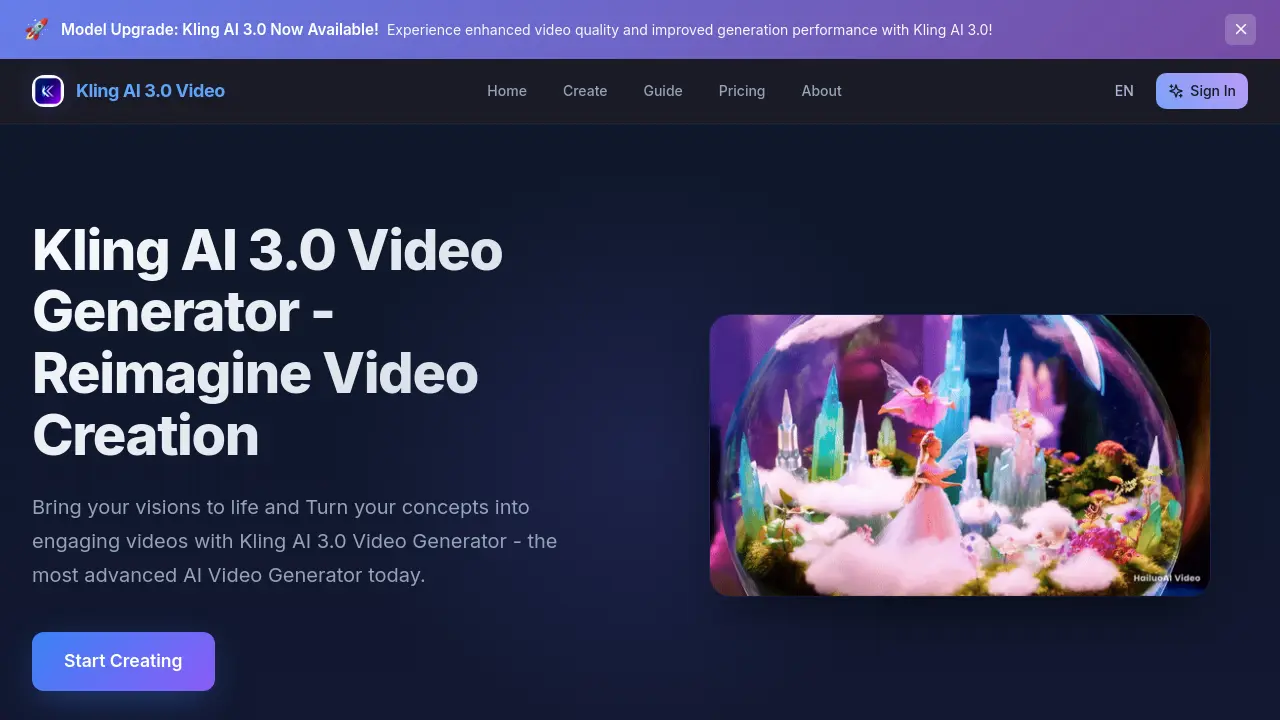
Kling AI 3.0 is an AI‑driven video generator that converts text prompts or static images into high‑resolution videos with realistic human motion. The platform supports multiple visual styles—from hyper‑realistic cinematography to anime and sci‑fi—while maintaining fluid, natural movement across diverse scenes such as ocean sunsets, neon‑bathed city streets, and arctic auroras. Leveraging cutting‑edge AI models, Kling AI 3.0 delivers faster generation times without sacrificing quality, and its English‑language interface is designed for global creators. Users begin by entering a description or uploading an image, customize style and settings, then receive a downloadable video ready for sharing. The service includes a free trial and showcases creator testimonials that highlight its speed, quality, and versatility for content production, marketing, and artistic projects.
How does Kling AI 3.0 work
Kling AI 3.0 operates as a cloud‑based AI video generator that converts text prompts or uploaded images into full‑length video clips. The platform’s core model analyzes the input, maps semantic elements to a motion engine, and synthesizes human‑like movement, lighting, and background details using advanced neural networks. Users select from diverse style presets—hyper‑realistic, sci‑fi, anime, or fantasy—while adjustable parameters fine‑tune frame rate, resolution, and color grading. Generation runs on high‑performance GPUs, delivering lightning‑fast output with consistent quality, after which the video is streamed for download and sharing. Keywords: AI video generator, text to video, image to video, motion generation.
Benefits of Kling AI 3.0
Kling AI 3.0 Video Generator delivers high‑resolution, AI‑driven video creation that converts both text prompts and static images into dynamic footage. Its advanced motion models produce fluid, human‑like movement across styles ranging from hyper‑realistic to sci‑fi and anime, while lightning‑fast rendering reduces wait times. An intuitive English interface lets creators customize prompts, select visual styles, and download finished videos for immediate sharing. The platform’s diverse sample library—featuring ocean sunsets, neon city rain, and underwater coral reefs—demonstrates the tool’s capacity for realistic scenery and cinematic storytelling, supporting rapid prototyping and professional‑grade content alike.
Pros and Cons of Kling AI 3.0
Pros
- Enhanced video quality and realism.
- Fast generation speed with consistent output.
- Supports both text and image inputs.
- Offers multiple style options, including sci‑fi and anime.
- Full English interface for global users.
Cons
- Pricing details not disclosed in the provided context.
- Free trial scope unclear.
- No explicit mention of API or integration support.
- Limited information on customer support channels.
- Potential hardware requirements not specified.
Core Features of Kling AI 3.0
Text & Image to Video Conversion
Generates dynamic videos from written prompts or uploaded images, enabling creators to instantly visualize concepts with realistic motion and scene composition.
High-Fidelity Human Motion Engine
Produces natural, fluid human movements that closely mimic real-world behavior, enhancing the authenticity of generated characters and actions.
Multi-Style Video Rendering
Offers diverse visual styles—hyper‑realistic, fantasy, sci‑fi, anime—allowing users to tailor aesthetic tone to specific project requirements.
Lightning‑Fast Generation Pipeline
Delivers completed videos within seconds, combining rapid processing with consistent quality to accelerate production workflows.
Advanced AI Model Architecture
Leverages cutting‑edge neural networks for superior video resolution, color accuracy, and motion coherence, ensuring professional‑grade outputs.
Global English Interface & Accessibility
Provides an intuitive, English‑language UI designed for creators worldwide, simplifying navigation, settings adjustment, and video export processes.
Use Cases of Kling AI 3.0
- Students: Produce short educational videos from textbook passages or lecture slides using text‑to‑video conversion.
- Marketing teams: Generate promotional clips with customized branding styles and rapid rendering for social media campaigns.
- Game developers: Create cinematic cutscenes by converting concept art into animated sequences with natural human motion.
- Researchers: Visualize scientific phenomena, such as auroras or volcanic eruptions, through realistic AI‑generated simulations.
- Content creators: Transform static photography into dynamic videos, expanding portfolio range with diverse visual styles.
FAQs of Kling AI 3.0
What makes Kling AI 3.0 different from other video generators?
Kling AI 3.0 differentiates itself through a combination of higher‑resolution output, industry‑leading human motion synthesis, and a versatile text‑ and image‑to‑video pipeline. The platform leverages cutting‑edge neural models that produce smoother transitions and more realistic lighting than many competing services.
What types of content can I create with Kling AI 3.0?
Users can generate a broad spectrum of video content, including cinematic landscapes, cultural scenes, sci‑fi environments, fantasy sequences, and anime‑style clips. The system supports both hyper‑realistic and stylized outputs, making it suitable for marketing, education, entertainment, and personal creative projects.
How does the image-to-video feature work?
The image‑to‑video module extracts visual semantics from an uploaded picture, then expands those cues into a temporal sequence using motion‑aware diffusion models. By interpreting depth, perspective, and object placement, the engine animates static elements while preserving the original aesthetic, resulting in a seamless video expansion of the source image.
What's included in the free trial?
The free trial grants access to the full Kling AI 3.0 interface for a limited number of generations, typically allowing users to create several short videos (up to 30 seconds each). It also provides basic style options, preview rendering, and direct download of completed clips without watermarks, enabling a hands‑on evaluation before committing to a paid plan.
How long does it take to generate a video with Kling AI 3.0?
Generation speed varies with video length and selected resolution, but the platform is optimized for “lightning‑fast” processing. Most 15‑second clips at 1080p are rendered in under two minutes, while higher‑resolution or longer projects may require slightly more time, still significantly faster than many traditional rendering pipelines.
Can I customize motion and style after the initial generation?
Yes, Kling AI 3.0 offers post‑generation controls that let users fine‑tune motion trajectories, adjust lighting, and switch between predefined style presets. Users can re‑render specific segments or apply global style changes without starting from scratch, improving workflow efficiency for iterative creative work.
Is there an API for integrating Kling AI 3.0 into other applications?
Kling AI 3.0 provides a RESTful API that allows developers to submit text prompts or image assets programmatically and retrieve generated video files. Documentation includes authentication methods, rate‑limit guidelines, and example code snippets for popular languages, facilitating seamless integration into web platforms, mobile apps, or automated content pipelines.
How to use Kling AI 3.0
Kling AI 3.0 functions as an AI video generator, converting text prompts or uploaded images into high‑quality, stylistically diverse videos for creative and professional projects.
Access the platform, sign in, and navigate to the Create page; the interface presents a prompt field and an image‑upload option for video initiation.
Input a descriptive text prompt or upload a reference image, then select a desired style—such as hyper‑realistic, sci‑fi, or anime—to guide the generation algorithm.
Adjust optional parameters like duration, motion intensity, or color palette; these settings refine motion realism and visual coherence before processing.
Press the Start Creating button; Kling AI 3.0 leverages advanced motion models to render the video, typically completing within seconds to minutes.
Once generation finishes, preview the video in the embedded player; assess continuity, frame quality, and style fidelity against the original prompt.
If revisions are needed, modify the prompt or style settings and re‑run the generation; the platform supports iterative refinement without additional cost.
Download the final video file in the provided format, then share or embed it across platforms to achieve the intended communication or storytelling goals.
Review the analytics dashboard, which displays generation time, resolution, and user‑rated quality metrics, helping users gauge efficiency and plan future projects.
Consult the built‑in FAQ or support resources for troubleshooting specific issues, such as image‑to‑video conversion quirks or style selection limitations.