
UniRoute: Unified AI API Gateway for Claude, GPT & Gemini

What is UniRoute
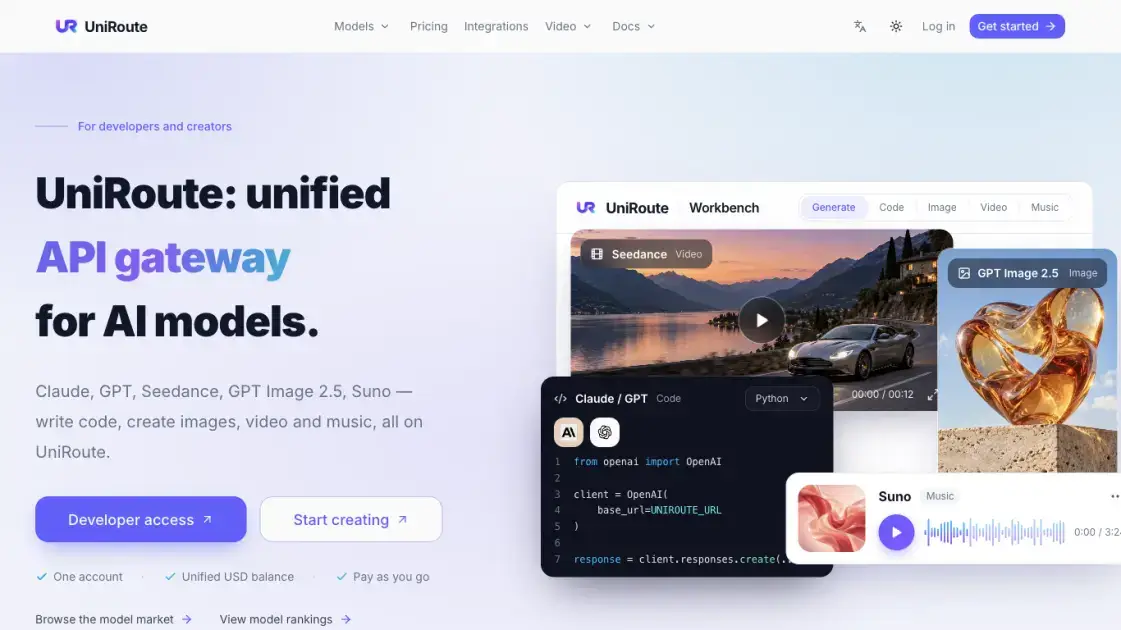
Model access tends to be scattered: one vendor account for a coding model, another for image generation, a third for video, each with its own credential, invoice and request shape. UniRoute collects text, image, video and audio models from providers such as Anthropic, OpenAI, Google, ByteDance, Alibaba and Suno behind a single API and one US-dollar balance. Switching to a different model means editing the model field instead of rebuilding the integration. Developers keep working from their own client code, while creators who would rather not write any can use the browser workspace for code, images, clips and songs. Every catalog entry carries its rate, benchmark score and current availability before a request is sent.
How does UniRoute work
An account holds one prepaid balance denominated in US dollars, and each request draws from it at the rate listed for the chosen model when the call is made. Submissions follow the OpenAI style: the client's base URL points at UniRoute, the model field names the route, and the surrounding code is unchanged when a model is swapped. Behind that endpoint a request is matched to a channel, with current availability surfaced in the model market. What is billed depends on the work — input and output tokens for language calls, one charge per finished image, a per-second figure for video. Every deduction lands in the call logs, and a later top-up returns money to the balance, where the principal never expires but bonus credit from a first qualifying recharge is limited to 30 days.
Benefits of UniRoute
Consolidating providers removes an account, a credential and an invoice per vendor, so a change of model costs one edited field rather than a fresh integration. Where a vendor publishes rates, the comparison shows UniRoute at 58% below Anthropic's official prices on the models listed with both figures, against a table marked as updated 2026-11-08. Money added to the balance never expires, and because spending is funded by top-ups rather than a subscription, a light month and a heavy month are charged the same way. A first qualifying recharge credits more than it takes — $11.00 from $10.00, $55.00 from $50.00 and $115.00 from $100.00 — with only the bonus portion expiring after 30 days. Continuous health checks move traffic away from a degraded route, and the platform states that what is sent through the API stays out of model training.
Pros and Cons of UniRoute
Pros
- One key and one USD balance across text, image, video and speech models
- Rates shown per unit beside official prices, with savings calculated
- Existing OpenAI-format code keeps working after a base URL and model change
- Per-key spending, channel and model restrictions
- Rankings drawn from Artificial Analysis and Provider Voice Arena
Cons
- Usage begins with a paid top-up; no free tier appears on the site
- Media output is billed per completed request rather than bundled in a plan
- Bonus credit from the first qualifying recharge is only valid for 30 days
- Five active keys per account is the default ceiling
- Scores apply to the exact version and settings listed, and boards are not comparable across categories
Core Features of UniRoute
One integration across four model families
A single key covers reasoning and coding models such as Claude Opus 5.5 and GPT-6 Astra, stills from GPT Image 2.5 Sunburst, clips from Seedance 2.5, Wan 3.0 and MiniMax H3, music through Suno, and speech synthesis on Gemini Flash TTS.
Benchmark-ranked model market
Listings are ordered by independent scores — Intelligence Index v5.0.1 for text, AA-Image-T2I v2.1 and AA-Video-T2V v2.1 Elo for images and video, Provider Voice Arena for speech — attributed to Artificial Analysis, with each board kept separate from the others.
Per-unit pricing next to official rates
Language models are quoted per million tokens, images per complete request and video per second, and entries that have a published vendor price show both side by side with the percentage gap calculated.
Workbench, templates and prompts
The playground opens Generate, Code, Image, Video and Music tabs in the browser, with a template gallery and a prompt library linked from the footer for output without any integration work.
Keys that carry their own limits
Each key may hold a spending ceiling plus channel and model restrictions, an account keeps up to five active keys by default, and extra capacity is arranged through customer support.
Usage views and route failover
The console presents call trend, model usage and individual request logs, while upstream health is watched continuously so traffic can be moved off a route that is degrading.
Use Cases of UniRoute
- Teams shipping several AI features: Claude, GPT and Gemini calls share one endpoint, one key set and one balance instead of three vendor accounts.
- Coding-agent users: installation write-ups cover Claude Code, Codex, Gemini CLI, OpenCode, Cline, Cursor, JetBrains IDEs and TRAE.
- Creators producing assets: GPT Image 2.5 renders stills, Wan or Seedance turn a prompt into a clip, and Suno converts an idea into a song.
- Procurement and cost reviews: the pricing pages line official rates up against UniRoute rates with the verified difference already computed.
- Voice-enabled products: Gemini Flash TTS variants sit at the top of the Provider Voice Arena board and are billed per completed request.
FAQs of UniRoute
What is UniRoute?
An API gateway and browser workspace that puts Claude, GPT, Gemini, Seedance, GPT Image and Suno work behind one integration and one prepaid US-dollar balance.
Is there a free plan?
No free tier is advertised. Spending starts with a top-up, the smallest listed amount being $10.00, which credits $11.00 when the first-recharge bonus applies.
How is a call billed?
By the unit of the work: language models per million input and output tokens, images per complete request, video per second of output. All prices and the balance are shown in USD.
Do I have to rewrite my application?
No. Point the OpenAI SDK's base URL at UniRoute, pass a UniRoute key, and change only the model field — the platform documents keeping API formats intact on purpose.
Which clients and tools are supported?
Guides cover Claude Code, Codex, Gemini CLI, OpenCode, OpenClaw, Hermes Agent, Cline, Kilo Code, Cursor, JetBrains IDEs, TRAE, the Claude and Codex desktop apps, Cherry Studio and Chatbox, plus CC Switch as a third-party tool.
What if a model is temporarily unavailable?
Upstream health is monitored continuously and a degraded route gives way to an available one; each model's current status is also visible in the model market.
Is my data used for training?
No. The site states that request content is not used to train models, with collection, use and retention described in its privacy policy and terms.
How to use UniRoute
- Sign in at https://uniroute.app and open API keys in the console's left navigation.
- Click Create key, name it after the project, device or teammate that will own it, and copy the full value straight away because it is displayed only once.
- Optionally attach a spending limit and narrow the channels or models the key may reach; an account starts with five keys and support can raise that number.
- Direct an existing OpenAI SDK client at the UniRoute base URL with that key, then set the model field to any catalog entry.
- For media output, follow the image, video and music guides under the Multimodal API section of the docs, or work in the playground at https://uniroute.app/playground.
- Add funds on the top-up page and afterwards review spend in the call trend and call-log views.
UniRoute Alternatives
TokLab puts AI image, video, language and audio models behind one API key and one prepaid USD balance, with live listed prices and no subscription.
Photo-to-video studio that turns portraits into Hello 2027 climb, Goodbye 2026 and Lunar New Year clips with fixed Wan templates. No prompts, 6-15s MP4s.
Multimodal AI video generator that turns text prompts, reference images, and clips into cinematic multi-shot sequences with consistent characters.
Seedance 3.0 preview page: planned multi-shot continuity, scene editing and audio-visual sync for AI video, while the on-page generator runs Seedance 2.5.
Browser workspace for AI image generation, reference photo editing, and short video drafts, aimed at creators, marketers, and product teams.
Black Forest Labs' multimodal model with a web generator for text-to-video, image-to-video and image editing with native audio, for creators and marketers.
SeedRouter puts image, video, language and audio models from OpenAI, Google and Anthropic behind one key, billing per request and never for failed calls.
Open-source AI coworker for Slack and Lark that runs Claude Code, Codex or Pi on your own machine with the plan or API key you already pay for.
Wan API is an independent platform for Wan and Seedance video models. Compare specs and rates, generate clips in the Playground, or call them through one API.
Seedance 3.0 turns text, images, video clips, and audio into videos with sound, and edits one part of a clip without regenerating the rest.
Wery is a virtual AI studio that routes one goal to specialist agents for video, images, music and documents, keeping characters and project assets consistent.

AI video and image studio with text-to-video, image-to-video and keyframe control across Seedance, Kling, Wan and Vidu — all on one credit balance.