
TokLab: One API for AI Image, Video, LLM and Audio Models

What is TokLab
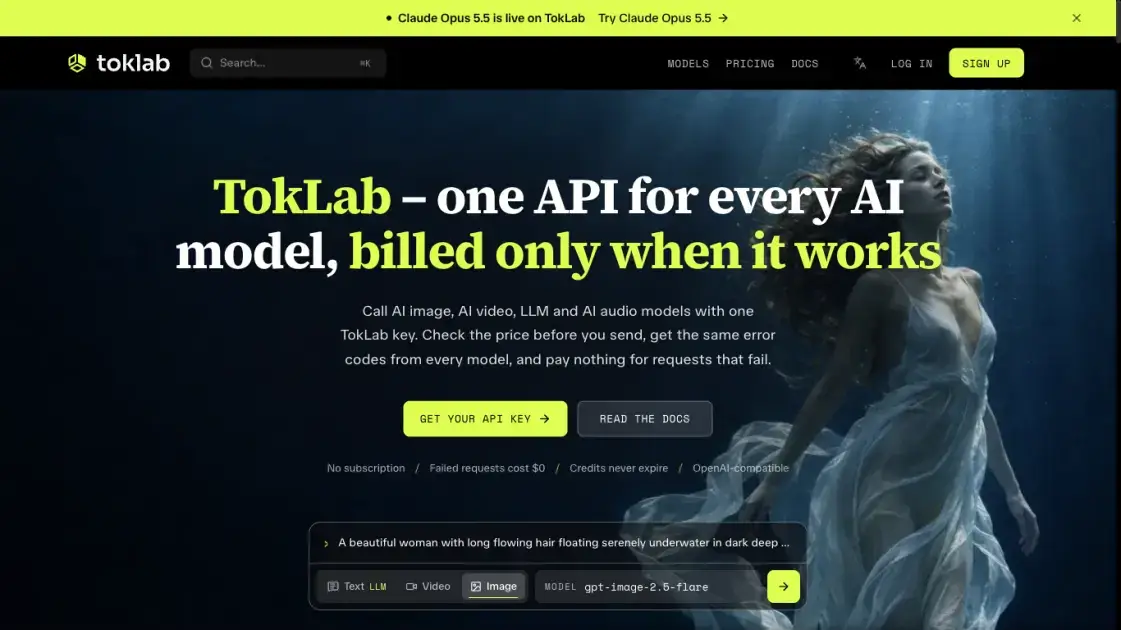
A single TokLab key reaches image, video, language and audio models from 15 providers, billed against one prepaid balance held in US dollars. Shipping an AI feature used to mean one account, one key and one invoice per model vendor, and swapping a model meant rewriting the integration; TokLab keeps the request shape, the credential and the balance unchanged whichever model is called. Every catalog entry shows its live rate, its parameters and the request format it accepts before anything is sent. Charges follow delivered results only, so a timeout, a filtered prompt or an empty render is billed at $0. Teams moving from an existing OpenAI, Anthropic or Gemini endpoint change two values and keep the rest of their code.
How does TokLab work
TokLab sits between the caller and the upstream vendor: a Bearer-authenticated request is matched to a model channel, forwarded, and the delivered result is written back to TokLab storage. Text models answer on an OpenAI-compatible endpoint, while media submissions return a task id that is polled at GET /v1/tasks/{id} until the status reads completed or failed. Deduction comes out of the prepaid USD balance at the rate listed for the chosen model and tier when the request was submitted, and nothing is taken if the task ends in failure. Billing units follow the route: input, output and cache tokens for language models, a flat price per delivered image on Standard channels, tokens per render on Official channels, and the video tokens a render consumes, shown as a price per second. Each call is recorded in usage history beside task logs and LLM logs, where its exact charge can be inspected afterwards.
Benefits of TokLab
Routing several models through one account removes a separate integration, key and invoice per vendor, so a change of model is one field rather than a rewrite. Because an unsuccessful task is never billed, retries, fallbacks and prompt experiments carry no extra cost, and the rate shown before submission matches the one deducted. Where a vendor publishes a rate, the pricing table puts it beside TokLab's with the difference calculated, for example 70% lower on Claude Opus 5.5 and 90% lower on GPT-6 Astra, checked on 2026-09-22. The balance has no expiry date, no monthly reset and no plan to cancel, and Auto Top-Up keeps a running app funded above a threshold the account sets. Every request is recorded with its model, time and charge, which makes spending auditable without leaving the dashboard.
Pros and Cons of TokLab
Pros
- One key and one balance across 44 models from 15 providers
- Failed tasks deduct nothing from the balance
- No subscription, no monthly minimum, credits never expire
- Live per-model rates, selectable tiers and a price calculator on image pages
- OpenAI, Anthropic and Gemini formats, plus a hosted MCP server for agents
Cons
- Paid use starts at a $20 card top-up once the $0.10 starter balance is spent
- Media jobs are asynchronous, so results need a polling loop
- A per-second video price is only a baseline: rate follows resolution and reference length
- Quoted video rates assume 16:9, other aspect ratios differ slightly
- MCP clients that can authenticate only through OAuth cannot connect yet
Core Features of TokLab
One key across 44 models
Video, image, language and audio routes share a single credential and one USD balance. The catalog spans 15 providers and is split into 16 video, 9 image, 18 LLM and 1 audio model.
No charge for failed tasks
A task that ends in failure deducts nothing, so retrying, falling back to another model or experimenting with prompts never bills twice.
Four request formats plus one task API
Chat Completions, Responses, Anthropic Messages and Gemini native bodies are all accepted for text models, while image, video and audio submissions go through one task endpoint that returns a pollable id.
Live prices and named tiers
Rates are read from the same price list billing uses. A cheaper tier of the same model is selected by appending it to the model name (gpt-image-2:<tier>), and a tier request never moves to another tier on its own.
Error codes that mean the same thing everywhere
The same failure produces the same error.code on every model, each with a documented next step such as adding credits, backing off or revising the prompt.
Agents and an MCP server included
Claude Code and Codex CLI can run against TokLab models with charges taken from the balance, and a hosted MCP server lets clients list models, read schemas and submit jobs without integration code.
Use Cases of TokLab
- Product teams shipping AI features: photo, clip, chat and transcription routes are covered by one integration, with no separate account or invoice per vendor.
- Developers benchmarking generators: the same prompt runs across GPT Image 2.5, Nano Banana 2.1, Midjourney V8.2 and FLUX 3 Image Klein, and each request's cost shows up in task logs.
- Video and image pipelines: Seedance 2.5, Kling 4.0 or Veo 3.1 render from a prompt or a still frame, and an unsuccessful run returns nothing billed.
- Coding agents: Claude Code aimed at
ANTHROPIC_BASE_URLand Codex CLI spend the TokLab balance instead of a vendor plan. - Audio processing: Whisper-1 transcribes recordings or translates them into English, billed by the minute and returned as JSON, SRT or VTT.
FAQs of TokLab
What is TokLab?
An API platform that serves AI image, video, language and audio models from one credential against a single prepaid USD balance. The catalog counts 44 models from 15 providers.
Does TokLab offer a free plan?
There are no plans at all. New accounts receive $0.10 of balance, enough for a few test requests, after which the smallest top-up is $20 by card or $15 in crypto.
What happens when a request fails?
Nothing is deducted, and the response carries a shared failure code such as 30001 for an insufficient balance or 60001 for a prompt that needs revision, each with a documented next step.
Can existing OpenAI code keep working?
Yes. Chat Completions, Responses, Anthropic Messages and Gemini request shapes are all accepted, so a working integration only needs a new base URL and key.
Can AI agents call TokLab?
Coding tools such as Claude Code and Codex can be aimed at TokLab models, and MCP clients connect to https://api.toklab.ai/v1/mcp with a Bearer key to inspect the catalog and submit jobs.
Can a price change while a request is running?
No. A newly published rate applies to requests made after that point; a submitted request keeps the price in force when it was sent.
How to use TokLab
- Create an account at https://toklab.ai and sign in with Google; every model and price is visible before any money is added.
- Top up on the Credits page, from $20 by card, PayPal, Alipay or WeChat Pay, or from $15 with crypto, which adds a 2% bonus.
- Generate a key at https://toklab.ai/apikeys, one per app, and keep it in a server-side environment variable.
- Point the client at https://api.toklab.ai/v1 and send the key in the
Authorization: Bearerheader, leaving the existing SDK call otherwise intact. - Submit the request: text models answer right away, image, video and audio jobs return a task id.
- Poll
GET /v1/tasks/{id}every three seconds while the status is processing, then read the delivered files fromoutput.data[].url.
TokLab Alternatives
UniRoute gives developers one API and one pay-as-you-go USD balance for Claude, GPT, Gemini, Seedance and Suno text, image, video and audio models.
Photo-to-video studio that turns portraits into Hello 2027 climb, Goodbye 2026 and Lunar New Year clips with fixed Wan templates. No prompts, 6-15s MP4s.
Multimodal AI video generator that turns text prompts, reference images, and clips into cinematic multi-shot sequences with consistent characters.
Seedance 3.0 preview page: planned multi-shot continuity, scene editing and audio-visual sync for AI video, while the on-page generator runs Seedance 2.5.
Browser workspace for AI image generation, reference photo editing, and short video drafts, aimed at creators, marketers, and product teams.
Black Forest Labs' multimodal model with a web generator for text-to-video, image-to-video and image editing with native audio, for creators and marketers.
SeedRouter puts image, video, language and audio models from OpenAI, Google and Anthropic behind one key, billing per request and never for failed calls.
Open-source AI coworker for Slack and Lark that runs Claude Code, Codex or Pi on your own machine with the plan or API key you already pay for.
Wan API is an independent platform for Wan and Seedance video models. Compare specs and rates, generate clips in the Playground, or call them through one API.
Seedance 3.0 turns text, images, video clips, and audio into videos with sound, and edits one part of a clip without regenerating the rest.
Wery is a virtual AI studio that routes one goal to specialist agents for video, images, music and documents, keeping characters and project assets consistent.

AI video and image studio with text-to-video, image-to-video and keyframe control across Seedance, Kling, Wan and Vidu — all on one credit balance.