
TTAPI: Unified AI API Gateway for Image, Video, Music & LLMs

What is TTAPI
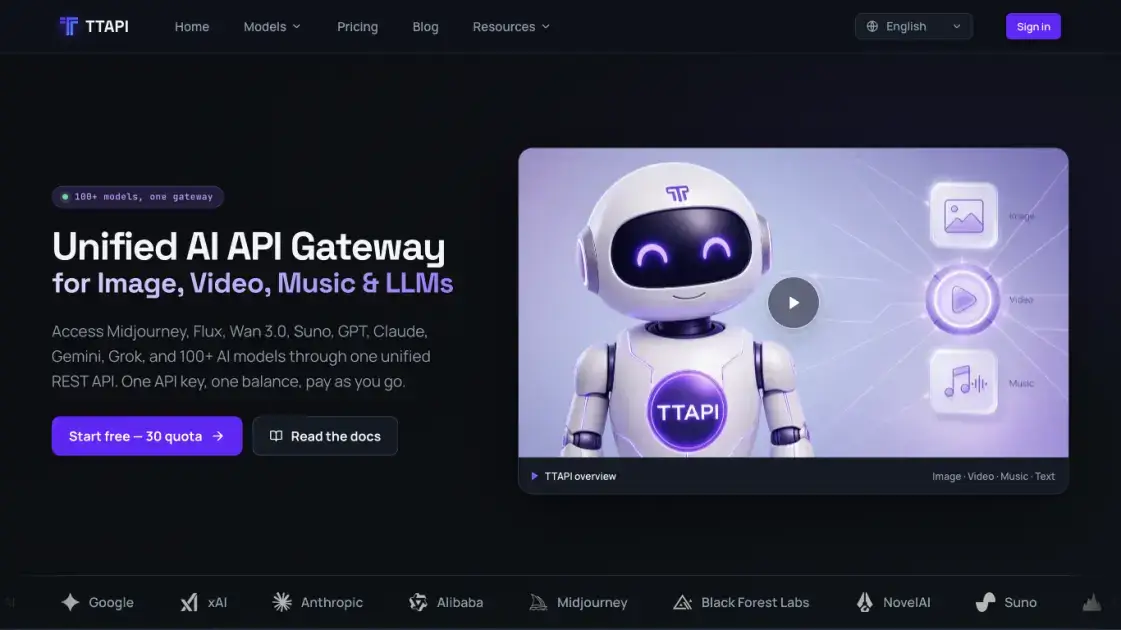
TTAPI consolidates more than 100 generative models spanning images, video, music and text behind a single REST interface. Developers who would otherwise register with each provider, manage separate cards and reconcile multiple invoices instead work through one credential and one prepaid wallet. The gateway exposes named models from OpenAI, Google, xAI, Anthropic, Alibaba, Midjourney, Black Forest Labs, NovelAI and Suno, with per-product documentation describing endpoints and request formats. New accounts receive 30 units of trial credit and a ready-made key, so first calls can be made before any top-up. The service targets teams adding generative capabilities to applications without maintaining a stack of vendor relationships.
How does TTAPI work
Requests travel from an application to the gateway, which routes them to the selected upstream model and returns results in a consistent JSON envelope. Metering is handled in quota, where 100 units equal one US dollar, and each model or operation draws its own rate from the shared prepaid balance. For operations that finish quickly the response can be read directly, while longer generations follow an asynchronous pattern: submitting a task yields a jobId, and the client either polls the product's fetch endpoint or supplies a hookUrl for a completion callback. Generated media is served through a CDN, and the same key authenticates calls across image, video, music and language endpoints.
Benefits of TTAPI
Consolidating several providers under one account removes the administrative overhead of separate registrations, payment methods and currencies, and aggregated sourcing often puts rates below direct vendor pricing. A single prepaid wallet funds every media type, so credits need not be split across products or left idle with one supplier. Asynchronous processing with polling and webhooks keeps user-facing applications responsive while large batches run in the background. Published status codes, monitoring and a stated uptime SLA make error handling and capacity planning more predictable. Because purchased credits do not expire, teams can top up when convenient and consume the balance over time.
Pros and Cons of TTAPI
Pros
- Broad catalog spanning four media types
- One key and one prepaid balance
- Pay-as-you-go rates often below direct pricing
- Asynchronous jobs with fetch polling and webhooks
- Credits do not expire
Cons
- Trial credit is limited to 30 quota
- Generated-file URLs are temporary
- Queue-full submissions can return HTTP 499
- Rates vary by model and operation
- Documentation is the source of truth for fast-changing models
Core Features of TTAPI
Multi-provider model catalog
A browsable catalog lists 26 models across image, video, music and text categories, with plan counts shown per category. Entries include Midjourney Image, GPT Image 2.6 Flare, Flux 3, Nano Banana 2.1, Seedream, Suno, Veo 3.1, Wan 3.0 and several GPT, Claude, Gemini and Grok variants.
Single credential and shared wallet
One TT-API-KEY and one prepaid balance work across every endpoint, so topping up once funds generation in all four media categories. Billing is metered per image, per second of video or per track, with model-specific rates shown on the pricing pages.
Asynchronous job handling
Long-running requests return a jobId that can be polled through a free fetch endpoint or delivered via a webhook hookUrl where the product supports it. The queue is designed for thousands of concurrent submissions.
Production-oriented delivery
A 99.9% uptime SLA, monitoring, structured error handling and CDN delivery of generated files support live workloads. Documented HTTP and business status codes help integrations handle failures.
Documentation and agent tools
Endpoint references, authentication rules, request examples, response formats and async workflow guides are published in the docs. A changelog tracks releases and price updates, and Agent Skills are offered alongside the API.
Use Cases of TTAPI
- Image and design products: add generation, editing, upscaling and face-swap features powered by Midjourney, GPT Image, Flux or Nano Banana.
- Music and audio apps: create, extend and remix tracks, replace vocals or instruments, and separate stems through Suno and FlowMusic endpoints.
- Chatbot and RAG builders: route conversations and agent workflows to Claude, GPT, Gemini or Grok through an OpenAI-compatible interface.
- Video creators: turn prompts or stills into short clips with Veo, Wan 3.0, HappyHorse, Grok Video or Midjourney Video.
- High-volume automation: run batch generation pipelines that rely on asynchronous jobs, webhooks and a queue built for concurrent tasks.
FAQs of TTAPI
Can TTAPI be tried without paying?
Yes. New accounts start with 30 units of trial credit plus an API key that works on every endpoint before any top-up is needed.
How is usage billed?
Charges are denominated in quota, with 100 credits to one US dollar; each model and operation lists its own rate, and the dashboard shows live spend.
Which model families are available?
Image, video, music and language services are covered, including Midjourney, Suno, Flux, GPT Image, Gemini, Grok, Claude, Seedream and Seedance.
How are long generations returned?
A submission returns a jobId; applications then check the fetch endpoint or register a hookUrl so the result arrives by webhook when ready.
Do purchased credits expire?
Credits bought into the wallet currently remain valid indefinitely, and discounts for particular models or channels appear on their pricing pages.
What happens when the queue is full?
A submission may answer with HTTP 499, which signals that active jobs for that product have reached the account's queue limit rather than a rate limit.
Are generated files hosted permanently?
No. Links to finished media are temporary and retention depends on the delivery host, so important outputs should be saved elsewhere promptly.
How to use TTAPI
- Create an account to receive 30 trial quota and a ready-to-use TT-API-KEY.
- Browse the model catalog or API reference to locate the endpoint and request format for the desired product.
- Send an authenticated request with the required parameters, using the key across any image, video, music or LLM endpoint.
- Save the returned jobId for any long-running generation task.
- Retrieve the result by polling the fetch endpoint or by providing a hookUrl for webhook delivery.
- Download finished files to external storage, since generated-file URLs are temporary.
TTAPI Alternatives
Alook is a workspace where teams and friends chat with shared Claude Code and Codex agents in one place, coordinating multi-agent work without relaying messages.
UniRoute gives developers one API and one pay-as-you-go USD balance for Claude, GPT, Gemini, Seedance and Suno text, image, video and audio models.
TokLab puts AI image, video, language and audio models behind one API key and one prepaid USD balance, with live listed prices and no subscription.
SeedRouter puts image, video, language and audio models from OpenAI, Google and Anthropic behind one key, billing per request and never for failed calls.
Open-source AI coworker for Slack and Lark that runs Claude Code, Codex or Pi on your own machine with the plan or API key you already pay for.
Wery is a virtual AI studio that routes one goal to specialist agents for video, images, music and documents, keeping characters and project assets consistent.

Relay App turns plain-language instructions into AI workflows that connect 200+ apps, run reliable automations, and pause for human approval.
AtAt runs Claude Code, Codex, or local models in the text field you are typing in, no app-switching. It adds TabTab autocomplete, screenshots, and clipboard history.
Play HT is a free AI voice generator that turns text into speech with 200+ public voices, streams previews in the browser, and exports MP3 files.
Dash is an AI teammate in Slack and Microsoft Teams that connects 3,000+ tools, automates workflows and completes tasks in your channel.
Jev is TypeSafe AI's System One model that returns typed decisions with calibrated confidence for automation. Fast, cheap, zero hallucinations.
Use GPT, Claude, Gemini and Grok through one OpenAI-compatible API. Compare model rates, create a key, and make your first request in minutes.