
MiroFish AI Simulation Chat for Scenario Prediction Platform

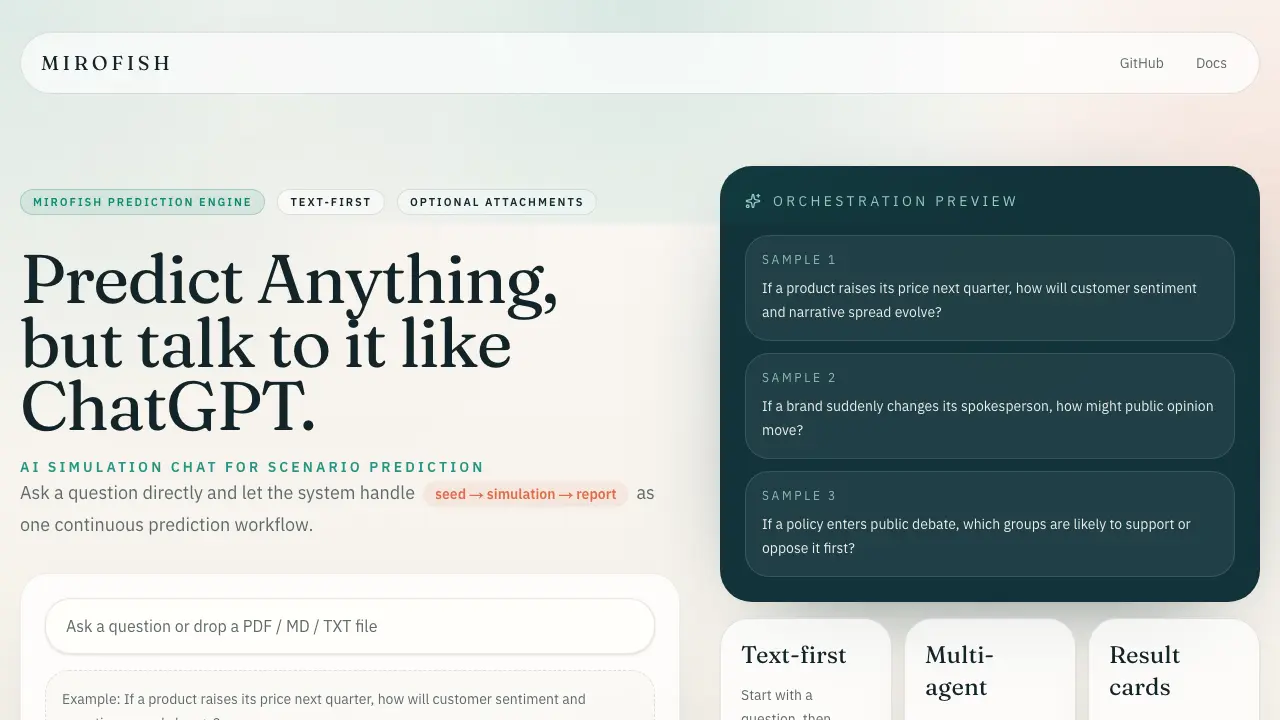
What is MiroFish
MiroFish is an AI‑driven prediction engine that combines conversational interaction with scenario simulation. Users begin by typing a question—such as the impact of a price increase on customer sentiment—and the system automatically decides whether additional files are needed, preserving the speed of a chat interface. Behind the scenes, a multi‑agent workflow constructs a graph, runs the simulation, and generates a structured result card that includes a concise summary, a link to the full report, and suggested follow‑up actions. The platform supports optional attachments, enabling richer context for complex queries like brand spokesperson changes or policy debates. By integrating prediction, orchestration, and reporting into a single chat window, MiroFish streamlines the decision‑making process for analysts and strategists who need fast, data‑backed insights.
How does MiroFish work
MiroFish operates as a text‑first prediction engine that integrates chat‑style interaction with automated scenario simulation. Users pose a question, after which the platform’s multi‑agent system constructs a causal graph, runs simulations, and generates a structured result card containing a summary, a report entry point, and suggested follow‑ups. Optional file attachments can be added without breaking the conversational flow, allowing the engine to incorporate additional data when needed. By handling graph building, simulation, and reporting behind the scenes, MiroFish delivers continuous predictions for inquiries such as price changes, spokesperson swaps, or policy debates, while maintaining a seamless chat experience.
Benefits of MiroFish
MiroFish provides a text‑first prediction engine that lets users pose scenario questions and receive structured, multi‑agent simulations without leaving the chat interface. By handling graph building, simulation, and reporting behind the scenes, it delivers concise result cards that summarize outcomes and suggest follow‑up actions. Optional file attachments can be added when needed, preserving conversational speed. The platform supports diverse use cases—from forecasting customer sentiment after price changes to analyzing public opinion shifts following brand or policy updates—offering a unified workflow for complex scenario analysis.
Pros and Cons of MiroFish
Pros
- Text-first interface accelerates query input.
- Multi‑agent architecture handles simulation and reporting.
- Supports optional file attachments for richer context.
- Structured result cards summarize predictions clearly.
Cons
- Documentation limited to brief README.
- No explicit pricing or subscription details.
- Integration options not described.
- Potential learning curve for complex scenario setup.
Core Features of MiroFish
AI Simulation Chat for Scenario Prediction
Enables users to ask complex “what‑if” questions and receive continuous, AI‑driven forecasts, maintaining a conversational flow similar to ChatGPT.
Text‑First Interaction with Optional Attachments
Starts the prediction process with natural language input, allowing users to add supporting files only when needed, preserving chat speed and simplicity.
Multi‑Agent Orchestration
Coordinates graph building, simulation execution, and report generation behind the scenes, delivering integrated outcomes without leaving the chat interface.
Structured Result Cards
Automatically generates concise result cards after each answer, summarizing key insights and providing direct links to detailed reports and follow‑up actions.
Predictive Analytics Across Domains
Applies the prediction engine to diverse scenarios—price changes, brand shifts, policy debates—offering actionable forecasts on sentiment, narrative spread, and stakeholder reactions.
Use Cases of MiroFish
- Market analysts: Simulate quarterly price changes to forecast customer sentiment and narrative spread.
- Brand managers: Predict public opinion shifts when altering spokespersons or messaging strategies.
- Policy researchers: Identify early supporter and opponent groups for emerging public policy debates.
- Business strategists: Conduct multi-agent scenario simulations without leaving a single chat interface.
- Data scientists: Attach supplemental files to text queries for enriched prediction modeling.
FAQs of MiroFish
What is the MiroFish Prediction Engine?
MiroFish Prediction Engine is an AI‑driven simulation chat platform that allows users to pose scenario‑based questions in natural language. It processes the query, optionally incorporates attached data files, runs multi‑agent simulations, and returns structured result cards that summarize predictions and suggest next steps.
How does MiroFish handle text‑first interactions?
In a text‑first workflow, users begin with a plain‑language question. MiroFish then decides if additional attachments are needed, preserving conversational speed. This design eliminates the need for separate data upload steps, making scenario prediction feel like a continuous chat with ChatGPT‑style responsiveness.
Can MiroFish predict business outcomes such as price changes?
Yes. By entering a question like “If a product raises its price next quarter, how will customer sentiment and narrative spread evolve?” MiroFish runs a graph‑based simulation that models market reactions, sentiment dynamics, and narrative propagation, delivering a concise prediction report within the chat interface.
What role do multi‑agent simulations play in MiroFish?
MiroFish orchestrates multiple AI agents behind the scenes to handle graph construction, simulation execution, and report generation. This multi‑agent architecture enables complex scenario analysis—such as public opinion shifts after a brand spokesperson change—while keeping the user experience within a single conversational thread.
How are results presented to the user?
After each prediction, MiroFish provides a result card positioned directly below the answer. The card includes a summary of key insights, a link to a detailed report, and suggested follow‑up questions, allowing users to quickly assess outcomes and continue the analytical conversation.
How to use MiroFish
- Identify the prediction question, phrasing it clearly in natural language, because MiroFish operates as a text‑first AI simulation chat for scenario prediction.
- Open the MiroFish interface, locate the chat box, and enter the question; the system automatically initiates the simulation workflow without requiring initial attachments.
- Review the optional “Attach Files” prompt; upload supporting documents only if they add contextual data, ensuring faster processing when no files are needed.
- Observe the multi‑agent engine generate a result card containing a concise summary, a link to the full report, and suggested follow‑up actions.
- Click the report entry point to expand detailed simulation outputs, including sentiment trajectories, narrative spread, and stakeholder analysis relevant to the query.
- Apply the insights to strategic planning, adjusting pricing, messaging, or policy approaches according to the predicted public response demonstrated by MiroFish.
MiroFish Website Traffic Analysis
Latest traffic information
- Monthly Visits613.49K
- Bounce Rate47.66%
- Pages Per Visit2.52
- Visit Duration00:00:32
- Global Rank84.67K
- Country/Region Ranking8.73K
Visits Over Time
Traffic Sources
- Organic Search: 70.83%
- Direct: 20.01%
- Referrals: 7.09%
- Mail: 1.07%
- Generative AI: 0.49%
- Organic Social: 0.46%
Top Keywords
| Keyword | Traffic | Volume | Cost Per Click |
|---|---|---|---|
| mirofish | 103.29K | 122.1K | $0.84 |
| miro fish | 11.65K | 15.29K | $0.85 |
| mirofish ai | 10.08K | 13.1K | $2.33 |
| miro fish ai | 1.73K | 1.35K | $1.4 |
| microfish ai | 1.13K | 1.63K | $2.47 |
Top Regions
| Region | Percentage |
|---|---|
| India | 11.64% |
| United States | 11.42% |
| Indonesia | 6.69% |
| Brazil | 5.48% |
| Germany | 4.02% |
