
Aldena: AI Agents That Run Your Client Projects
| Added on: | Jul 26, 2026 |
| Monthly Visits: | 1.1K |
| Social & Email: | -- |

What is Aldena
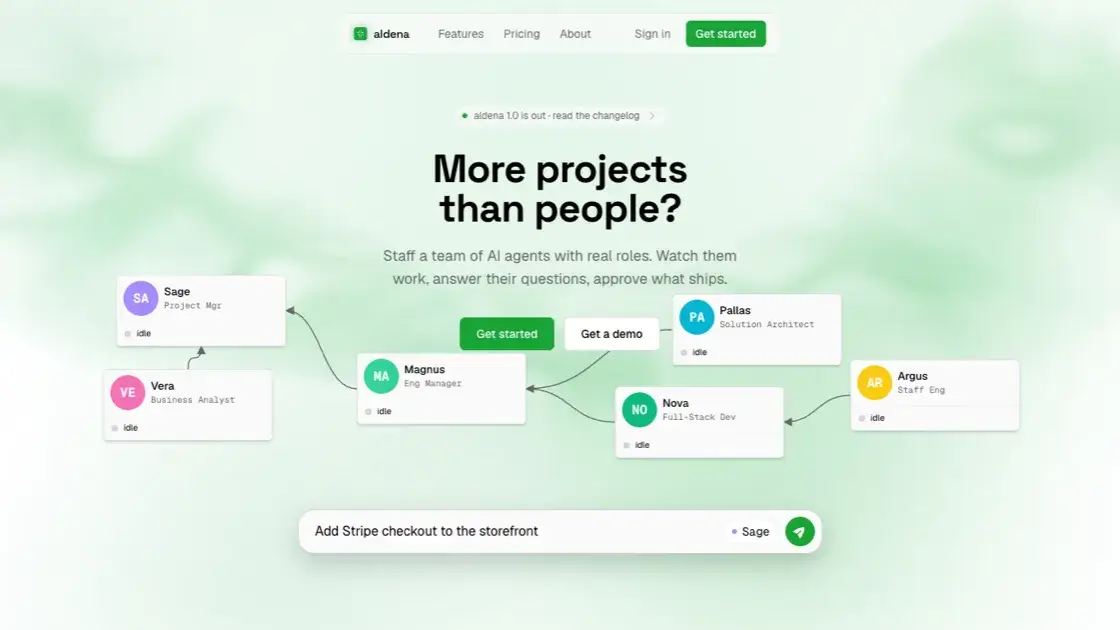
Aldena is an AI workforce platform that creates isolated rooms where AI agents handle client projects with real roles and human oversight. Each room comes with a dedicated server, ensuring nothing leaks between projects. Users can build hierarchies with managers, senior developers, and specialists, or run flat teams. The platform integrates with existing tools like GitHub, Jira, Google Drive, and Bitbucket, letting agents ship real work through familiar workflows. Pricing is usage-based with no subscription fees — rooms are free to create, and users only pay for model requests at provider rates plus a 20% platform fee on credit purchases.
How does Aldena work
Aldena creates an isolated room with a dedicated server for each project. Users staff the room by selecting AI agents with specific roles — project managers, business analysts, engineers, architects — and configure the hierarchy. Agents access the project's tools through integrations with GitHub, Jira, and other platforms. When tasks are assigned, agents work autonomously but pause at decision points for human approval. The approval gate ensures nothing merges, deploys, or ships without review. Agents maintain private memory for individual learning while the room holds shared context for team coordination. All actions are logged and auditable through the existing tool stack.
Benefits of Aldena
Aldena eliminates the headcount ceiling by letting teams staff AI agents into specific roles rather than hiring full-time employees for every gap. The isolated room architecture ensures project security — each client or product gets its own server with no data leakage. The approval gate provides accountability, with every change logged and requiring human sign-off before deployment. Usage-based pricing removes subscription overhead, letting teams pay only for actual model consumption. Integration with existing tools means agents work within current workflows rather than requiring migration to new platforms.
Pros and Cons of Aldena
Pros
- Free room creation with no subscription fees
- Isolated servers prevent data leakage between projects
- Approval gate ensures human oversight on all changes
- Integrates with existing development tools
- Supports real team hierarchies with role-based agents
Cons
- Usage-based pricing can become unpredictable at scale
- Currently limited tool integrations — Slack, Figma, Vercel, Linear coming soon
- Approval gate may slow down rapid iteration cycles
- Two-person team behind the platform — long-term support uncertain
Core Features of Aldena
Isolated Rooms
Each project gets its own dedicated server with isolated memory. Nothing leaks between rooms, so multiple clients or projects can run simultaneously without data mixing.
Dual-Layer Memory
Agents maintain private memory for individual context while the room holds shared context that the entire team draws on. This separation keeps individual learning distinct from collaborative knowledge.
Real Hierarchies
Rooms support actual organizational structures — hire a manager agent, then seniors, then middles, or run completely flat. The hierarchy mirrors real team dynamics with delegation and oversight.
Approval Gate
Every ship goes through human review. Agents pause at decision points and wait for approval before merging, deploying, or shipping. Nothing leaves the room without explicit sign-off.
Skill Marketplace
Pre-built skills with real tool integrations can be attached to any agent. These combine platform abilities with external tool access for comprehensive task handling.
Tool Integration
Agents work through existing tools including GitHub, Bitbucket, Jira, Google Drive today, with Slack, Figma, Vercel, and Linear coming soon. No need to migrate workflows.
Real Output
Agents produce actual deliverables — pull requests, deployments, documentation, and backlog items — through the user's own tools and infrastructure.
Use Cases of Aldena
- Agencies: Managing multiple client projects simultaneously with isolated rooms for each client, preventing cross-client data leakage.
- Software Teams: Staffing development gaps without full-time hires, using AI agents for specific roles like QA, DevOps, or frontend work.
- Startups: Running lean operations by combining human oversight with AI agent execution for faster product delivery.
- Consultancies: Handling concurrent consulting engagements with dedicated rooms that maintain separate contexts and tool access.
- Freelancers: Scaling output by delegating routine development tasks to AI agents while maintaining approval control.
FAQs of Aldena
What is Aldena?
Aldena is an AI workforce platform that creates isolated rooms where AI agents handle client projects. Each room comes with a dedicated server, role-based agents, and human approval gates for all changes.
How does the approval gate work?
Agents pause at every decision point and wait for user approval. Nothing merges, deploys, or ships until you review the diff and sign off. Work resumes where it paused once approved.
What tools does Aldena integrate with?
Currently Aldena integrates with GitHub, Bitbucket, Jira, and Google Drive. Slack, Figma, Vercel, and Linear integrations are coming soon.
How is Aldena priced?
Rooms are free to create with no subscription fees. Usage is pay-as-you-go — model requests deduct from a team balance at provider rates, with a 20% platform fee on credit purchases. Minimum top-up is $10.
Can I run multiple clients without their work mixing?
Yes. Each client or project gets its own isolated room with a dedicated server. Nothing leaks between rooms, so multiple clients can run simultaneously without data cross-contamination.
Do I need to write orchestration code?
No. Aldena provides a ready-to-use interface where you staff rooms with AI agents, assign tasks, and manage workflows without writing orchestration code.
What roles can AI agents fill?
Agents can be project managers, business analysts, engineering managers, solution architects, full-stack developers, staff engineers, and other roles. You can build hierarchies or run flat teams.
How to use Aldena
- Sign up for an account at aldena.ai and create a new room for your project or client.
- Staff the room by selecting AI agents with appropriate roles — project managers, developers, analysts — and configure the team hierarchy.
- Connect your existing tools including GitHub, Jira, Google Drive, and Bitbucket to give agents access to your workflow.
- Assign tasks to the agent team through the room interface, specifying goals and priorities.
- Review agent work at decision points — the approval gate pauses all changes until you sign off on diffs and deployments.
- Monitor progress through the room's shared context and agent memory, adjusting team composition as needed.
- Top up your team balance with credits to cover model usage costs at provider rates.
Aldena Website Traffic Analysis
Latest traffic information
- Monthly Visits1.1K
- Bounce Rate32.94%
- Pages Per Visit1.06
- Visit Duration00:00:00
- Global Rank14.04M
- Country/Region Ranking1.22M
Top Keywords
| Keyword | Traffic | Volume | Cost Per Click |
|---|---|---|---|
| aldena ia | 70 | 70 | -- |
| workers ai | -- | 2.91K | -- |
| ai agent extension chrome that reads or copy from google drive disabled | -- | 70 | -- |
| lmarena codex spark | -- | 70 | -- |
| what is coding agent by chatgpt called | -- | 10 | -- |
Aldena Alternatives
Open-source AI coworker for Slack and Lark that runs Claude Code, Codex or Pi on your own machine with the plan or API key you already pay for.
Wery is a virtual AI studio that routes one goal to specialist agents for video, images, music and documents, keeping characters and project assets consistent.

Relay App turns plain-language instructions into AI workflows that connect 200+ apps, run reliable automations, and pause for human approval.
Dash is an AI teammate in Slack and Microsoft Teams that connects 3,000+ tools, automates workflows and completes tasks in your channel.
Git-native task management for AI coding agents: track intent, status, blockers, dependencies, history, and commit evidence in Git.
Ritto AI learns from one real demonstration of your work, finds the repeated tasks, and completes them the same way. Join the beta for early access.
AI project scheduling tool that generates editable Gantt charts from prompts, templates, or imported files, checking dependencies and revision impact.
Referent uses AI agents to automate legal practice operations - client intake, matter management, document filing, and billing prep. Built for solo and small law firms.
Loop Engineering is an AI-powered platform that automates SaaS maintenance through verified agent workflows, memory persistence, and independent verification for every product run.
Taskly is an AI-native task manager where teams describe work in plain English and Otto drafts, prioritizes, and organizes tasks with your approval every step.
Tenderbolt uses AI to automate RFP and tender responses. It analyzes documents, completes security questionnaires, and generates tailored proposals.
BidPacto is an RFP response automation platform for proposal teams, enabling rapid source-backed drafting, missing‑info alerts, review workflows, and export to Word, PDF or CSV formats.