
LTX: Real-Time AI Video Generation from Text & Images

What is LTX
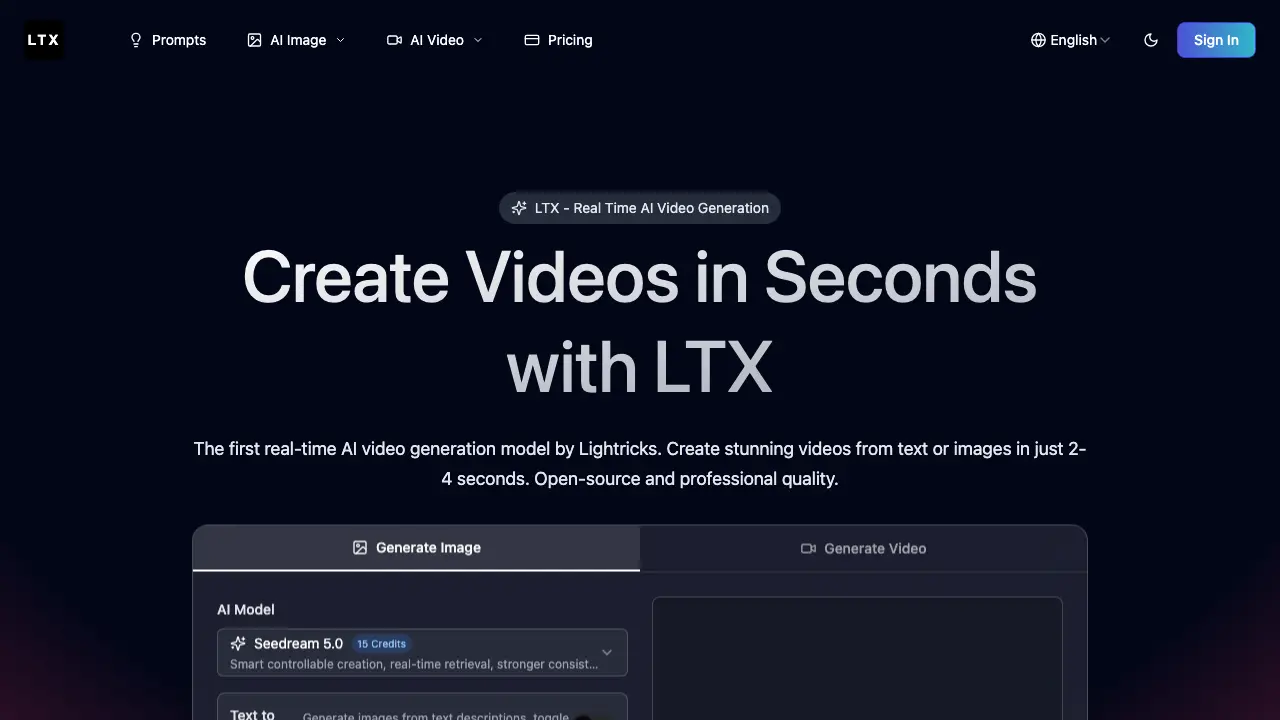
LTX is a real-time AI video generation model developed by Lightricks, utilizing a 2-billion parameter DiT (Diffusion Transformer) architecture. It generates 5-second videos at 768x512 resolution and 24 FPS in 2-4 seconds, faster than playback speed. The model supports both text-to-video and image-to-video generation, enabling creators to produce professional content from descriptive prompts or by animating static images.
As an open-source project under the Apache-2.0 license, LTX integrates with ComfyUI for customizable workflow design and runs on consumer-grade GPUs and TPUs. Its fast iteration cycle suits applications like film pre-visualization, advertising, social media content, and educational materials. Outputs are delivered in standard MP4 format, facilitating immediate use across platforms. The technology prioritizes efficiency and accessibility for rapid prototyping without traditional production bottlenecks.
How does LTX work
LTX is a real-time AI video generation model developed by Lightricks, utilizing a 2B parameter DiT (Diffusion Transformer) architecture. It operates by processing either text prompts or input images to produce short video clips, typically 5 seconds long at 768x512 resolution and 24 FPS. The system generates output faster than playback speed, completing a clip in 2-4 seconds on compatible hardware like the NVIDIA H100. It supports both text-to-video and image-to-video workflows, allowing for animation of static inputs. As an open-source model under an Apache-2.0 license, LTX integrates with tools such as ComfyUI and targets use cases including rapid prototyping, social media content, and pre-visualization.
Benefits of LTX
LTX is the first real-time AI video generation model, producing professional-quality videos from text or images in 2-4 seconds. Its 2B parameter DiT architecture enables faster-than-playback generation at 768x512 resolution and 24 FPS. As an open-source tool, LTX integrates with platforms like ComfyUI and supports both text-to-video and image-to-video workflows. This combination of speed, quality, and accessibility makes it suitable for rapid prototyping, social media content, and film pre-visualization, providing creators with an efficient solution for high-quality video production.
Pros and Cons of LTX
Pros
- Generates 5-second videos in 2-4 seconds.
- Fully open-source under Apache-2.0 license.
- Supports both text-to-video and image-to-video inputs.
- Achieves professional 768x512 resolution at 24 FPS.
- Integrates with ComfyUI for visual workflows.
Cons
- Output resolution is fixed at 768x512.
- Requires technical setup for local deployment.
- Generates short, 5-second video clips only.
- Demands significant GPU resources for real-time speed.
- Limited frame counts constrained by model architecture.
Core Features of LTX
Real-Time Text-to-Video Generation
Converts text descriptions into 5-second, 768x512 resolution videos at 24 FPS within 2-4 seconds using a 2B parameter DiT model, enabling rapid content prototyping and production.
Real-Time Image-to-Video Generation
Animates static input images into video sequences based on textual motion instructions, maintaining strong consistency for seamless and controllable video outputs from visual sources.
AI Image Generation from Text
Produces high-quality images from text prompts with multiple aspect ratio options, employing models like Seedream 5.0 to support diverse creative and marketing design workflows.
Use Cases of LTX
- Filmmakers: Pre-visualize scenes by generating storyboard videos from text prompts in seconds.
- Social media creators: Produce platform-specific short videos quickly using image-to-video animation.
- Advertising teams: Rapidly prototype campaign visuals with consistent AI-generated video clips.
- Educators: Convert lesson plans into engaging educational videos via text-to-video generation.
- E-commerce businesses: Animate product images to create dynamic showcase videos for online listings.
FAQs of LTX
What is LTX and what makes it unique?
LTX is the first DiT (Diffusion Transformer) based real-time AI video generation model developed by Lightricks. It features a 2B parameter architecture that can generate 5-second, 768x512 resolution videos at 24 FPS in just 2-4 seconds - faster than playback speed. It's open-source and supports both text-to-video and image-to-video generation.
How fast is LTX generation?
LTX generates videos faster than real-time playback. On an NVIDIA H100 GPU, it can produce a 5-second video in approximately 4 seconds. This breakthrough speed makes it practical for real-time creative workflows and rapid prototyping.
What video formats and resolutions does LTX support?
LTX generates videos at 768x512 resolution with 24 FPS frame rate. The model supports frame counts divisible by 8 plus 1 (e.g., 9, 17, 25 frames). Output is in MP4 format, suitable for social media, marketing, and professional content creation.
Is LTX open-source?
Yes! LTX is fully open-source, hosted on GitHub by Lightricks. It integrates with ComfyUI for visual workflow design and supports both GPU and TPU systems. Developers can freely use, modify, and distribute it under the Apache-2.0 license.
What are text-to-video and image-to-video generation?
Text-to-video allows you to create videos from text descriptions - simply describe the scene you want. Image-to-video lets you animate static images - upload a photo and describe how it should move. LTX excels at both modes with consistent, high-quality results.
What are the use cases for LTX?
LTX is perfect for film pre-visualization, advertising creative, social media content, educational materials, and rapid prototyping. Content creators, marketers, educators, and businesses use it to produce professional video content efficiently.
What system requirements are needed to run LTX?
LTX requires a GPU with sufficient VRAM, with optimal performance on NVIDIA H100 hardware. It supports consumer-grade GPUs and TPU systems. The 2B parameter model typically needs at least 16GB VRAM for local execution, and generation speed varies with hardware capabilities.
How can I get started with LTX?
New users can access LTX through the official ltx.dev website using free credits without a credit card. For local deployment, the open-source model is available on GitHub with integration guides for ComfyUI. Lightricks provides documentation and example workflows to assist with initial setup and exploration.
What are the licensing terms for commercial use?
LTX is released under the Apache-2.0 license, permitting commercial use, modification, and distribution with proper attribution. There are no licensing fees, but users must comply with the license terms. Lightricks also offers proprietary models like FLUX.1 Kontext under separate commercial licensing.
Can LTX be integrated with other creative tools?
Yes, LTX integrates with ComfyUI for node-based workflow design, allowing combination with other AI models and effects. Output videos in MP4 format can be imported into standard video editing software. Developers can also use available APIs for custom integrations into proprietary applications.
What are the current limitations of LTX?
LTX currently generates videos at a fixed 768x512 resolution with frame counts limited to specific values like 9, 17, or 25 frames. Consistency may vary with highly complex or abstract prompts. Real-time speed depends on hardware; consumer GPUs will result in longer generation times compared to the advertised 2-4 seconds on high-end GPUs.
How to use LTX
- LTX is a real-time AI video generation model that creates short videos from text or image inputs using a 2B parameter DiT architecture for fast, professional-quality results.
- Navigate to the LTX web interface at https://ltx.dev/ and sign in or create an account to access the generation tools and credit system.
- Select the appropriate generation mode: use "Text to Video" for descriptive prompts or "Image to Video" to animate an uploaded static image with a motion prompt.
- Enter a detailed text prompt describing the desired scene, subject, and motion, ensuring clarity within the character limit for optimal output consistency.
- For image-to-video, upload a source image and pair it with a prompt specifying how the image should animate or transform over the video duration.
- Choose an aspect ratio (e.g., 16:9, 9:16) that matches your target platform's requirements before initiating the generation process.
- Click the "Generate Video" button; the system will consume the specified credits (e.g., 10-15) and process the request using the Seedream 5.0 model.
- Wait approximately 2-4 seconds for the 5-second, 768x512 resolution MP4 video to render, as LTX operates faster than real-time playback speed.
- Preview the generated video directly in the interface, assessing visual quality, motion smoothness, and alignment with the input prompt or source image.
- Download the final MP4 file for use in editing software, social media, presentations, or other creative and professional video production workflows.
- Iterate by adjusting prompts, changing aspect ratios, or modifying source images to refine results, leveraging the tool's speed for rapid prototyping.
- Apply the generated clips to specific use cases such as social media content, advertising storyboards, educational clips, or film pre-visualization.
LTX Website Traffic Analysis
Latest traffic information
- Monthly Visits1.4K
- Bounce Rate33.96%
- Pages Per Visit1.2
- Visit Duration00:00:00
- Global Rank11.42M
- Country/Region Ranking--
Visits Over Time
Top Keywords
| Keyword | Traffic | Volume | Cost Per Click |
|---|---|---|---|
| ltx.dev | 260 | -- | -- |
| ltx | 190 | 49.84K | $1.38 |
| ltx studio | -- | 69.29K | $1.05 |
| ltx video | -- | 6.51K | $2.4 |
| ltx studio ai | -- | 3.89K | $3.9 |
Top Regions
| Region | Percentage |
|---|---|
| United States | 53.83% |
| Iraq | 46.17% |
