
Kling 5 FAQs
Kling 5 video generator allows creators to test text-to-video and image-to-video workflows online with limited free generations, suitable for ads and social media content.

FAQs of Kling 5
What is this Kling 5 free video generator?
This homepage is an independent browser workspace for people searching for a Kling 5 free video generator. It does not claim to be the official Kling site. Instead, it gives you a simple way to test currently available Kling-powered video workflows, compare prompt ideas, and move from concept to short render without extra setup. The tool supports both text-to-video and image-to-video inputs within a single interface.
Is this Kling 5 free video generator really free?
The generator offers limited free testing to allow users to evaluate Kling-powered video workflows. However, the free tier is not unlimited and is intended for initial experimentation. Extended usage, higher credit volumes, and additional features require upgrading to a paid plan. The site does not guarantee permanent free access beyond the initial trial credits.
Does it support both text to video and image to video?
Yes, the Kling 5 generator supports both text-to-video and image-to-video workflows. Users can enter a natural language prompt to generate a video from scratch or upload a reference image to guide the motion. This flexibility accommodates different creative needs, from concept visualization to extending existing still frames into motion sequences.
Do I need an API key to use it?
No API key is required. The Kling 5 generator operates as a browser-based tool, allowing users to test video generation directly in the web interface without any additional setup or credentials. This design simplifies access for quick creative tests and lowers the barrier to entry for evaluating Kling models.
Can I use generated videos for commercial projects?
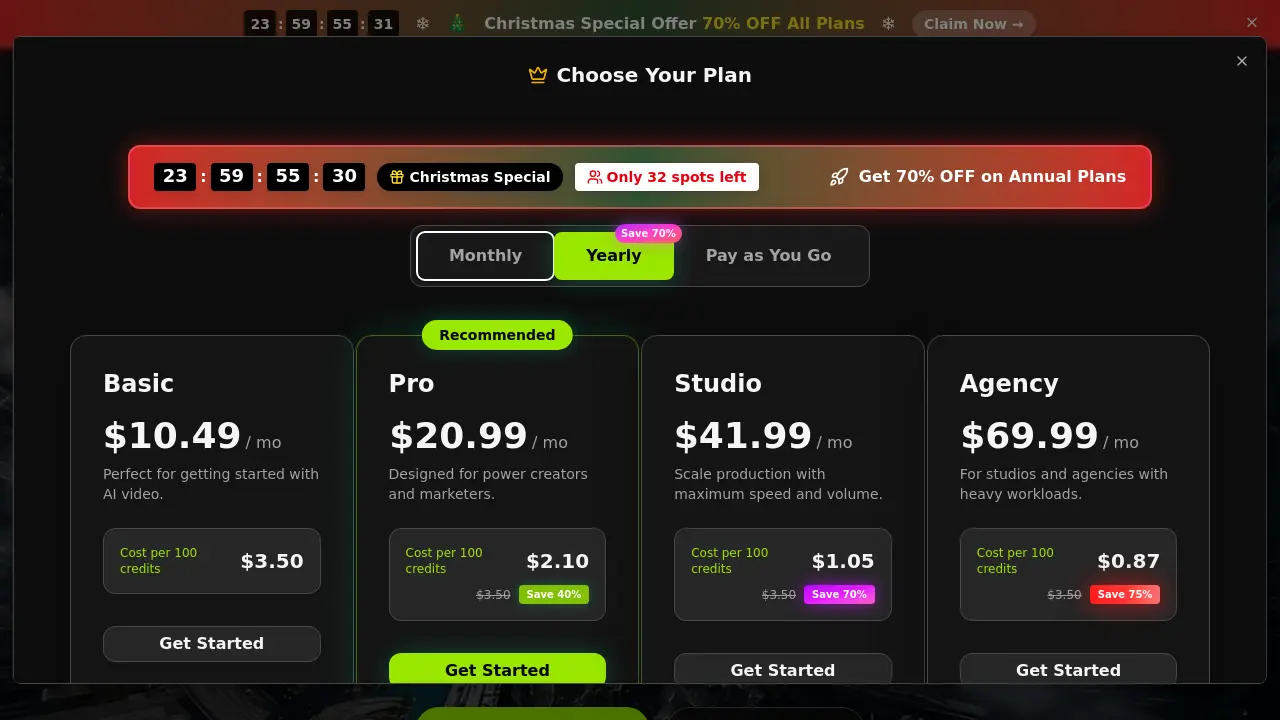
Commercial use rights are included with paid plans, such as the Basic, Pro, Studio, and Agency tiers. The free testing tier may have restrictions on commercial usage. Users should review the specific plan terms on the pricing page to understand the scope of commercial rights, watermark policies, and any usage limitations before employing outputs in client work or monetized content.
What video scenarios work best here?
The generator is optimized for short-form video testing, including advertisements, social media clips, product demos, and storyboard exploration. Its presets for aspect ratios like 16:9, 9:16, and 1:1 align with common publishing formats for platforms such as TikTok, Instagram Reels, and YouTube Shorts. Rapid prompt iteration helps validate visual concepts before full production.
Which models and output settings are available on the homepage?
The homepage currently exposes the Kling 5 and Kling 2.5 Turbo models. Output settings include resolution options of 720p and 1080p, aspect ratios of 16:9, 9:16, and 1:1, and duration presets of 5 or 10 seconds. The available models and controls are limited to what is integrated into this unofficial workspace and may not reflect the full official Kling ecosystem.
Is this the official Kling website?
No, this is not the official Kling website. It is an independent, unofficial browser workspace that provides access to certain Kling-powered video generation workflows. The site clarifies its unofficial status and directs users to official channels for comprehensive features, support, and announcements from the Kling development team.
What resolutions and aspect ratios are available in the Kling 5 generator?
The generator offers 720p and 1080p resolution options alongside aspect ratios of 16:9, 9:16, and 1:1. These settings cater to various publishing needs, from widescreen presentations to vertical mobile formats. Users select these parameters before generation to ensure the output matches their target platform's specifications, such as social media feeds or presentation slides.
How does the credit system work for video generations?
Credits are deducted per video generation based on factors like duration, resolution, and the chosen model. For example, a standard 5-second video at 720p using Kling 2.5 Turbo consumes 100 credits. Longer durations or higher resolutions increase credit costs. Paid plans provide a monthly credit allowance, while the free tier includes a limited number of test credits. Exact consumption rates are displayed in the generator interface before rendering.
Why might an image-to-video generation fail on Kling 5?
Image-to-video workflows may reject uploads containing photorealistic people due to policy restrictions or technical limitations. For the most reliable results, users should employ non-identifiable or non-photorealistic source images, such as illustrations, product shots, or stylized scenes. Paid plans may include credit protections for failed jobs, as detailed in the respective plan terms.
What are the differences between Kling 5 and Kling 2.5 Turbo models?
Kling 5 represents the newer model, generally expected to deliver higher quality and more coherent motion in generations. Kling 2.5 Turbo prioritizes faster rendering speeds, making it suitable for rapid iteration during early-stage testing. Users can compare both models on the homepage to determine which best suits their balance of quality and speed requirements for a given project.
Are there any usage limits on the free tier of Kling 5?
The free tier provides a limited number of credits for initial testing, typically allowing a few short video generations. Specific limits, such as the exact credit count or monthly refreshes, are not permanently guaranteed and may be adjusted by the site operators. Users seeking higher volume, longer durations, or commercial rights must subscribe to a paid plan for sustained access.
How to use Kling 5
Kling 5 Free Video Generator is a browser-based tool for testing Kling-powered text-to-video and image-to-video generation workflows. It provides limited free access to Kling 5 and Kling 2.5 Turbo models for short-form video prototyping.
- Navigate to the Kling 5 homepage and locate the generator interface to begin.
- Select the desired Kling model, either Kling 5 or Kling 2.5 Turbo, for your test.
- For text-to-video, enter a descriptive natural language prompt in the input field.
- For image-to-video, upload a reference image, avoiding photorealistic people for reliability.
- Configure the video settings, choosing an aspect ratio, duration, and resolution.
- Initiate the generation process, which consumes credits based on the selected parameters.
- Preview the generated short video directly in the browser interface after processing.
- Download the output file if the result meets your testing objectives.
- Review your remaining credit balance on the plan to monitor usage for subsequent tests.
- Upgrade to a paid plan via the pricing page for higher credit volumes and commercial usage rights.
- Use the generated clips for rapid validation of ad concepts, social media posts, or storyboards.
- Interpret results by assessing motion quality, prompt adherence, and suitability for your target format.
- Iterate by adjusting prompts or settings to refine the video output for your specific use case.
- Access the prompt inspiration gallery on the homepage for examples of effective text-to-video queries.
- Remember this is an unofficial tool; official vendor support and terms differ from those shown.
- Commercial use rights are granted per the selected subscription plan's terms and conditions.
