
GPT Realtime Introduction
GPT Realtime is an AI voice generator platform for developers and product teams, offering low‑latency speech‑to‑speech, image‑aware prompts, SIP call support, API workflow planning and reusable cache for rapid voice‑app prototyping.

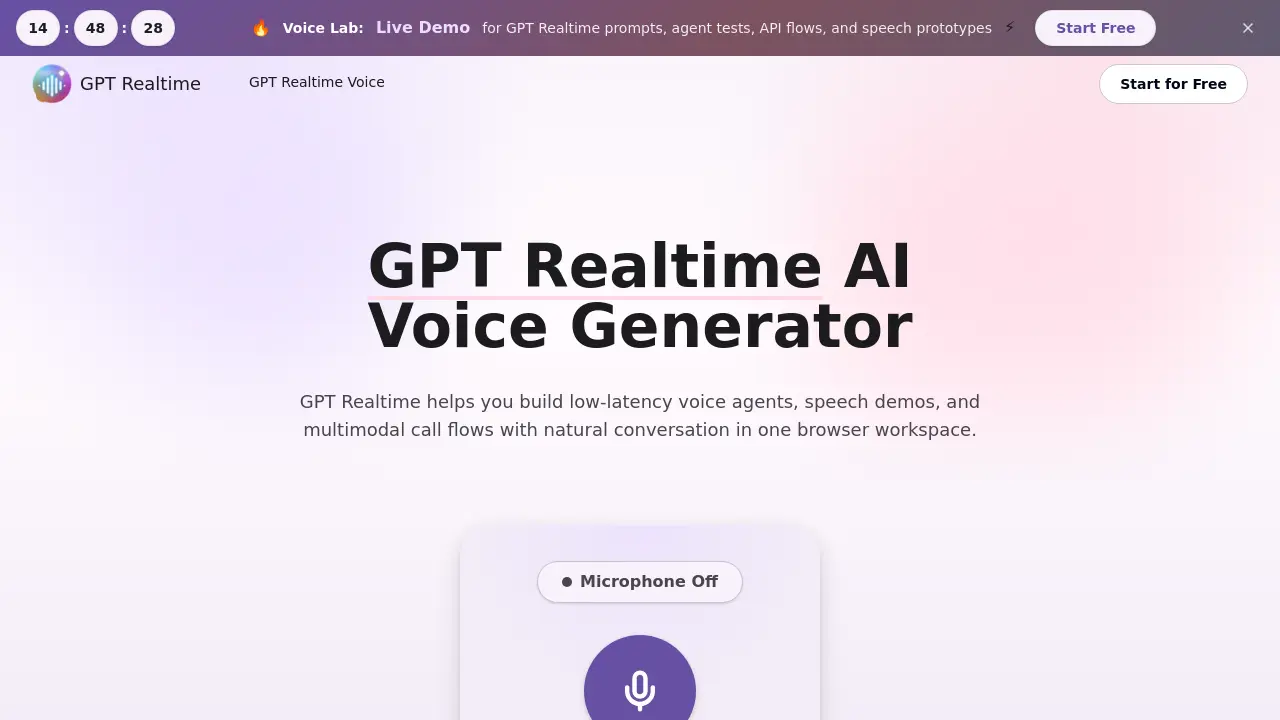
What is GPT Realtime
GPT Realtime is a browser‑based workspace that enables rapid prototyping of low‑latency voice agents, speech‑to‑speech demos, and multimodal call flows. Users define a scenario, select a voice model, and launch a real‑time conversation that can incorporate image context, tool calls, and SIP‑based phone routing. The platform consolidates speech generation, API planning, cached prompts, and review notes into a single flow, allowing product teams to compare model behavior, latency, and tone across variations. Built‑in features such as voice control, model comparison, and cache workflow support repeatable testing and documentation for QA, stakeholder alignment, and launch readiness. An integrated API further supports WebRTC demos, function‑call retries, and automated handoff logic, making GPT Realtime suitable for support, coaching, and product‑support prototypes.
How does GPT Realtime work
GPT Realtime operates as a browser‑based workspace that captures audio via the microphone, streams it through a low‑latency speech‑to‑speech model, and returns a synthesized voice response in real time. Users define a scenario, select a voice model, and optionally attach image context or tool schemas; the platform then processes the spoken input, invokes any required function calls, and manages handoff logic such as SIP routing or API callbacks. Cached prompts and reusable contexts accelerate repeat tests, while built‑in controls let teams fine‑tune greeting style, interruption handling, and escalation rules, producing repeatable voice‑agent prototypes for QA and launch planning.
Benefits of GPT Realtime
GPT Realtime provides a browser‑based workspace for building and testing low‑latency voice agents, speech‑to‑speech prototypes, and multimodal call flows. The platform combines live voice interaction, image context, tool calls, and SIP‑style phone routing in a single environment, enabling teams to compare model behavior, tune greeting styles, interruption handling, and escalation rules, and organize reusable prompts through caching. Features such as API planning, model comparison, and visual context support rapid iteration and clearer QA documentation, while the free trial lets users evaluate voice settings, API flows, and cached sessions before committing to a production build.
Pros and Cons of GPT Realtime
Pros
- Low‑latency speech‑to‑speech interaction.
- Browser‑only workspace eliminates local setup.
- Integrated cache for reusable prompts and tool schemas.
- Supports multimodal input, including image context.
- SIP and API workflow features enable phone‑call prototyping.
Cons
- Not an official OpenAI model page, may cause trust concerns.
- Limited to browser environment; no native app support.
- Pricing and credit details not disclosed on the site.
- Advanced customization may require external tool integration.
- Documentation focuses on demos, not large‑scale production deployment.
