
APIXO: Unified API for all AI models, cost-effective

What is APIXO
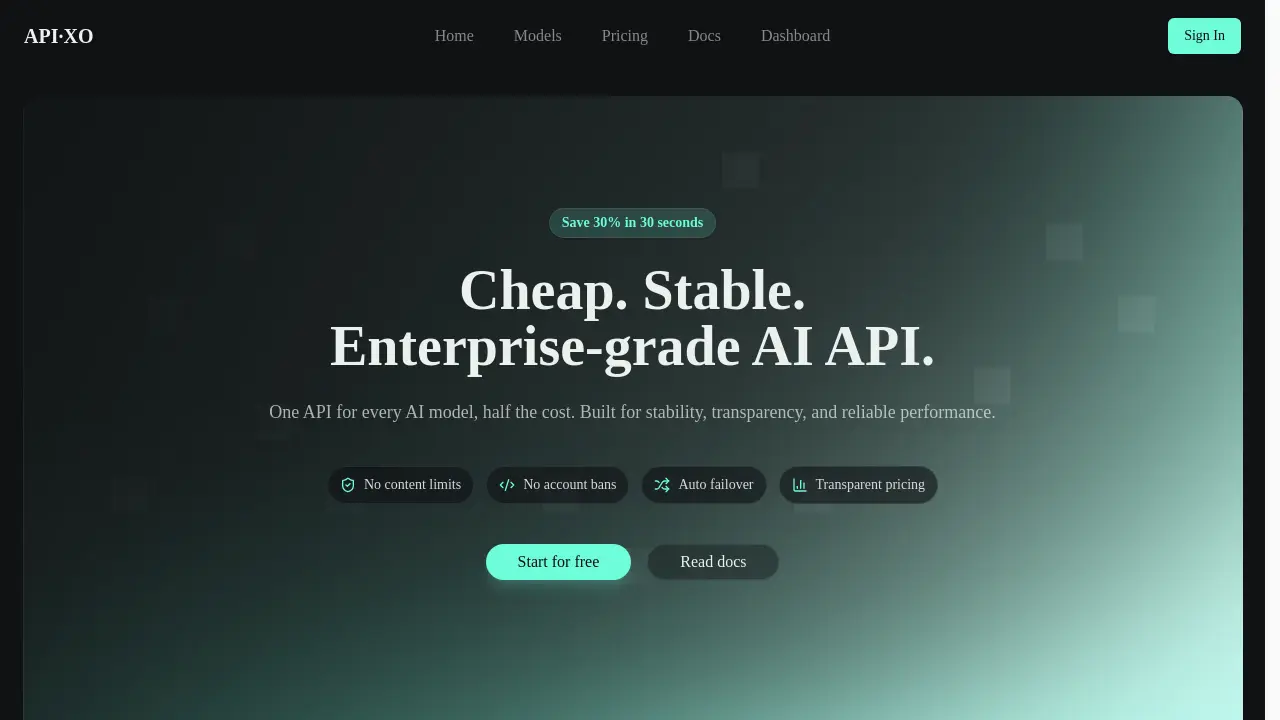
APIXO offers a unified, pay‑as‑you‑use API that consolidates access to leading AI models—including Sora, Veo, Flux, GPT‑4o, Claude, Gemini, and more—through a single, stable endpoint. The platform eliminates the need for multiple SDKs or authentication flows; developers authenticate via an apixo login and then specify the desired model in a single request field. Transparent pricing is paired with best‑value routing that automatically selects the lowest‑cost, highest‑performance provider based on real‑time health and latency metrics, while automatic failover ensures uninterrupted service. No content limits or account bans apply, and usage is tracked per project with daily and weekly reports to keep budgets in check. APIXO’s architecture supports rapid model switching, continuous health scoring, and per‑project rate limits, making it an efficient choice for production‑grade AI deployments.
How does APIXO work
APIXO delivers a single API endpoint that normalizes request and response formats across text, image, video, and audio models from providers such as OpenAI, Google, and Alibaba. By routing each request through health scoring and best‑value selection, the platform automatically fails over to the most reliable provider, ensuring low latency and cost savings. Developers authenticate via apixo login, manage per‑project keys, and can switch models by editing a parameter. The service supports medical AI workflows, enabling analysis of apixaban tablet dose, side effects, renal dosing, and half‑life predictions, as well as integration with tools like apixol sirop and apixol spray.
Benefits of APIXO
APIXO offers a single, cost‑effective endpoint that unifies access to leading AI models—Sora, Veo, Flux, GPT‑4o, and more—while automatically routing requests to the best‑value provider. Developers can switch models by editing one parameter, and the platform provides real‑time health scoring, failover, and transparent pay‑as‑you‑use billing. The API supports medical AI workflows, enabling analysis of data such as apixaban dose, side effects, renal dosing, and apixaban half life, and can be accessed via a simple apixo login. With per‑project keys and no data persistence, teams keep control and stay under budget.
Pros and Cons of APIXO
Pros
- Unified API reduces SDK juggling.
- Transparent pricing cuts costs by 50%.
- Automatic failover ensures high uptime.
- Real‑time health scoring optimizes performance.
- Pay‑as‑you‑use eliminates monthly fees.
Cons
- Limited to supported providers; new models may lag.
- No built‑in data persistence; requires external storage.
- Requires API key management per project.
- Learning curve for unified schema.
- Potential rate limits may restrict heavy usage.
Core Features of APIXO
Unified API Endpoint for Multiple AI Models
Provides a single request format that supports text, image, video, and audio models, eliminating the need for separate SDKs and authentication flows.
Best-Value Routing with Real-Time Health Scoring
Automatically selects the most cost‑effective and reliable provider per request based on live latency, error rates, and pricing signals, ensuring optimal performance.
Automatic Failover and Redundancy
Continuously monitors provider health and switches to alternative sources when degradation occurs, maintaining uninterrupted service without manual intervention.
Transparent Pay‑As‑You‑Use Billing
Offers a single balance covering all models, with no monthly fees, credits that never expire, and clear per‑model cost breakdowns for predictable budgeting.
Per‑Project Key Management and Rate Limits
Isolates projects with dedicated API keys, configurable quotas, and rate limits to control spending and protect against runaway usage.
Usage and Cost Analytics
Generates daily, weekly, and monthly reports by model, project, and time, enabling teams to track spend, detect spikes, and share insights with stakeholders.
Data Privacy and Logging Controls
Defaults to non‑persistent data handling, encrypts traffic, and allows configurable logging to meet audit and privacy requirements.
Use Cases of APIXO
- Healthcare developers: Build apixaban dose calculators using APIXO's unified AI model integration.
- Pharma analytics: Analyze apixaban side effects data with APIXO's text generation models.
- Clinical research: Automate apixaban reversal protocol documentation via APIXO's language models.
- Medical education: Create interactive apixaban drug class quizzes using APIXO's image generation.
- API developers: Simplify apixo login integration with APIXO's unified authentication schema.
FAQs of APIXO
What AI models can I use?
APIXO provides access to a broad range of leading AI models, including text, image, video, and audio engines such as Sora 2, Veo 3.1, Flux Kontext, GPT‑4o, Claude, Gemini, Llama, Mistral, and many others. New releases are added promptly as providers ship them, ensuring developers can experiment with the latest capabilities without managing multiple SDKs.
What is best‑value routing?
Best‑value routing is APIXO’s default mechanism that selects the most cost‑effective and reliable provider for each request. It evaluates real‑time health, latency, and pricing signals across all available providers for a model, automatically choosing the optimal one and switching if conditions degrade.
How much cheaper is APIXO?
APIXO’s transparent, pay‑as‑you‑use pricing typically halves the cost of direct provider usage. By aggregating a single balance across all models and employing best‑value routing, users often see significant savings compared to managing separate accounts and keys for each AI service.
How do I switch models without rewriting code?
The unified API schema allows developers to change the model field in a single request while keeping the rest of the payload identical. This means you can swap from, for example, flux-1.1-pro to veo-3.1 without modifying authentication, headers, or request structure, simplifying experimentation and deployment.
What happens if an upstream goes down?
APIXO maintains multiple providers per model and continuously scores their health. If a preferred provider fails or degrades, the system automatically fails over to a more reliable alternative, ensuring uninterrupted service and high uptime for your applications.
How does billing work?
Billing is purely pay‑as‑you‑use with no monthly fee or lock‑in. Credits never expire, and a low minimum top‑up is required. A single balance covers all models, and usage reports are available daily, weekly, and monthly to help teams monitor spending and adjust budgets.
Is my data secure?
Data is not persisted by default, and all traffic is encrypted in transit. APIXO offers per‑project API keys, rate limits, and quotas to control access. Logs are configurable to meet privacy requirements, and the platform adheres to industry‑standard security practices to protect user information.
How can I monitor usage and costs per project?
APIXO provides dashboards and API endpoints that break down spend by model, project, and time period. Daily and weekly reports can be emailed to product and operations teams, enabling early detection of cost spikes and facilitating budget management across multiple projects.
What are the rate limits and quotas for APIXO?
Each project receives configurable rate limits and usage quotas to prevent runaway costs. Administrators can set per‑minute or per‑hour limits, and the platform enforces these thresholds automatically, ensuring predictable billing and protecting against accidental over‑usage.
Does APIXO support real‑time health monitoring of providers?
Yes, APIXO continuously probes each provider’s error rates and p95 latency. These live health scores inform best‑value routing decisions and trigger automatic failover when a provider’s performance falls below acceptable thresholds, maintaining service reliability.
Can I customize the request format for specific models?
While the unified schema standardizes most requests, APIXO allows model‑specific parameters to be included in the input payload. Developers can pass additional options required by particular models without altering the overall request structure, preserving code simplicity.
How do I obtain an API key and set up a project?
To start, create a project on the APIXO dashboard, which generates a unique API key tied to that project. The key is used in the Authorization header of every request. Projects can be isolated with separate keys, rate limits, and quotas, providing clear separation for development, testing, and production environments.
How to use APIXO
- APIXO serves as a single, cost‑efficient API gateway for text, image, video, and audio models, offering unified request formats, best‑value routing, and automatic failover for reliable performance.
- Create a project through the dashboard, then log in with apixo login to receive a project‑specific API key, which isolates limits and quotas for secure usage.
- Send a request to the unified endpoint, e.g., POST https://api.apixo.ai/api/v1/generateTask/nano-banana, including an Authorization header and a JSON body with a prompt, then receive the output.
- To experiment with different models, modify the model field in the request payload; the rest of the code remains unchanged, enabling rapid iteration.
- Track usage and spend via the dashboard’s daily and weekly reports; analyze model‑level metrics to identify cost spikes and adjust quotas accordingly.
- Interpret the generated content—for example, AI‑generated articles on apixaban dose, apixaban side effects, or apixol sirop—and integrate them into product features or marketing materials.
- Use insights from usage analytics to refine prompts, reduce token consumption, and maintain compliance with data privacy policies, ensuring sustainable AI deployment.
- Generate detailed drug profiles for apixaban tablet, apixaban reversal, and apixaban antidote, and compare apixaban renal dose with standard dosing guidelines.
- Create marketing copy for apixol spray and apixol prix maroc using AI, ensuring compliance with regulatory language and local market nuances.
- Leverage AI to draft technical documentation for apexon, apexon careers, and apexon company, integrating best practices from apex.oracle.com and apexogenesis.
- Use the platform to simulate scenarios for apixotor 5 and apixofx, evaluating performance under different model configurations and compare latency and cost metrics across providers.
- Generate a summary report for apexon nest and apexon pune, highlighting usage trends and recommending budget adjustments to align with quarterly targets and improve ROI.
APIXO Website Traffic Analysis
Latest traffic information
- Monthly Visits689
- Bounce Rate7.74%
- Pages Per Visit2.65
- Visit Duration00:00:19
- Global Rank--
- Country/Region Ranking--
Visits Over Time
Top Keywords
| Keyword | Traffic | Volume | Cost Per Click |
|---|---|---|---|
| suno api | 90 | 22.45K | $2.14 |
| kling 3.0 motion control free | 80 | 1.17K | -- |
| kling api | 60 | 13.59K | $2.93 |
| sora 2 api | 50 | 4.49K | $4.57 |
| nano banna free api keyt | 40 | 40 | -- |
Top Regions
| Region | Percentage |
|---|---|
| Türkiye | 100% |