
Seedance 2: Free AI video generator from text and images.
| Added on: | Feb 9, 2026 |
| Monthly Visits: | -- |
| Social & Email: | -- |

What is Seedance 2
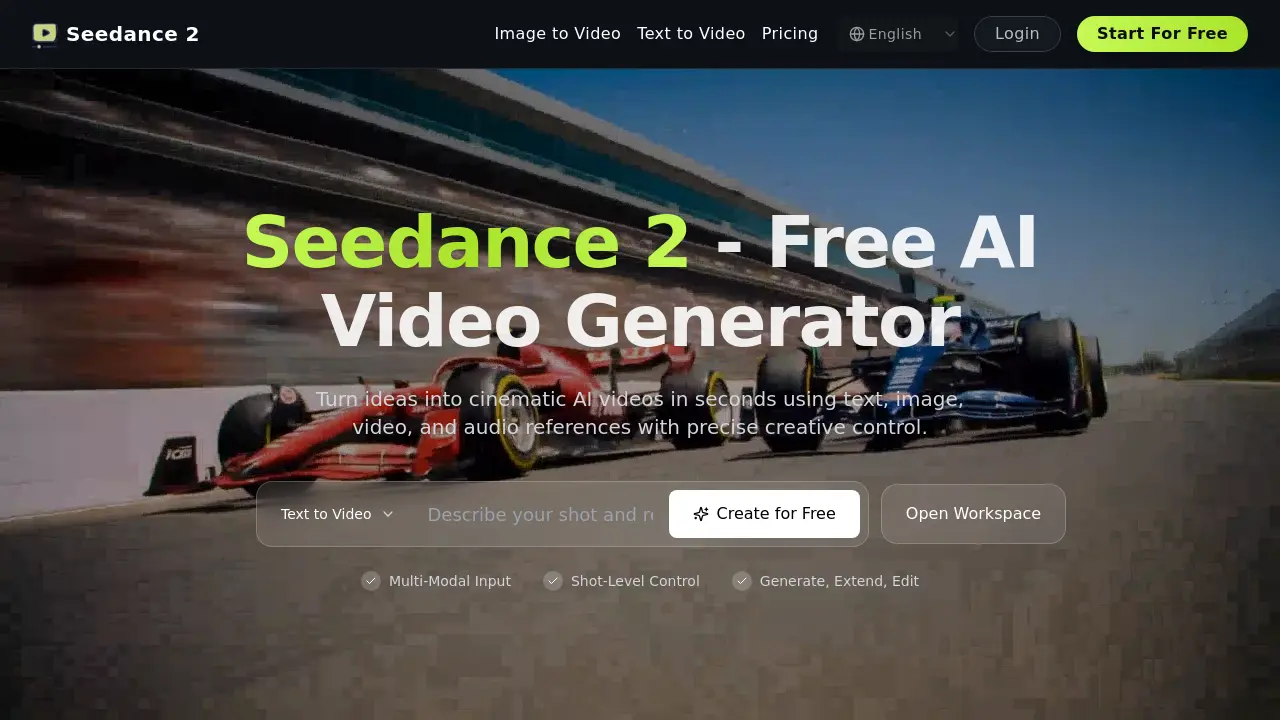
Seedance 2 is a multi-modal AI video generator designed for production-focused content creation. It accepts text, images, video, and audio inputs with explicit role assignments (@references) to maintain creative intent and reduce output drift. Key capabilities include high-fidelity image guidance for stable composition, video motion transfer for replicating camera movement, and native audio-driven generation for rhythm alignment. The tool supports extending existing clips and performing targeted edits without full regeneration, which streamlines iteration for teams. Character and scene consistency are managed across sequences, aiding multi-shot storytelling. Compared to competitors like Veo 3, Seedance 2 emphasizes a reference-first workflow for faster setup and more predictable short-form output. Pricing is tiered based on annual credit packs, offering commercial licenses and access to multiple AI models. The platform targets creators needing efficient, controllable video production for social media, marketing, and narrative projects.
How does Seedance 2 work
Seedance 2 operates as a reference-first AI video generator, employing a structured multi-modal input system where text, images, video, and audio assets are assigned explicit roles using @symbols. This methodology clarifies creative intent, enhancing instruction adherence and minimizing content drift. The engine utilizes reference images for compositional fidelity, transfers camera motion from source videos, and synchronizes timing with audio inputs. It supports extending existing clips by generating only new segments and facilitates targeted edits—such as subject swaps—without full regeneration. These functions provide shot-level control, maintain character consistency across scenes, and produce short, production-ready videos optimized for rapid iteration in professional workflows.
Benefits of Seedance 2
Seedance 2 is a multi-modal AI video generator that supports text, image, video, and audio inputs for creating cinematic content with precise creative control. Its reference-first prompting system uses @ roles to assign assets explicitly, reducing drift and ensuring shot consistency. Users can generate new videos, extend existing clips, and apply targeted edits without full regeneration, enhancing workflow efficiency. Features like high-fidelity image guidance, video motion transfer, and audio-driven generation maintain character identity, camera movement, and rhythmic alignment, making it suitable for production teams requiring reliable and controllable AI video tools.
Pros and Cons of Seedance 2
Pros
- Multi-modal input support enables versatile video creation.
- Reference-first control enhances consistency and creative intent.
- Allows video extension and targeted edits without full regeneration.
- Competitive pricing tiers with annual discounts available.
- User testimonials confirm improved workflow efficiency.
Cons
- Output duration limited to 4-15 seconds per generation.
- Input file caps restrict complex multi-modal projects.
- Reference asset preparation increases initial setup overhead.
- Subscription costs may not suit low-volume or casual users.
- Evolving capabilities could require workflow adjustments.
Core Features of Seedance 2
Reference-First Multimodal Control
Assigns text, image, video, and audio assets with explicit @ roles to maintain creative intent, improve instruction adherence, and reduce unpredictable drift in complex video shots.
High-Fidelity Image Guidance
Uses reference images to lock composition and character details, ensuring stable faces, wardrobe, and branded objects across generated shots for consistent visual output.
Video Motion Transfer
Replicates camera movement and pacing from source video references, enabling complex motion patterns without manually scripting every individual motion cue for dynamic sequences.
Native Audio-Driven Video Generation
Attaches audio references to guide video timing and mood, aligning motion rhythm with soundtrack intent for cohesive short-form narrative and music-driven content.
Character and Scene Consistency
Preserves subject identity through scene changes using prompt roles and references, reducing rework and maintaining continuity in multi-shot storytelling projects.
Extend Existing Video Clips
Generates only new segments to continue a source video, preserving narrative flow while providing editors flexible control over runtime extension without full regeneration.
Edit Videos Without Full Regeneration
Applies targeted modifications like subject swaps or local scene adjustments to existing videos, allowing faster iteration cycles without discarding previous draft outputs.
Use Cases of Seedance 2
- Music Producers: Generate beat-synced videos by attaching MP3 references to guide motion timing and mood.
- Social Media Managers: Produce multiple ad variants rapidly using multi-modal inputs for consistent branding.
- Filmmakers: Extend existing clips seamlessly without full regeneration to maintain narrative flow.
- Influencers: Ensure character and style consistency across multi-shot stories using reference images.
- Marketing Teams: Apply targeted edits like subject swaps to iterate campaign videos efficiently.
FAQs of Seedance 2
What is Seedance 2 AI video generator?
Seedance 2 is a multi-modal AI video generator designed to create cinematic videos from various inputs, including text, images, video, and audio. It enables precise creative control for generating, extending, and editing videos, with a reference-first approach that prioritizes predictable and consistent outputs suitable for production workflows.
What inputs does Seedance 2 support?
Seedance 2 supports natural language text prompts, reference images, reference videos, and MP3 audio files as inputs. This multi-modal capability allows users to combine different media types—such as using an image for composition, a video for motion, and text for scene description—to guide the AI with richer, more explicit instructions.
How do @ references work in Seedance 2?
Users incorporate @ references in their text prompts to assign specific roles to uploaded assets, such as @first_frame for initial composition, @camera_reference for camera movement, @motion_reference for action pacing, and @audio_ for soundtrack guidance. This structured method clarifies creative intent and helps the AI follow complex instructions more reliably.
What are the current video input limits?
The system permits up to 9 reference images, up to 3 reference videos with a combined duration of 15 seconds, and up to 3 MP3 files with a combined duration of 15 seconds. When mixing input types, the total number of files is capped at 12 to maintain processing efficiency and optimal generation performance.
How does Seedance 2 maintain character consistency in multi-shot videos?
Seedance 2 uses prompt roles and persistent reference assets to lock subject identity across scene transitions. By assigning specific references for characters or key objects, the AI preserves visual details like wardrobe, facial features, and branded elements throughout multiple shots, reducing rework for narrative or campaign-based video series.
How does video motion transfer simplify camera movement replication?
Video motion transfer allows users to upload reference clips that define camera language, movement patterns, and pacing. The AI then replicates these complex motions in generated footage without requiring manual scripting of every cue. This enables precise control over cinematic techniques like panning, zooming, or tracking shots directly from source material.
How does Seedance 2 synchronize video with reference audio?
Through native audio-driven generation, Seedance 2 aligns generated video motion with the rhythm, beat, and mood of attached MP3 reference tracks. This synchronization ensures that visual actions—such as cuts, transitions, or character movements—match the audio timing, creating cohesive audiovisual experiences for music videos, ads, or narrative content.
Can I extend an existing video clip?
Yes, Seedance 2 supports video extension by generating only the additional segment needed. Users specify the desired extra duration, and the AI continues the clip while maintaining the original's visual style, motion, and continuity. This feature allows for flexible runtime expansion without regenerating the entire video, streamlining post-production.
Can I edit an existing video instead of regenerating everything?
Seedance 2 enables targeted edits on existing videos, such as swapping subjects, modifying local scenes, or adjusting specific elements. This avoids full regeneration, allowing faster iterations. For example, a creator can change a background or character attribute while keeping the rest of the video intact, which is efficient for refining drafts.
Does Seedance 2 generate audio?
Generated videos can include sound effects and music. Additionally, users can attach reference audio files to guide the style, tone, and timing of the soundtrack. This native audio integration helps align the video's mood and pacing with the intended auditory elements, enhancing the overall production quality.
What output video duration is supported?
Each generation run produces videos with durations between 4 and 15 seconds. This range is optimized for short-form content like social media clips, promotional videos, and music visualizers. Longer sequences can be built by concatenating multiple outputs or using the extension feature to add segments incrementally.
What improved in Seedance 2.0?
Seedance 2.0 significantly enhances motion stability, reference fidelity, instruction following, and creative control. These improvements result in more consistent character appearances, smoother transitions, better adherence to prompts, and overall higher realism, making outputs more reliable for professional and creative projects compared to earlier versions.
What are the credit requirements for generating a video with Seedance 2?
Credit consumption depends on video length, resolution, and complexity. Pricing plans allocate annual credits—for instance, the Starter plan provides 3600 credits for up to 30 videos monthly, implying roughly 10 credits per standard 10-second generation. Higher plans offer more credits at lower per-credit costs, and extensions or edits typically use fewer credits than full generations.
How does Seedance 2 compare to Veo 3, Sora 2, and Kling 3?
Seedance 2 distinguishes itself with a reference-first workflow for faster setup and stable consistency in short sequences. It excels at targeted edits and video extensions, making it ideal for campaign variants and rapid iteration. While Veo 3 prioritizes cinematic realism and may need more tuning for brand continuity, Seedance 2 offers better control for production teams using mixed input types and requires less pipeline integration for editing.
How to use Seedance 2
Seedance 2 is an AI video generator that employs a reference-first, multi-modal approach to produce cinematic videos with shot-level control, enabling creation, extension, and targeted editing from diverse inputs.
- Begin by accessing the Seedance 2 workspace and selecting the appropriate model for text-to-video, image-to-video, or multi-modal generation based on available reference assets.
- Gather reference assets including descriptive text prompts, images, short video clips, and audio files, respecting upload limits of 12 total files with specific duration caps.
- In the prompt field, employ @ role assignments for each asset, such as @first_frame for composition or @motion_reference to dictate camera movement and pacing.
- Set the desired output duration between 4 and 15 seconds and configure motion or style parameters before submitting the composite prompt for AI generation.
- Upon completion, review the generated video clip, checking for reference accuracy, motion consistency, character stability, and audio-visual synchronization if audio was provided.
- To improve, use the edit function for localized changes such as subject replacement, or extend the clip by appending new generated segments without restarting.
- Iterate by refining prompts or reference assets based on review insights, then regenerate to progressively achieve the intended cinematic quality and narrative flow.
- Export final videos with commercial usage rights, suitable for social media content, advertising campaigns, or short-form storytelling, leveraging the reference-first workflow efficiency.
