
Fermi: AI Operational Brain that unifies enterprise systems

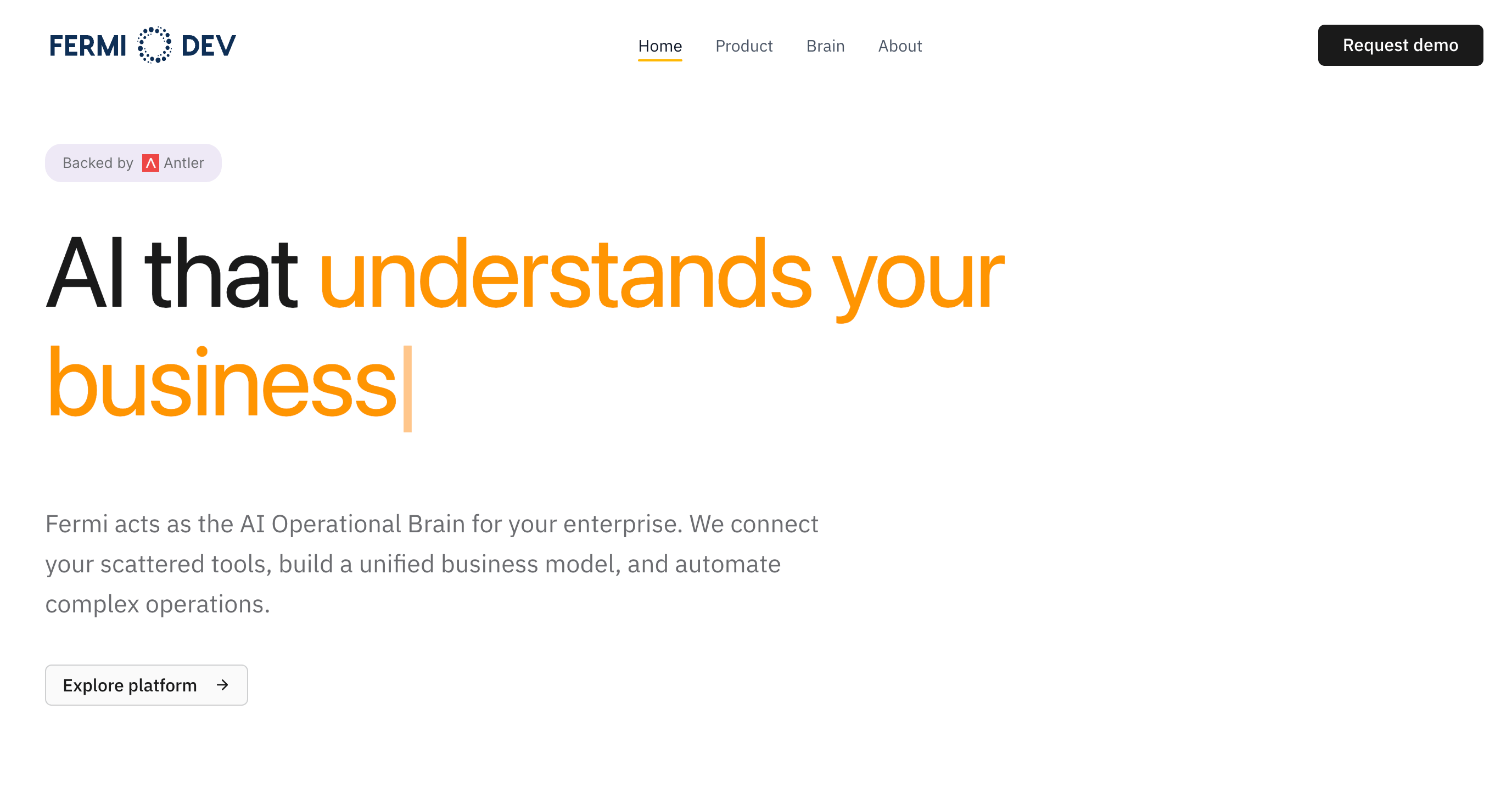
What is Fermi
Fermi operates as a unified operational brain that maps every entity, relationship, and workflow within an enterprise into a single intelligent network. By integrating data across all systems in real time, it delivers deep contextual understanding and predictive insights that drive automated decision‑making. Users can query the platform in natural language, receiving instant, data‑driven responses that cover sales performance, churn rates, and more. The platform’s three‑pillar architecture—The Brain, The Conductor, and The Agents—enables safe change management, adaptive simulations, and 24/7 AI agent execution. Named after Enrico Fermi, the solution echoes concepts such as fermi energy and fermi level in its data‑centric design, while the breadth of its capabilities reflects the reach of fermi surface modeling. With self‑onboarding in hours and measurable reductions in operational cost, Fermi delivers a scalable, AI‑powered foundation for modern enterprises.
How does Fermi work
Fermi AI functions as an AI operational brain that unifies dispersed enterprise tools into a single living neural network. It maps entities, relationships, roles, and workflows, enabling natural‑language queries that pull real‑time data from all connected systems. The platform learns continuously, adapting to shifts and spotting new patterns, while AI agents execute routine tasks 24/7 using shared context. A simulate‑approve‑apply change‑management conduit safeguards rollouts, and self‑onboarding brings the system online within hours. This architecture delivers immediate clarity and automation across business operations, positioning Fermi as a practical AI assistant for modern enterprises.
Benefits of Fermi
Fermi functions as an AI operational brain that unifies disparate enterprise tools into a single intelligent system. By mapping entities, relationships, and workflows, it delivers real‑time learning, contextual understanding, and predictive recommendations. The platform’s self‑onboarding lets businesses connect systems, configure policies, and deploy AI agents within hours instead of months. Agents execute tasks 24/7, reducing operational costs by up to 60 % and boosting throughput by 35 %. With safe change‑management workflows and a unified view of all operations, Fermi transforms coordination and decision‑making for modern enterprises.
Pros and Cons of Fermi
Pros
- Unifies disparate tools into one operational brain.
- Provides real‑time learning and AI predictions.
- Instantly answers queries using real systems.
- Enables self‑onboarding in hours, not months.
- Reduces operational costs by up to 60%.
Cons
- No drawbacks identified.
- No limitations noted.
- No cons mentioned.
Core Features of Fermi
Unified Operational Brain
Fermi provides a unified operational model that maps an enterprise's entities, relationships, policies, and goals, enabling holistic context understanding across departments and improving decision making enterprise-wide.
AI Assistant with Natural Language Queries
Fermi's AI assistant delivers instant, clear answers by interpreting natural language questions, remembering conversation history, and extracting real-time insights from all connected business systems without manual setup.
Real‑Time Learning and Intelligent Predictions
Fermi continuously adapts to operational changes, discovers emerging patterns, and anticipates needs, providing actionable recommendations that optimize processes and drive measurable performance gains.
Conductor: Safe Change Management Workflow
Fermi's Conductor simulates proposed changes, applies AI‑driven rules, and requires approval before execution, ensuring safe deployment of new policies and processes with minimal risk.
AI Agents for Autonomous Execution
Fermi deploys pre‑built or custom agents that share context, execute tasks 24/7, and scale operations, reducing costs and increasing throughput across order processing, support, invoicing, and approvals.
Rapid Self‑Onboarding
Fermi maps business goals, connects systems, configures policies, and activates agents within hours, enabling enterprises to achieve operational visibility and automation without the traditional months of implementation.
Use Cases of Fermi
- Enterprise CFO: Leverage Fermi AI’s real‑time data analysis to forecast sales trends and reduce forecast lag.
- Operations Manager: Automate order processing with Fermi’s AI agents, self‑onboarding in hours reduces cycle time by 25%.
- Data Analyst: Use Fermi AI Assistant to query inter‑departmental data, producing insights faster than traditional SQL queries.
- Finance Director: Simulate budget changes through Fermi Conductor’s AI‑driven workflow, approving adjustments safely before live rollout.
- Customer Success Lead: Deploy Fermi AI Agents for ticket triage, cutting response time by 40% and improving satisfaction.
FAQs of Fermi
What is Fermi and what are its main capabilities?
Fermi is an AI‑driven operational brain that captures all enterprise data, models entities and their relationships, and autonomously predicts and recommends actions. It connects disparate tools, learns from real‑time inputs, and exposes a unified view through natural‑language queries. The platform’s architecture allows scaling from a few dozen nodes to thousands, with automated workflow design and execution driven by intelligent agents.
How does Fermi integrate with existing business systems?
Fermi uses a modular integration layer that supports standard APIs, webhooks, and direct database connections. During onboarding, connectors map data fields to the unified model, preserving data integrity and security. The system automatically detects overlapping entities across sources, resolves conflicts, and updates the operational graph in real time. This integration ensures consistency without requiring custom code for each tool.
What is the onboarding process for a new company using Fermi?
Self‑onboarding begins with a quick configuration wizard that imports business goals, maps key systems, and defines policies. The platform performs data extraction, entity resolution, and automatic graph construction in hours. Users can validate and adjust models through an intuitive visual editor, after which AI agents are provisioned. Continuous learning cycles refine the model as new data arrives, enabling rapid operational readiness.
How do the AI agents in Fermi execute operational tasks?
Fermi’s agent layer comprises pre‑built workflows for common functions—order processing, customer support, invoice handling—and a no‑code builder for custom scenarios. Agents share context from the unified graph, allowing them to access cross‑department data. Each task is evaluated against policy rules; if approved, the agent triggers the necessary system calls via secured APIs. Agents run continuously and can be scaled on demand, paying only for executed operations.
What monitoring and change‑management features does Fermi provide?
Fermi’s Conductor module enables simulated changes through a “Simulate > Approve > Apply” pipeline. Before deployments, the system runs predictive models to assess impact, providing confidence scores and risk flags. Post‑deployment, dashboards track key metrics—task throughput, error rates, and SLA adherence—in real time. Auditable logs record every agent action, ensuring compliance and traceability across the organization.
How to use Fermi
Begin by accessing the Fermi dashboard, logging in, and opening the self‑onboarding interface that maps your company’s objectives and existing tools.
During onboarding, the panel displays the菲尔米诺 integration graph, illustrating connections between departments and highlighting the system’s fermi level of data flow.
Connect each enterprise tool by selecting the appropriate adapter; the wizard verifies authentication and establishes a two‑way sync, matching the fermi surface of business processes.
Next, define company policies within the Policy Configurator, using declarative rules that mirror the fermi golden rule to predict task transition probabilities.
Deploy the pre‑built agent library or construct custom agents through the Agent Builder; treat each agent as a fermion, ensuring unique state allocation across workflows.
Use the “Conductor” to simulate changes: run Simulate, review the projection, approve, then apply the update safely across the unified model.
Engage the live AI Assistant by entering natural language queries; the assistant retrieves real‑time analytics from all connected sources and answers with contextual clarity.
Visualize results on the analytics dashboard; observe key metrics such as revenue, churn, and throughput, then interpret them through fermi energy analogies to assess system load.
Address potential data gaps—the fermi paradox of missing entries—by running completeness checks; the system flags anomalies and suggests remediation tasks for agents.
Leverage the insights to refine business strategies; schedule quarterly reviews with the AI Assistant, then implement automated optimizations through the Conductor or new agents.
Fermi Website Traffic Analysis
Latest traffic information
- Monthly Visits1.41K
- Bounce Rate36.11%
- Pages Per Visit1.04
- Visit Duration00:00:00
- Global Rank12.5M
- Country/Region Ranking819.04K
Visits Over Time
Top Keywords
| Keyword | Traffic | Volume | Cost Per Click |
|---|---|---|---|
| fermi | 10 | 17.12K | $0.95 |
| fermi ai | 10 | 2.76K | $0.39 |
| fermi company | -- | 570 | $1.89 |
| fermi logo | -- | 30 | -- |
Top Regions
| Region | Percentage |
|---|---|
| India | 100% |
