
Defapi Introduction
Defapi provides a cost-effective AI API gateway, offering unified access to models from OpenAI, Anthropic, and Google with intelligent routing and enterprise security.

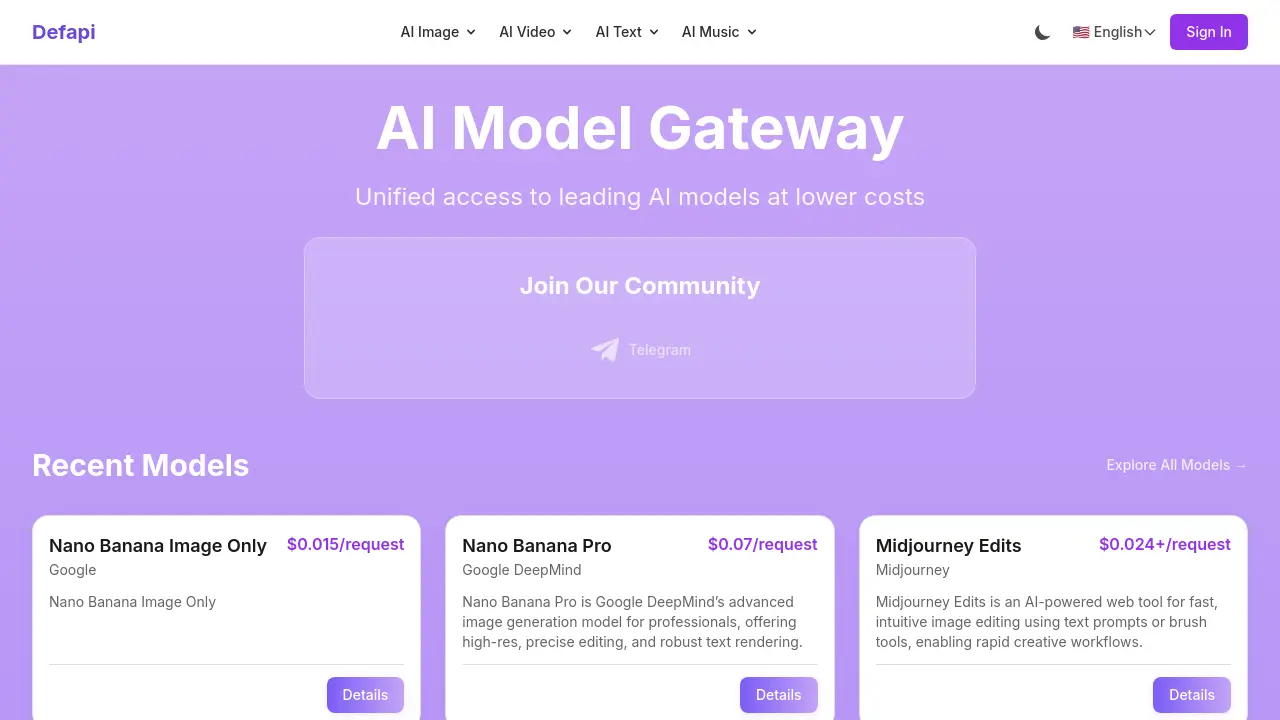
What is Defapi
Defapi is an AI model API aggregation platform providing unified access to various leading AI models, including those for image, video, text, and music. It simplifies AI integration for developers by offering a single API endpoint to access models from providers such as OpenAI, Google, and Anthropic. The platform features cost optimization, real-time monitoring, and enterprise-grade security. Defapi supports large language models, vision AI, audio AI, and specialized APIs, streamlining the development of AI-powered applications.
How does Defapi work
Defapi serves as a def api gateway that aggregates models from OpenAI, Anthropic, and Google. Users register, obtain an API key, and send tokenized requests through a single endpoint, while the system’s intelligent routing selects the most cost‑effective model. The service offers real‑time usage metrics, enterprise‑grade security, multi‑region deployment, and SDKs plus documentation for developers. Supporting LLM, vision, and audio models, Defapi enables streamlined integration and pay‑per‑use billing across multiple AI providers. By consolidating vendor APIs, Defapi shortens development cycles and improves cost visibility.
Benefits of Defapi
Defapi is a unified AI model API platform that aggregates leading providers such as OpenAI, Anthropic, and Google, giving developers a single interface to access LLM, vision, audio, and specialized models. The platform offers cost‑optimizing routing, enterprise‑grade security, real‑time usage monitoring, and global multi‑region deployment. Comprehensive SDKs and documentation simplify integration, while transparent pay‑per‑use pricing ensures you only pay for what you consume. Defapi’s one‑stop access reduces integration time and lowers overall AI spend for startups, enterprises, and individual developers.
Pros and Cons of Defapi
Pros
- Unified access to multiple AI models.
- Automatic cost‑optimization routing.
- Enterprise‑grade security and compliance.
- Real‑time usage monitoring dashboards.
- Developer‑friendly SDKs and documentation.
Cons
- No free tier disclosed.
- Limited niche model support.
- Requires account registration.
- No on‑prem deployment.
- Support limited to API calls.
