
Tenderbolt Introduction
Tenderbolt uses AI to automate RFP and tender responses. It analyzes documents, completes security questionnaires, and generates tailored proposals.

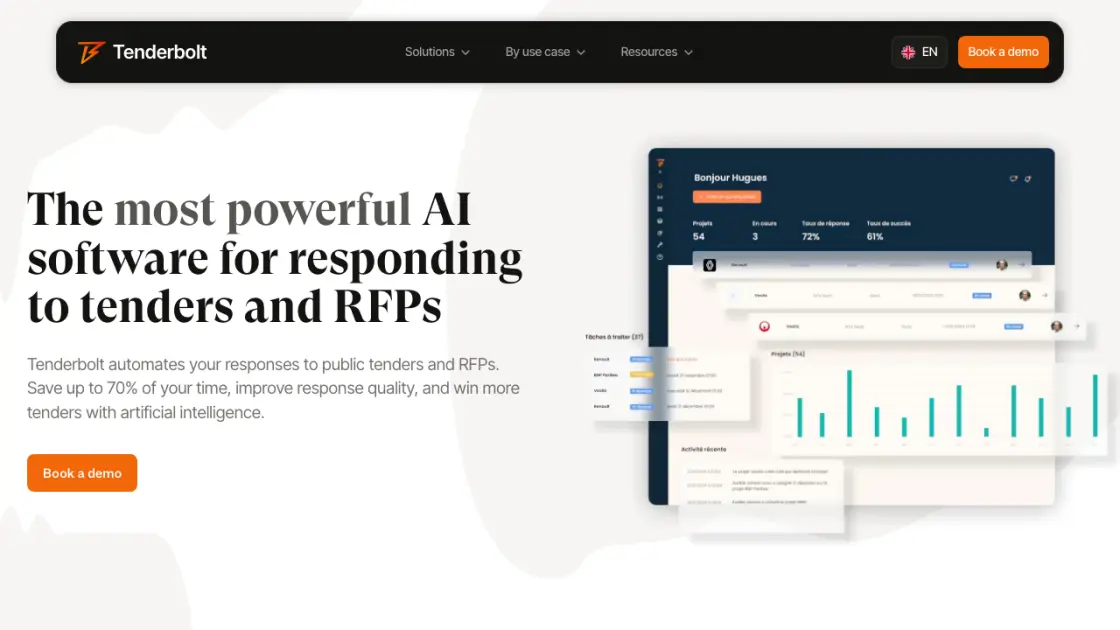
What is Tenderbolt
Tenderbolt is an AI-powered platform designed to streamline how businesses respond to tenders, RFPs, RFIs, and security questionnaires. Instead of spending hours reading lengthy procurement documents and manually drafting responses, teams upload their documents and let Tenderbolt's AI handle the heavy lifting. The platform analyzes requirements, extracts evaluation criteria, generates first-draft answers from a company's own knowledge base, and manages the entire review workflow. It serves presales engineers, bid managers, and sales teams who deal with recurring volumes of competitive proposals. Tenderbolt integrates with existing tools like SharePoint, CRM, and Google Drive, and its AI is trained specifically on procurement and RFP content rather than general web data. The result is faster response times, more consistent proposal quality, and higher win rates for organizations that rely on winning contracts through competitive bidding.
How does Tenderbolt work
Tenderbolt uses a Retrieval-Augmented Generation architecture combined with fine-tuned AI models trained on thousands of tender and RFP documents. When a user uploads a new tender, the system first analyzes all attached documents, extracting requirements, deadlines, evaluation criteria, and risks into a structured Go/No-Go summary. For questionnaire-style RFPs, the AI retrieves relevant content from the organization's knowledge base and generates draft responses with source citations. Domain experts then review and validate the AI-generated content through built-in collaboration workflows before final submission. The knowledge base updates automatically as new proposals and reference documents are added, while machine learning algorithms track source freshness and flag potentially outdated information.
Benefits of Tenderbolt
Tenderbolt reduces the time spent on each RFP by up to 70 percent, letting bid teams focus on strategy rather than administrative work. Its AI draws exclusively from the organization's own knowledge base, so every claim in a proposal is traceable to a verified source. The platform enforces consistency across team members, eliminating the variability that comes from different contributors drafting sections independently. European hosting, SOC 2 certification, and AES-256 encryption ensure data security for organizations with strict compliance requirements. Teams report an average of 34 hours saved per RFP and a 25 percent improvement in win rates after adopting the platform.
Pros and Cons of Tenderbolt
Pros
- Automates document analysis and response drafting
- Responses traceable to verified source documents
- Reduces RFP response time by up to 70 percent
- European hosting with SOC 2 certification
- Integrates with SharePoint, CRM, and Google Drive
Cons
- Limited to French and English language support
- Requires initial knowledge base setup effort
- Pricing not publicly listed on website
