
NanoWow AI FAQs
NanoWow AI offers AI‑powered photo editing, background removal, and text‑to‑image generation, allowing e‑commerce sellers to produce product visuals in seconds.

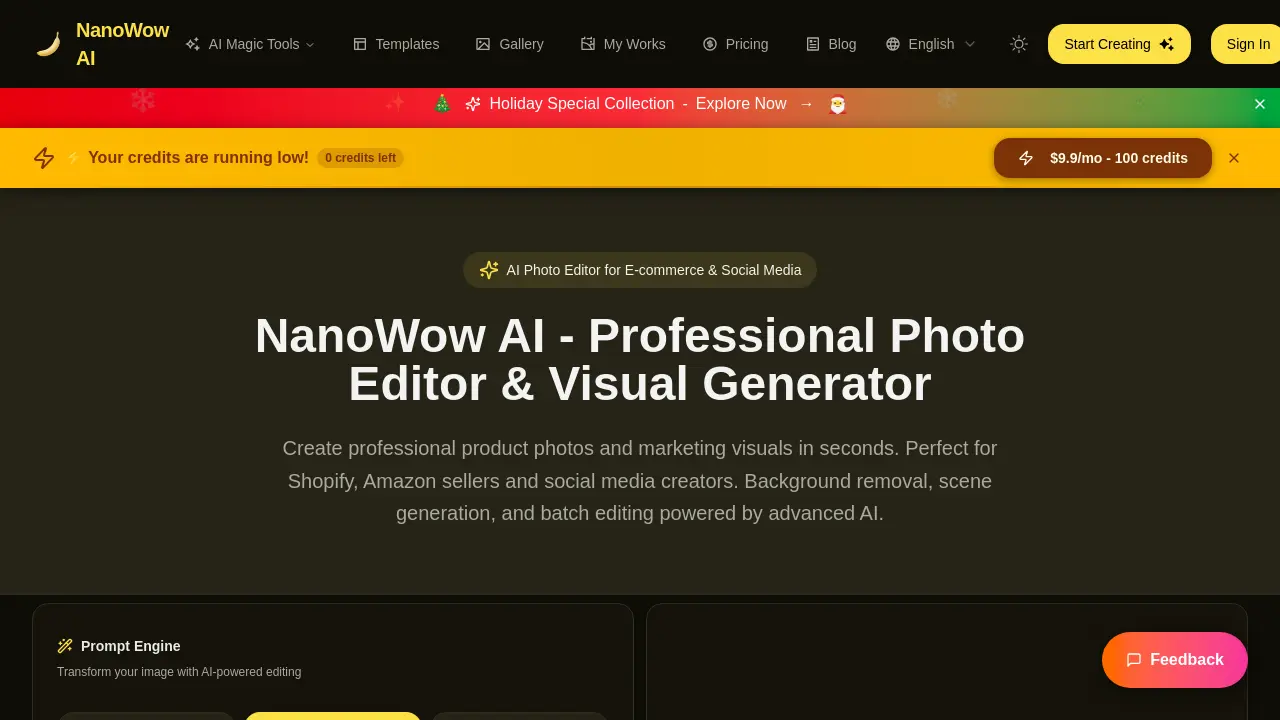
FAQs of NanoWow AI
What is NanoWow AI and how does it differ from other AI tools?
NanoWow AI is a professional photo‑editing platform that specialises in e‑commerce and social‑media visuals. Unlike generic AI generators, it provides background removal, scene generation, and multi‑image composites tailored for Amazon, Shopify, and Instagram. The tool leverages Gemini 3.0 Pro for high‑resolution 2K/4K output and consistent style across batches, ensuring uniform branding for merchants.
How does NanoWow AI relate to Nano Banana Pro and NanoBanana2?
NanoBanana2 is the underlying product line of which NanoWow AI is a re‑brand focused on visual creation for marketing and commerce. Nano Banana Pro is the enterprise version that powers NanoWow AI; it uses the same Gemini 3.0 Pro model but offers additional technical integrations. The relationship is essentially a branding and feature extension rather than a separate product.
What is the difference between subscriptions and credit packs?
Subscriptions grant you a set number of credits each billing cycle, with auto‑renewal and flexible plans (Starter, Professional, Maximum). Credit packs can be purchased individually without a subscription, offering the same credits without recurring billing. Subscriptions usually include customer support and priority queues, while credit packs do not.
Do unused credits carry over to the next month?
No. Credit allocations reset each billing period for subscription plans. Unused credits expire at the end of the month and are not transferable to the next cycle. Credit packs also do not roll over beyond the purchase date.
Can I upgrade or downgrade my plan at any time?
Yes, you can change to a higher or lower subscription tier at any point. Switching to a lower tier will stop automatic renewal for that plan, while moving to a higher tier immediately applies the new rate and credit amount. Downgrades do not refund unused credits.
What payment methods are accepted by NanoWow AI?
NanoWow AI accepts major credit and debit cards (Visa, MasterCard, American Express) and PayPal. Subscription fees are charged automatically through the chosen payment processor, and invoices are emailed after each transaction.
Is there a free trial available for NanoWow AI?
At present, NanoWow AI does not offer a subscription‑free trial. However, new users can receive a limited amount of free credits upon signup to test the platform before committing to a paid plan.
What happens if I cancel my subscription?
Cancelling stops future automatic renewals and removes access to premium features immediately. Credits already purchased remain usable until they expire. There is no partial refund for unused periods.
How many credits does each generation use in NanoWow AI?
Credit consumption depends on tool and image size. For example, a 1024 × 1024 image in the image editing mode costs 5 credits, while larger 4K images may use up to 20 credits. Batch jobs calculate credits per image.
Do you offer refunds for NanoWow AI?
Refunds are not available for credit purchases or subscription fees. All sales are final. If you encounter a technical issue, support can assist with troubleshooting or credit adjustments.
What file types and sizes can I upload to NanoWow AI?
You may upload images up to 50 MB and supported formats include JPEG, PNG, and WebP. For best results, use high‑resolution source files. The platform can resize images to 4K for output, preserving detail and quality.
Can NanoWow AI be integrated with Shopify or Amazon listing tools?
Yes, NanoWow AI offers API endpoints and export presets for major marketplaces. Users can download product images in the exact dimensions required by Amazon, eBay, or Shopify, and manage them directly through the platform.
Does NanoWow AI support batch processing for multiple products?
The tool allows batch editing of up to nine images simultaneously through the Multi‑Blend mode. Batch jobs are queued and processed within the same 15‑30 second turnaround per image, enabling rapid scaling of visual assets.
How does NanoWow AI handle text and graphics rendering in images?
NanoWow AI uses Gemini 3.0 Pro’s advanced text rendering capabilities to generate sharp, legible typography, including Asian characters, charts, and infographics. This feature is especially useful for promotional banners and product labels where clarity is essential.
How to use NanoWow AI
- NanoWow AI serves as a professional AI photo editor and visual generator for e‑commerce and social media creators, automating background removal, scene composition, and batch enhancement.
- Users initiate a project by selecting the desired magic mode—Text‑to‑Image, Image Editing, or Multi‑Blend—through the main dashboard’s dropdown near the top.
- After mode selection, upload a reference image up to 50 MB, then enter a descriptive prompt in the Main Prompt field beneath the upload box.
- Click the “Generate Now” button; the system calculates the required credits—typically 5 for 1024×1024 outputs—then processes the request in 15‑30 seconds.
- The resultant image appears in the preview pane; optional overlays include predefined templates such as Christmas Background or Product Photo accessible via the template gallery, often referenced in nanoworld projects.
- Users can refine the output by adjusting the prompt, re‑uploading a different reference, or applying a new template, then regenerating until the desired composition is achieved.
- Interpreting results involves checking the image’s resolution—2K/4K PNG—color accuracy, and alignment with marketing assets, ensuring consistency across product listings for.
- Successful images are downloaded via the high‑resolution button; credits are deducted automatically, and users receive an update in the credit counter displayed beside the Generate button.
- For bulk workflows, the Multi‑Blend mode accepts up to nine reference images; users can merge and blend them into a composite through the interface’s drag‑and‑drop area.
