
WebPageSnap is a professional web scraper API.

What is WebPageSnap
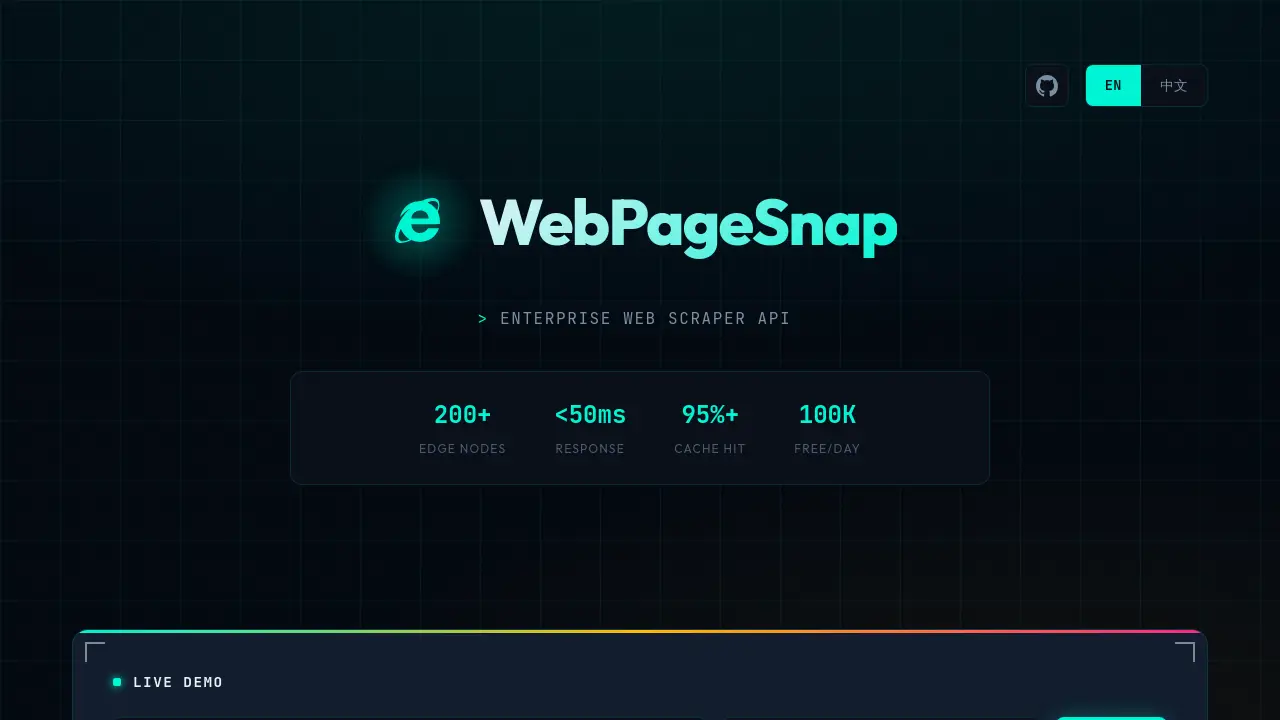
WebPageSnap is an enterprise-grade web scraper API for programmatic content extraction. It provides structured JSON output or raw HTML from web pages, automatically following JavaScript redirects to capture final page content. The API uses a global network of over 200 edge nodes for fast responses, typically under 50ms. A smart caching system with a 95%+ hit rate and 7-day TTL optimizes performance and enhances quota efficiency. Ideal for developers building content aggregation or link preview services, it includes robust anti-bot bypass capabilities and browser simulation.
How does WebPageSnap work
WebPageSnap provides a high-performance web scraping API engineered for fast webpage snapshot generation. The system operates by issuing an HTTP GET request to its REST API endpoint, which accepts a target URL and an output format parameter. Upon receiving a request, the API uses an intelligent caching layer with a seven-day TTL to serve cached webpage snapshots, aiming for a 95% cache hit rate and sub-50ms responses. For new or bypassed requests, it employs realistic browser simulation on a network of over 200 global edge nodes to fetch content, bypass anti-bot mechanisms, and provide the resulting snapshot in either structured JSON or raw HTML format.
Benefits of WebPageSnap
WebPageSnap is an enterprise-grade web scraper API designed for efficient webpage snapshot retrieval. Its global network of 200+ edge nodes ensures rapid responses of approximately 50ms. A key benefit is its intelligent caching system, which provides a 95%+ hit rate and a 7-day TTL to maximize efficiency. The API delivers webpage data in either JSON or HTML formats and intelligently manages content, with automatic handling of JavaScript redirects and anti-bot bypass. Operating a generous free tier of 100,000 requests per day, the service supports both structured data extraction and raw HTML retrieval for various applications.
Pros and Cons of WebPageSnap
Pros
- Uses a global CDN with 200+ edge nodes.
- Provides sub-50ms response times for cached content.
- Offers a generous free tier of 100,000 requests daily.
- Extracts a wide range of metadata, including Open Graph tags.
- Bypasses anti-bot measures with realistic browser simulation.
Cons
- Cache time-to-live is limited to seven days.
- Lacks pricing details for scaling beyond the free tier.
- Forces cache refresh with a simple boolean parameter.
- No information provided regarding limitations on request rates.
- May not handle highly interactive, app-like websites.
Core Features of WebPageSnap
Smart Cache
KV storage system with a 7-day TTL and 95%+ hit rate, providing quick access to frequently requested webpage snapshots.
Global Edge Network
Leverages 200+ edge nodes distributed worldwide to deliver fast webpage scraping responses, typically under 50ms.
Multi-Format Output
Supports JSON structured data or raw HTML output formats, allowing extraction of metadata and content.
Smart Redirect
Automatically detects and follows JavaScript redirects, ensuring the final page content is captured accurately.
Anti-Bot Bypass
Employs realistic browser simulation techniques to access content on websites protected by anti-bot measures.
Use Cases of WebPageSnap
- Developers: Automate webpage snapshot archival and content extraction for research by integrating the REST API to fetch and scrape web pages.
- Researchers: Collect webpage snapshots and metadata for academic studies by programmatically retrieving content from targeted URLs.
- Businesses: Monitor competitor website content changes and login page updates with automated web scraping and snapshot capture.
FAQs of WebPageSnap
What is WebPageSnap?
WebPageSnap is an enterprise-grade web scraper API service designed to programmatically extract content from websites. It offers structured data extraction capabilities, providing users with a reliable tool for integrating web scraping into their applications.
How does this API handle JavaScript-heavy pages?
The WebPageSnap scraper API automatically detects and follows JavaScript redirects to ensure users receive the final rendered page content. It employs realistic browser simulation to bypass anti-bot measures and capture content from even the most complex JavaScript-heavy websites effectively.
What are the free usage limits for this web scraping service?
WebPageSnap offers a generous free tier with 100,000 requests per day, making it highly accessible for both personal and commercial projects. This substantial daily quota is supported by an intelligent caching system that maximizes efficiency.
What output formats does WebPageSnap support?
WebPageSnap supports two primary output formats: JSON for structured data extraction, and HTML for raw page content. The JSON format conveniently includes extracted metadata such as page titles, descriptions, Open Graph tags, and Twitter card information alongside the body content.
How fast can I expect responses from WebPageSnap?
The service typically provides responses in under 50 milliseconds for content stored in its cache. This performance is achieved through Cloudflare's global edge network, which consists of over 200 nodes distributed worldwide to minimize latency regardless of geographic location.
Does WebPageSnap automatically extract webpage metadata?
Yes, the WebPageSnap API automatically extracts comprehensive metadata from every scraped page, including titles, meta descriptions, keywords, author information, Open Graph tags, Twitter cards, and canonical URLs. This makes it particularly suitable for applications requiring link previews or content aggregation features.
Can businesses use WebPageSnap for commercial applications?
WebPageSnap is designed to support both personal and commercial projects, offering enterprise-grade reliability suitable for production environments. The service includes robust infrastructure with global CDN distribution and intelligent caching mechanisms to ensure consistent performance.
What is the Smart Cache feature?
WebPageSnap's Smart Cache utilizes key-value storage with a 7-day time-to-live (TTL) and achieves a cache hit rate exceeding 95%. This intelligent system optimizes performance by serving frequently accessed content from cache, significantly improving response times and reducing load on target websites.
Are there any additional parameters I can use with the API?
The WebPageSnap API supports several optional parameters, including the format parameter for choosing between JSON and HTML output, and the nocache boolean flag that allows you to bypass the cache and force a fresh fetch from the target webpage when necessary.
How to use WebPageSnap
- Construct an API request by sending a GET request to
https://webpagesnap.com/api/scrape. - Append the target website's URL using the
urlparameter, ensuring it is properly URL-encoded. - Specify the desired output format with the
formatparameter, choosing eitherjsonfor structured data orhtmlfor raw content. - Optionally, add
&nocache=trueto the request to bypass the cache and force a fresh fetch of the webpage content. - Submit the request and receive a response; the
jsonformat returns structured metadata and the HTML body. - Parse the generated JSON to extract SEO data like page titles, Open Graph tags, meta descriptions, and canonical URLs.
- Use the retrieved HTML content for further website analysis or content processing within your application.
