
UNI-1 AI: Unified reasoning for stunning 4K images
| Added on: | Mar 13, 2026 |
| Monthly Visits: | 797 |
| Social & Email: | -- |

What is UNI-1
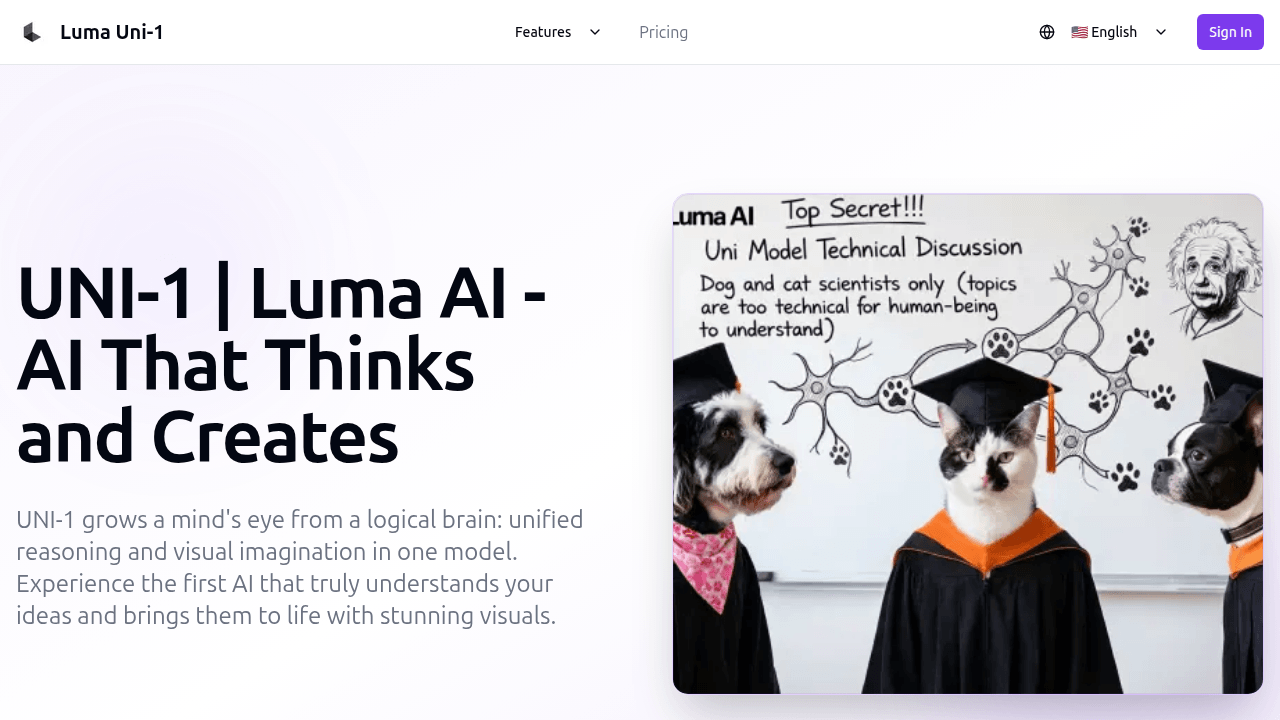
UNI-1 by Luma AI is a unified multimodal model that integrates logical reasoning with visual imagination. Unlike traditional AI image generators, this system reasons through a prompt to understand spatial relationships, composition, and context before generating an image. This "think-then-generate" process aims to produce outputs that are more logically consistent and aligned with user intent.
Key benefits include the ability to create professional-quality images in 2-5 seconds using natural language descriptions, eliminating the need for complex prompts. The model demonstrates cultural awareness and adaptability across photographic, artistic, and technical styles. Its single transformer architecture processes text and images within a shared sequence, facilitating efficient end-to-end optimization. The tool is positioned for creators, marketers, and designers seeking to accelerate visual content production while maintaining control and quality.
How does UNI-1 work
UNI-1 functions as an AI image generator by employing a unified Transformer-based architecture that combines reasoning and visual imagination. Users provide textual prompts or reference images, and the model processes input in a single interleaved sequence representing both text and visual data. It performs structured internal reasoning to decompose instructions, plan composition, and ensure logical consistency before generating outputs in 2-5 seconds. This end-to-end design avoids multi-stage pipeline inefficiencies, enhances fine-grained visual understanding, and supports applications such as marketing content, game asset production, and creative design through fast, coherent image synthesis.
Benefits of UNI-1
UNI-1 by Luma AI is a unified model integrating reasoning and visual imagination, allowing it to think before creating. This approach enables professional AI image generation from natural language prompts in 2-5 seconds, eliminating complex prompt engineering. Its culturally aware design adapts to diverse artistic styles and contexts, while enterprise-grade security protects user data. Case studies demonstrate significant workflow improvements, including up to 80% cost reduction and 5-10x faster iteration for marketing, design, and content creation teams. The single-model architecture ensures logical consistency and high-quality outputs, streamlining production pipelines across industries.
Pros and Cons of UNI-1
Pros
- Unified reasoning and visual generation in one model.
- Fast generation time of 2-5 seconds per image.
- Simple natural language prompt interface.
- Culturally aware across artistic styles and contexts.
- SOC 2 certified enterprise-grade data security.
Cons
- High credit cost at 10 per standard generation.
- Pricing plans may not suit infrequent users.
- Relatively new with a modest user base.
- No offline capability as a web-based tool.
- Simplified prompts may limit expert-level control.
Core Features of UNI-1
Reasoning-Driven Image Generation
UNI-1 employs internal reasoning to decompose instructions, resolve constraints, and plan composition before generating images, ensuring logical consistency and alignment with user vision.
Rapid Image Production
Generates professional-quality images in 2-5 seconds, enabling quick iteration and efficient workflows for content creation across various industries and applications.
Natural Language Interface
Processes simple, everyday language descriptions without complex prompts, making AI image generation accessible to users regardless of technical expertise.
Cultural and Stylistic Adaptation
Understands and integrates diverse artistic styles, cultural contexts, and visual languages, producing outputs that are contextually relevant and stylistically appropriate.
Use Cases of UNI-1
- Marketing teams: Reduce content production cycles by 80% using reasoning-driven AI image generation for brand-consistent visuals.
- Independent designers: Expedite client proposal development through rapid concept generation and style-consistent design variations.
- Content creators: Produce custom illustrations for articles that precisely match narrative themes, eliminating stock photo constraints.
- Game studios: Efficiently generate thousands of scene variants and character assets while ensuring artistic style cohesion across projects.
- Educators: Create accurate visual aids for complex topics from textual descriptions, enhancing student comprehension without design expertise.
FAQs of UNI-1
How many images can I generate with 100 credits?
Based on the current pricing structure, each standard image generation consumes 3 credits. Therefore, 100 credits allow for approximately 33 image generations. The exact number may vary slightly depending on specific features or aspect ratios used, as the base cost is consistent across standard generations.
Can I use the generated images for commercial purposes?
Yes, images generated by UNI-1 can be used for commercial purposes. The platform is actively applied in e-commerce marketing, product photography, and professional design workflows, indicating that commercial usage rights are granted to users. Always review the full Terms of Service for specific licensing details.
Do I lose unused credits at the end of the month?
Unused credits from monthly subscription plans typically expire at the end of each billing cycle and do not roll over. This is standard for credit-based subscription models. Users on yearly plans receive a bulk credit allocation for the annual period. Refer to the specific plan terms for definitive policy.
How does UNI-1's reasoning capability improve image generation?
UNI-1 employs a "think-then-generate" process using its unified transformer architecture. Before rendering, the model internally decomposes instructions, resolves constraints, and plans composition. This structured reasoning ensures accurate spatial relationships, logical consistency, and adherence to physical laws, producing outputs that are more coherent and aligned with user intent than standard diffusion models.
What is the maximum resolution supported by UNI-1?
UNI-1 supports a maximum output resolution of 4K. Users can select from common aspect ratios like 1:1, 16:9, and 9:16 during generation. This high-resolution capability makes the outputs suitable for professional applications including print media, detailed product visualization, and high-fidelity digital content.
How secure is the data processed by UNI-1?
Data security is handled with enterprise-grade measures, including bank-level encryption and SOC 2 compliance. The platform explicitly states it does not use user-uploaded images or text prompts to train its models. This ensures that user data and generated content remain private and are not incorporated into the model's training dataset.
What file formats are supported for reference image uploads?
UNI-1 accepts reference image uploads in PNG, JPG, JPEG, and WEBP formats. Each uploaded file has a maximum size limit of 10MB. The reference image feature is optional and helps guide the model's generation by providing visual context alongside text prompts.
How does UNI-1 handle diverse artistic and cultural styles?
The model is trained to be culturally aware, understanding a wide range of artistic styles, historical contexts, and visual languages. It adapts to requests spanning classical art movements, modern digital aesthetics, and region-specific visual idioms. This allows it to generate images that respect stylistic nuances and cultural contexts specified in the prompt.
How to use UNI-1
- UNI-1, developed by Luma AI, is a unified AI model that integrates reasoning and visual imagination to generate high-quality images from natural language prompts, understanding logic and spatial constraints.
- Users access the UNI-1 platform via its official website at https://uni1.art/, where the web-based interface facilitates immediate AI image generation without installation.
- In the prompt text box, users enter a descriptive sentence specifying the desired scene, subjects, style, and lighting to effectively guide the AI's reasoning process.
- Optionally, users upload a reference image by dragging or clicking, with support for PNG, JPG, JPEG, and WEBP formats up to 10MB to influence visual output.
- Users select an appropriate aspect ratio—1:1 for square, 16:9 for widescreen, or 9:16 for portrait—based on the intended application of the generated image.
- Users click the generate button to initiate image creation; each output consumes 10 credits and completes in 2-5 seconds due to the model's efficient design.
- After generation, users review the output image to assess its alignment with the prompt, checking for logical consistency, spatial accuracy, and cultural relevance as reasoned by UNI-1.
- Users download the image using the download option; the file is ready for direct integration into projects, marketing materials, or creative workflows.
- If the result is unsatisfactory, users iterate by refining the prompt or reference image and regenerating to better match their creative vision.
- Users apply the AI-generated images in practical contexts such as e-commerce product visuals, UI/UX design, content illustrations, or game asset production.
- Users monitor credit usage and select a pricing plan—Starter, Pro, or Premium—that aligns with their generation volume and feature needs for cost-effective use.
- Users benefit from enterprise-grade data security with encryption and SOC 2 compliance; UNI-1 does not train on user prompts or images, ensuring privacy.
UNI-1 Website Traffic Analysis
Latest traffic information
- Monthly Visits797
- Bounce Rate38.47%
- Pages Per Visit1.04
- Visit Duration00:00:00
- Global Rank10.34M
- Country/Region Ranking--
Visits Over Time
Top Keywords
| Keyword | Traffic | Volume | Cost Per Click |
|---|---|---|---|
| uni-1 | 110 | 9.72K | -- |
| uni 1 | 30 | 5.29K | -- |
| luma uni 1 | -- | 3.18K | -- |
| uni-1 ai | -- | 980 | -- |
| uni 1 luma | -- | 540 | -- |
Top Regions
| Region | Percentage |
|---|---|
| India | 78.73% |
| Spain | 21.27% |
