
Kitchen Remodel AI
Free AI kitchen design tool from your photo.

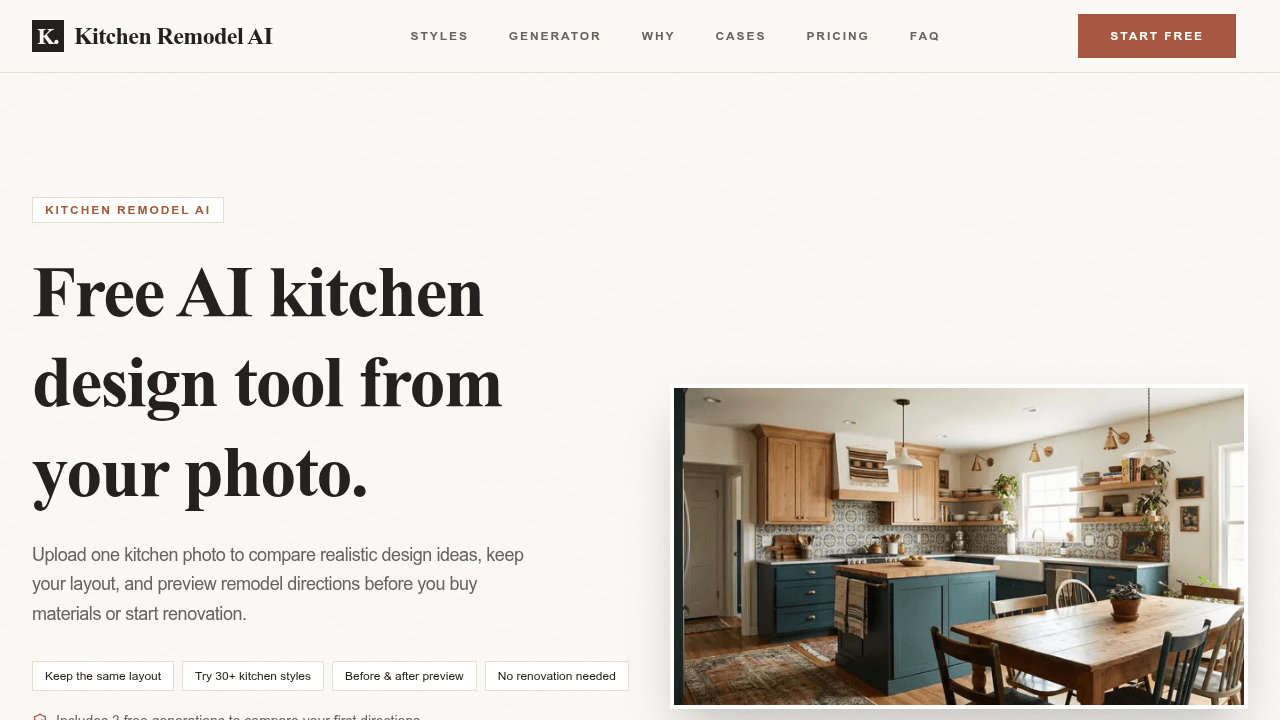
What is Kitchen Remodel AI
Kitchen Remodel AI is an AI-driven design tool that generates photorealistic kitchen remodel ideas from a single user-uploaded photo. The core function is to allow users to explore and visualize different kitchen styles while preserving the existing layout, enabling evaluation of material and aesthetic changes before any physical renovation begins.
The tool offers over 30 curated style templates, from modern and Scandinavian to farmhouse and luxury. Users can optionally refine the output with a brief text prompt specifying changes like cabinet color or lighting. Key benefits include providing homeowners with clear visual direction to avoid costly mistakes, helping interior designers secure faster client approvals, and assisting builders in pre-sales visualization. The process is designed for speed, typically producing a before-and-after comparison in under a minute, with three free generations available to start. This approach focuses on early-stage design validation, reducing guesswork and revision cycles in kitchen planning projects.
How does Kitchen Remodel AI work
Kitchen Remodel AI operates by processing a single uploaded kitchen photograph through a specialized image generation model. Users first select a style template from over 30 curated directions, such as modern or farmhouse, which serves as a pre-configured prompt. Optionally, a concise text description refines details like cabinet color or lighting. The core algorithm then generates a photorealistic redesign while preserving the original spatial layout and structural elements, altering only finishes and stylistic components. This layout-preserving mechanism allows homeowners, designers, and developers to visualize specific style transformations without architectural changes, facilitating early planning decisions and communication before renovation.
Benefits of Kitchen Remodel AI
Kitchen Remodel AI is a free AI design tool that generates realistic kitchen remodel previews from a single photo. It allows users to explore over 30 style directions—such as modern, Scandinavian, or farmhouse—while preserving the existing layout. This layout-preserving approach enables clear visualization of cabinet, material, and lighting changes before any renovation commitment. The tool supports faster decision-making for homeowners, interior designers, and builders by providing actionable visual directions in under a minute, with three free generations available to compare initial ideas without requiring CAD files or a credit card.
Pros and Cons of Kitchen Remodel AI
Pros
- Kitchen-specific AI optimization for relevant results.
- Preserves existing layout while changing aesthetics.
- Offers 30+ curated style templates for exploration.
- Provides 3 free generations to test the tool.
- Generates design previews in under a minute.
Cons
- Output quality is sensitive to prompt clarity and detail.
- Cannot handle structural architectural changes.
- Requires only a single photo, lacking CAD integration.
- Free tier has limited generations before paid plans.
- AI-generated realism may vary from final materials.
Core Features of Kitchen Remodel AI
AI-Powered Kitchen Redesign from Single Photo
Generates realistic kitchen designs by analyzing one uploaded image, enabling visualization of remodel ideas without physical changes or professional software.
Layout-Preserving Remodel Visualization
Maintains the existing spatial structure while changing styles and materials, allowing users to explore aesthetic updates without structural modifications.
30+ Curated Kitchen Style Templates
Provides diverse predefined styles like modern, Scandinavian, and farmhouse, each with tuned prompt presets for quick direction selection and exploration.
Optional Prompt-Based Customization
Users can add specific instructions (e.g., cabinet color, lighting) to refine AI output beyond template defaults for personalized design variations.
Rapid Design Generation
Produces rendered kitchen visuals typically in under a minute, facilitating fast iteration and comparison of different design directions efficiently.
Before-and-After Preview Interface
Enables side-by-side comparison of original and AI-redesigned kitchens, helping users clearly assess proposed changes before committing to renovations.
No-Cost Initial Trial
Offers three free design generations without a credit card, allowing risk-free evaluation of the tool's capabilities and output quality before any purchase.
Use Cases of Kitchen Remodel AI
- Homeowners: Compare kitchen styles before renovation by preserving layout and previewing material changes, reducing selection errors.
- Interior Designers: Convert client sketches into photorealistic kitchen visuals quickly to accelerate approvals and minimize revision loops.
- Builders & Developers: Generate sellable kitchen renderings from planning documents to illustrate renovation value and align stakeholders early.
- Real Estate Agents: Create virtual staged kitchen listings from existing photos to enhance property appeal and expedite buyer decisions.
- Contractors: Validate material and finish selections with clients using AI-generated before-and-after previews, reducing change orders.
FAQs of Kitchen Remodel AI
Is this a free kitchen design tool?
Yes. You can start with one kitchen photo, try a style direction, and preview AI-generated results before paying for a plan. The tool offers three free generations to test initial design ideas without any financial commitment.
Can I start with just one kitchen photo?
Yes. One kitchen photo is enough to generate a first design direction. You do not need CAD files, a floor plan, or multiple room angles to get started, making the process accessible for quick visualization.
Can I keep the same kitchen layout while changing style?
Yes. Include "keep the same layout" in your prompt and focus on cabinets, materials, lighting, or color changes instead of structural changes. The AI is optimized to preserve spatial structure during style transformations.
Can this help with kitchen remodel ideas before renovation?
Yes. It is built for early remodel planning, so you can compare styles, narrow down materials, and discuss a clearer direction before buying cabinets or hiring contractors. This reduces guesswork in the initial phases.
Which kitchen styles can I try?
You can explore modern, Scandinavian, Japandi, farmhouse, contemporary, and other kitchen directions using the built-in style templates. The platform provides over 30 curated styles for diverse aesthetic preferences.
Do I need to write a long prompt?
No. One clear sentence is enough. Start with what should stay the same and what should change, then regenerate if you want a tighter direction. The tool includes quick-start chips to simplify prompt creation.
Which image formats are supported?
JPG, PNG, and WEBP are supported with a max upload size of 10MB. This accommodates most smartphone and camera outputs, allowing flexible photo sources for design generation.
What if the result doesn't match what I described?
Try regenerating with a more focused prompt. One strong instruction per generation usually works better than combining layout, style, lighting, and material changes at once. Iterative refinement helps achieve closer matches.
How does Kitchen Remodel AI differ from traditional kitchen design software?
Kitchen Remodel AI uses a single uploaded photo and AI algorithms to generate visualizations rapidly, whereas traditional tools require manual CAD modeling, floor plans, and extensive design knowledge. It prioritizes quick aesthetic previews over technical specifications, enabling users to explore styles without learning complex software.
What types of kitchen changes can the AI realistically generate?
The AI realistically generates changes to cabinet finishes, countertop materials, wall colors, lighting fixtures, and decorative elements while maintaining the original kitchen layout and structural features. It does not support moving walls, changing window placements, or altering the room's fundamental architecture, as it is designed for style iteration rather than structural redesign.
How accurate are the AI-generated designs to actual materials and lighting?
AI-generated designs aim for photorealism in depicting materials and lighting based on training data, but they are approximations. Actual material textures, color tones, and light interactions may vary in real installations due to sample differences, room lighting conditions, and installation quality. The tool should be used for directional guidance, not as a final material specification.
How does Kitchen Remodel AI handle user privacy and data security?
User privacy is handled with a privacy-first approach; uploaded kitchen photos are processed to generate designs and are not used for AI training without explicit consent. Data transmission is encrypted, and storage complies with standard security protocols. For comprehensive details, users should consult the Privacy Policy and Terms of Service on the website.
Can homeowners and professionals both benefit from using this tool?
Yes, multiple user types benefit. Homeowners explore styles and validate ideas pre-renovation. Interior designers expedite client approvals by turning sketches into realistic visuals. Builders and developers use it to showcase potential kitchen upgrades in pre-sale contexts, helping buyers visualize finished spaces from plans or current conditions.
How to use Kitchen Remodel AI
- Kitchen Remodel AI generates style-specific kitchen redesigns from a single photograph while preserving the original spatial layout. Users begin by uploading a JPG, PNG, or WEBP file under 10MB.
- Select a style template from over 30 curated directions, including Modern, Scandinavian, Japandi, or Farmhouse, to establish the desired aesthetic outcome.
- Optionally, provide a concise prompt specifying material changes like cabinet color, countertop type, or lighting to guide the AI toward a particular finish.
- Initiate the generation; the system typically produces a photorealistic before-and-after visualization within one minute, maintaining the existing layout.
- Review the side-by-side comparison to evaluate how the chosen style transforms surfaces, fixtures, and overall ambiance without structural modifications.
- Download the resulting image or save it to a personal gallery after authentication for later reference during material selection or contractor meetings.
- Apply this visual direction to streamline decision-making, align project stakeholders, and minimize costly revisions before physical renovation begins.
