
Ottermind Introduction
Ottermind is an AI workspace where you describe your vision and it builds the architecture, code, and deployment. Work with files, memory, and tools across devices.

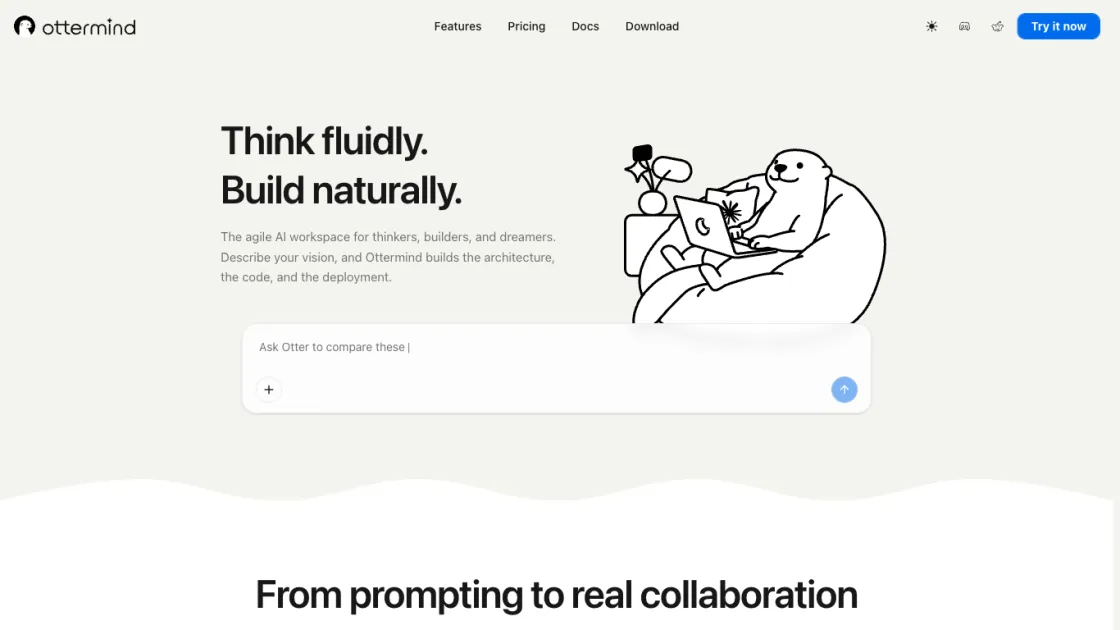
What is Ottermind
Ottermind is an AI workspace that shifts the paradigm from manual prompting to genuine collaboration. Instead of directing every action, users describe the outcome they want, and the system works through the process alongside them. It connects ideas, files, memory, devices, and tools so AI agents can plan, build, automate, and deliver real work. The product draws inspiration from the otter -- calm in the water, clever with tools -- and carries that spirit into a workspace that feels lighter than traditional AI interfaces. Ottermind is designed for thinkers, builders, and dreamers who want to move from having an idea to seeing it take shape, without getting buried in the mechanics of managing an AI step by step.
How does Ottermind work
Ottermind works by accepting a high-level goal from the user rather than step-by-step instructions. The agent interprets the desired outcome, breaks it down into actionable steps, and selects the appropriate tools for each stage -- whether that involves writing code, manipulating files, searching the web, or connecting to external services. Throughout the process, Ottermind maintains context through a shared memory system, so it remembers earlier decisions and avoids asking for repeated information. The result is delivered directly, and the user can refine or redirect the agent at any point without starting over.
Benefits of Ottermind
Ottermind reduces the friction between having an idea and executing it by removing the need to micromanage AI behavior. Users gain back time spent repeating instructions, thanks to persistent context memory that carries information across sessions. The ability to work across devices without losing progress makes it practical for both desk work and on-the-go tasks. Scheduled recurring workflows turn routine operations into set-and-forget processes, which is particularly valuable for teams managing ongoing content or monitoring tasks. The skill system allows the platform to grow with the user's needs rather than requiring feature switches.
Pros and Cons of Ottermind
Pros
- Goal-oriented workflow reduces manual prompting overhead
- Persistent memory eliminates repeated context setting
- Cross-device support with seamless progress carryover
- Recurring workflow automation for routine tasks
- Skill system allows extensibility without platform limits
Cons
- Credit-based pricing may limit heavy usage on lower tiers
- Relatively new product with limited community resources
- No offline mode for areas with unreliable connectivity
