
OpenFate AI Bazi FAQs
OpenFate AI Bazi is an online Bazi calculator and AI reading service that generates a free Four Pillars chart, analyzes Day Master, Ten Gods and Luck Pillars, and provides career, wealth and relationship timing insights in plain English.

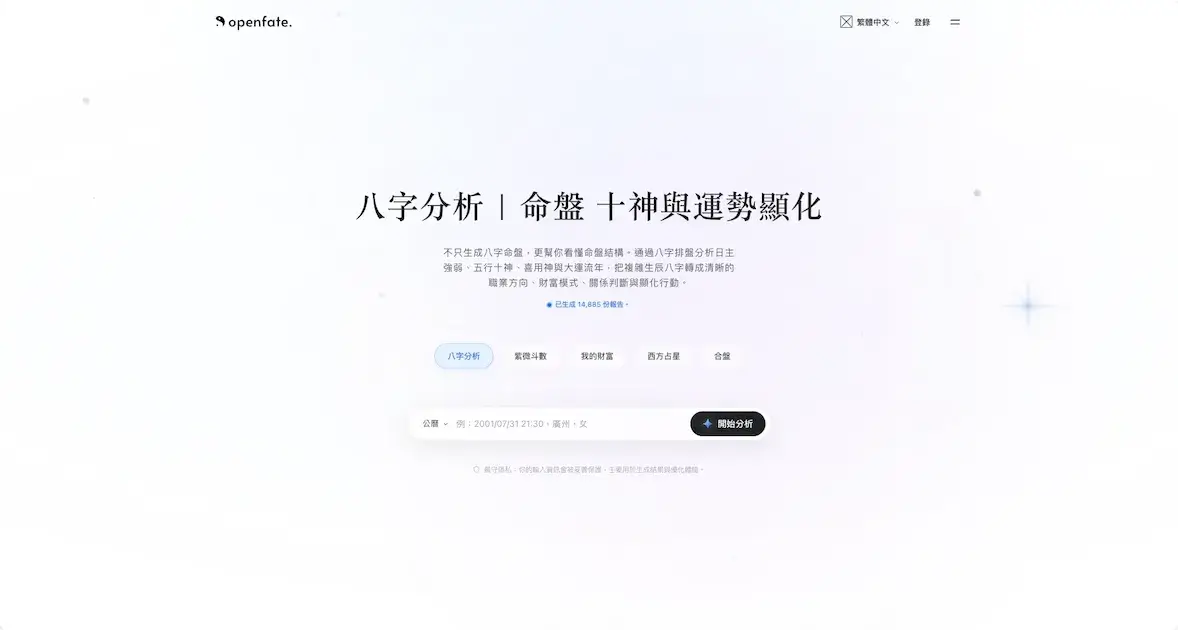
FAQs of OpenFate AI Bazi
What is OpenFate AI Bazi and how does it differ from a regular Bazi calculator?
OpenFate AI Bazi combines a standard Bazi calculator, which converts birth year, month, day, and time into the Four Pillars, with an artificial‑intelligence‑driven reading. The AI layer interprets the Day Master, Five Elements, Ten Gods, and Luck Pillars, delivering plain‑English insights on personality, career timing, wealth cycles, and relationship dynamics—something a simple calculator alone cannot provide.
How does the AI reading determine my Day Master strength and its significance?
The AI evaluates the Heavenly Stem of the Day Pillar (the Day Master) against the surrounding Five Elements in the chart. By measuring the proportion of supporting versus antagonistic elements, the system quantifies the Day Master’s strength. A strong Day Master indicates inherent resilience, while a weak one suggests the need for favorable elements to balance the chart, directly affecting career recommendations and life‑stage timing.
What are the Ten Gods in a Bazi chart, and why are they important for career and wealth analysis?
The Ten Gods are a set of symbolic relationships—Wealth, Officer, Resource, Output, Companion, etc.—derived from the interaction between the Day Master and the other elements. Each god reflects a specific life domain such as income (Wealth), leadership (Officer), education (Resource), creativity (Output), or social networks (Companion). By identifying which gods are strong or weak, OpenFate AI Bazi highlights optimal career paths, investment periods, and potential financial challenges.
Why is an exact birth time required for a complete Bazi reading?
The Hour Pillar, calculated from the exact birth time, represents the later stages of life, career pivots, and deep personal motivations. Without this pillar the AI can only generate a three‑pillar chart, which reduces the accuracy of Ten Gods distribution and limits the analysis of Luck Pillars and annual transits. Precise time data ensures a full four‑pillar structure and more reliable predictions.
How are Luck Pillars and annual transits used to identify timing windows for major life decisions?
Luck Pillars are ten‑year cycles that overlay new elemental influences onto the natal chart. The AI examines how each Luck Pillar interacts with the Day Master and Ten Gods, pinpointing periods when favorable elements dominate (ideal for career changes, business launches, or marriage) or when clashes occur (times to avoid major commitments). Annual transits add a yearly layer, refining the timing to specific calendar years.
Can OpenFate AI Bazi help me understand my relationship compatibility?
Yes. The AI analyzes the Spouse Palace (the Earthly Branch of the Day Pillar) and relationship‑related gods such as Companion and Resource. By comparing these indicators with a partner’s chart, the system can highlight harmonious elements, potential conflicts, and the best periods for deepening commitment or addressing relational challenges.
Is the AI Bazi reading suitable for beginners who are unfamiliar with Chinese astrology terminology?
OpenFate AI Bazi is designed to translate complex concepts—like Five Elements, Ten Gods, and Luck Pillars—into plain English explanations. The tool provides concise definitions alongside the analytical results, making it accessible to students or anyone new to Chinese astrology while still offering depth for more experienced users.
How to use OpenFate AI Bazi
OpenFate AI Bazi serves as a free Bazi calculator and AI‑driven Bazi reading, generating Four Pillars charts, analysing Day Master strength, Five Elements balance, Ten Gods, and Luck Pillars for career, wealth, and relationship timing.
Access the English interface, enter birth year, month, day, and exact time into the designated fields, then click Generate Chart; the system creates the Four Pillars (Heavenly Stems and Earthly Branches).
Review the displayed chart; hover over each pillar to view element symbols and associated Ten Gods, confirming that all input data are correctly reflected.
Activate the AI Bazi reading by selecting Interpretation, prompting the algorithm to evaluate Day Master, elemental interactions, and Ten Gods, then produce a concise English summary.
Examine the Day Master analysis to understand core personality traits and determine which of the Five Elements are supportive or weakening in the natal chart.
Study the Ten Gods section to identify wealth, career, authority, and relationship influences, noting any dominant or missing gods that guide life‑area focus.
Scroll to the Luck Pillars panel; observe the 10‑year cycles and annual transits, noting periods where favorable elements align with career or relationship goals.
Compare the AI‑generated timing recommendations with personal plans, selecting windows where supportive elements and positive Luck Pillars coincide for career moves or relationship decisions.
Export the full report as PDF or copy the text; use it as a reference for long‑term planning, ensuring each recommendation aligns with the identified strengths of the Day Master and Ten Gods.
Periodically revisit the tool with updated birth‑time accuracy or new life events, allowing the AI Bazi reading to recalibrate Luck Pillars and refine future timing insights.
