
Loop Engineering - AI SaaS Maintenance with Verified Agent Workflows
| Added on: | Jul 6, 2026 |
| Monthly Visits: | -- |
| Social & Email: | -- |

What is Loop Engineering
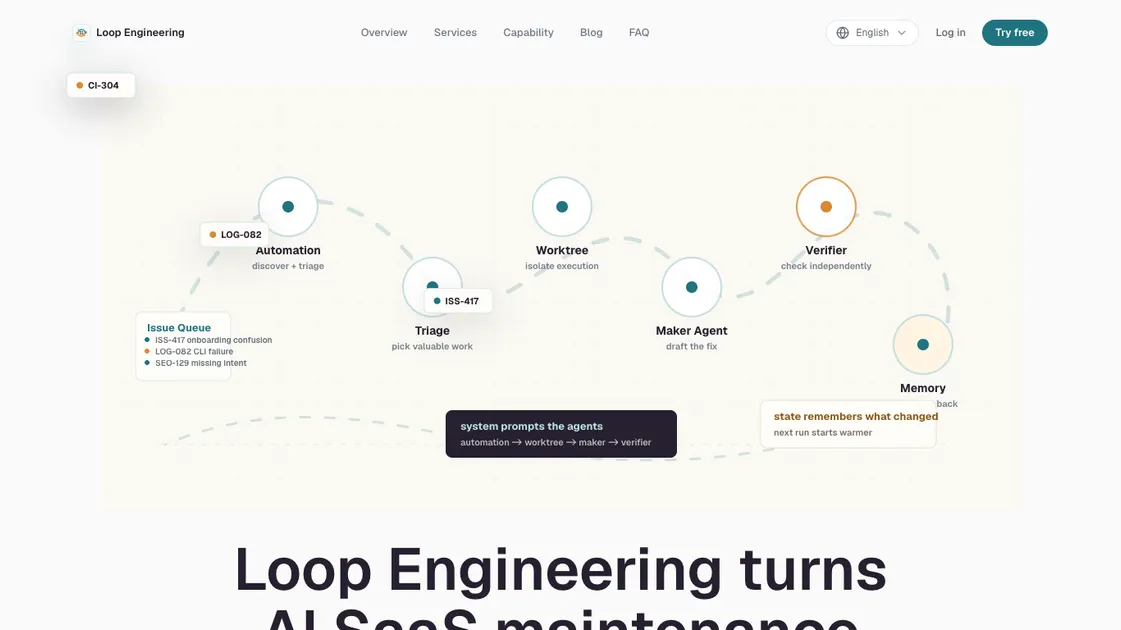
Loop Engineering provides an AI-powered system for SaaS maintenance that transforms CLI feedback loops into verified engineering work. The platform uses agents with defined goals, state management, tools, verification, and memory to turn product feedback into auditable improvement. Instead of manually triaging issues and deploying fixes, teams rely on an automated pipeline that discovers problems, triages them, isolates execution in worktrees, drafts fixes through maker agents, and independently verifies results. Each run accumulates state, making subsequent runs more efficient. Loop Engineering is built for AI SaaS teams that need evidence, boundaries, and continuous improvement without manually managing agent workflows.
How does Loop Engineering work
Loop Engineering operates through a sequential automated pipeline. The system first discovers and triages incoming issues from the queue, then isolates each task in a dedicated worktree to prevent side effects. A maker agent drafts the fix while an independent verifier agent cross-checks the result for correctness. Verified changes are written back to persistent memory, which accumulates state across runs. This feedback loop means each maintenance cycle starts warmer than the last, with the system continuously learning from previous outcomes without requiring manual intervention for routine tasks.
Benefits of Loop Engineering
Loop Engineering eliminates the manual overhead of managing AI agent workflows for SaaS maintenance. Teams gain auditable evidence for every change, clear boundaries between automated and human work, and a system that improves with each run through persistent memory. The maker-verifier separation ensures quality without constant human oversight, while isolated worktree execution prevents cascading failures. For product leads, it transforms vague user feedback into concrete, verified maintenance tasks with measurable outcomes and full traceability from signal to deployed fix.
Pros and Cons of Loop Engineering
Pros
- Automated triage reduces manual issue management
- Independent verification ensures fix quality
- Persistent memory improves efficiency over time
- Isolated execution prevents cross-task interference
- Full audit trail from signal to deployed fix
Cons
- Requires initial setup and system integration
- Limited to CLI and code-based feedback loops
- Complex fixes may still need human judgment
- New platform with evolving feature set
Core Features of Loop Engineering
Automated Issue Discovery and Triage
The system scans issue queues including error logs, CLI failures, and SEO issues to discover problems and automatically triage them based on priority and value.
Isolated Worktree Execution
Each maintenance task runs in a dedicated worktree that isolates the fix from other changes, preventing side effects and ensuring clean separation between concurrent tasks.
Maker-Verifier Separation
A maker agent drafts each fix while a verifier independently checks the result, creating a reliable two-step validation process that catches errors before deployment.
Persistent Memory State
After each run, the system writes state back so subsequent runs start with accumulated knowledge about the codebase, making the maintenance loop progressively faster.
CLI and Support Signal Integration
The platform ingests feedback from CLI logs, support tickets, interviews, and structured signals, turning raw input into prioritized maintenance tasks with full traceability.
Use Cases of Loop Engineering
- Product lead: Convert user feedback and support tickets into prioritized, verified maintenance tasks
- Engineering lead: Automate bug triage, fix drafting, and verification across the entire codebase
- Growth team: Systematically address onboarding friction and subscription pain points identified through user signals
- Agent developer: Deploy and monitor agent workflows with built-in verification boundaries and memory persistence
- Founder: Gain visibility into recurring product issues without manually reviewing every support ticket
FAQs of Loop Engineering
What is Loop Engineering?
Loop Engineering is an AI-powered maintenance platform that uses agent workflows to automatically discover, triage, fix, and verify software issues. It turns CLI feedback and support signals into auditable engineering work with persistent memory that accumulates across runs.
Who is Loop Engineering for?
The platform is designed for AI SaaS teams including product leads, engineering leads, growth teams, and agent developers who need structured maintenance workflows with evidence and boundaries rather than ad-hoc agent usage.
How does Loop Engineering differ from other AI coding tools?
Unlike single-prompt AI tools, Loop Engineering provides a complete engineering system with issue isolation in dedicated worktrees, independent verification through a separate verifier agent, persistent state memory, and configurable stop conditions. It is a control system around agents.
What types of feedback can Loop Engineering process?
The platform accepts CLI feedback, support tickets, error logs, user interviews, and structured product signals. It integrates with GitHub and GitLab for issue tracking and supports raw CLI log ingestion for custom workflows.
Does Loop Engineering replace human developers?
No. Loop Engineering automates specific maintenance workflows but requires human oversight for architectural decisions, feature development, and final deployment approval. It handles routine maintenance tasks at scale so teams can focus on higher-value work.
How to use Loop Engineering
- Sign up and create an account at loopengineering.sh to access the platform dashboard and configure your first project
- Connect your issue queue from GitHub, GitLab, or CLI logs to feed product signals and feedback into the system
- Configure agent goals, available tools, and verification criteria that match your team specific maintenance requirements
- Review verified fixes in the dashboard and deploy approved changes to your production environment with confidence
