
Zens AI - Account-Aware AI Customer Support for SaaS

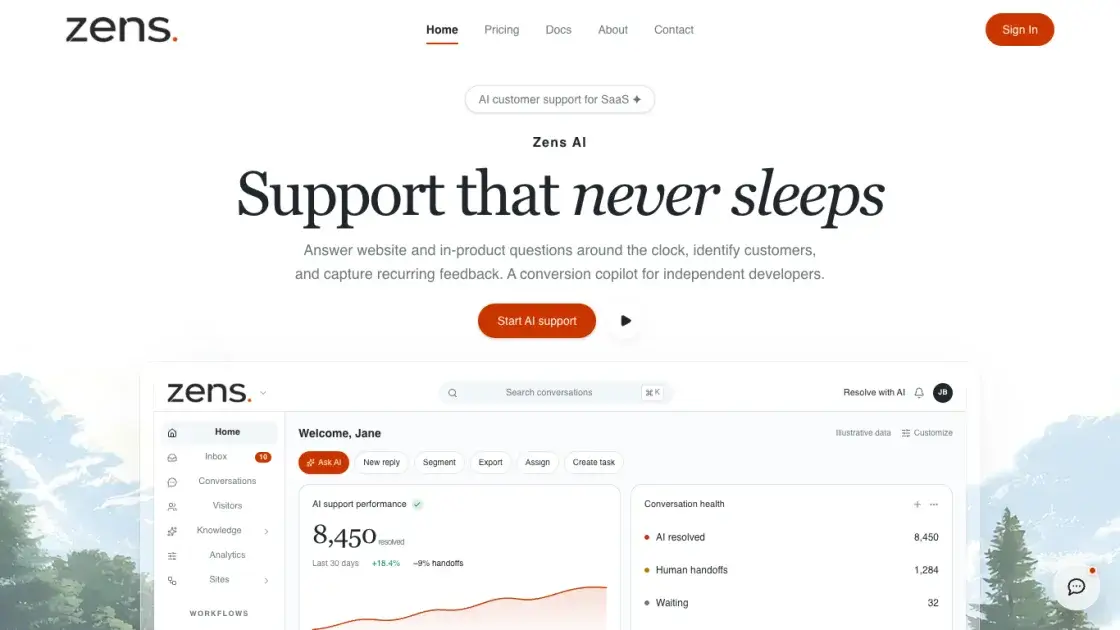
What is Zens AI
Zens AI is an AI customer support platform designed for SaaS teams that want support conversations to drive product improvements. It answers website and in-product questions around the clock, identifies signed-in users and anonymous visitors, and captures recurring feedback through a unified identity layer. Instead of a plain chat widget, Zens AI connects every conversation to account traits, plan state, session timeline, and page context, so replies are grounded in verified customer facts. The platform turns repeated questions into clustered feedback and packages it into actionable briefs that flow into Codex, Linear, Slack, and GitHub. A review-first mode keeps AI drafts under human control, and customer data is not used for model training. For founders, support leads, and product teams adopting agent workflows, Zens AI positions itself as a conversion copilot that turns every support interaction into the next product iteration.
How does Zens AI work
Zens AI works by building a governed identity model for every conversation. Teams register a site, install a snippet, and sync user, account, plan, and page context after login. When a visitor messages, the platform assembles a trusted context graph from identity, session timeline, and conversation history. The AI assistant drafts replies grounded in that context, shows the evidence used, and suggests a next action. Repeated questions are clustered into feedback themes, then packaged into briefs with affected routes and acceptance criteria, which are routed to Codex, Linear, Slack, or GitHub.
Benefits of Zens AI
Zens AI turns support from a cost center into product evidence. Its main advantage is a unified identity layer that merges user, account, plan, and page context into one verified profile, so replies and reports never drift across teams. AI-assisted drafts shorten resolution time, and recurring feedback is clustered automatically instead of staying buried in chat logs. Briefs with acceptance criteria flow into Codex, Linear, Slack, and GitHub, so product teams start from real customer problems. Review-first defaults, role controls, and a no-training policy make it safe for sensitive data, and the free tier lets small teams validate the workflow.
Pros and Cons of Zens AI
Pros
- Turns support conversations into actionable product feedback
- Account-aware context grounds AI replies in verified facts
- Integrates with Codex, Linear, Slack, and GitHub
- Review-first defaults keep AI outputs under human control
- Customer data is not used for model training
Cons
- Setup requires SDK installation and identity configuration
- AI action limits may be tight on lower plans
- Free plan keeps only 7 days of data history
Core Features of Zens AI
Account-aware AI inbox
Every message arrives beside user identity, account traits, recent activity, and a recommended next action, so support replies from verified customer context.
Unified identity layer
Signed users, anonymous visitors, plan, role, and session timeline are merged into one trusted profile that every workflow references.
AI-assisted reply drafts
The assistant grounds drafts in account facts, product events, and docs, and asks for clarification instead of inventing policy details.
Feedback clustering
Repeated questions, bugs, and feature requests are grouped into themes with affected routes and reproduction details.
Codex and tool integration
Feedback briefs with acceptance criteria move into Codex, Linear, Slack, and GitHub, connecting support to implementation.
Review-first automation
AI drafts summaries and recommendations, while teams decide what is sent automatically and what needs human approval.
Priority visitor queue
Conversations are grouped by checkout risk, plan limits, enterprise accounts, or onboarding stalls to surface high-intent visitors.
Granular permissions and security
Role controls, private traits, audit logs, and a no-training policy keep customer data visible only to authorized users.
Use Cases of Zens AI
- SaaS founders: validate identity-aware support on a single site and test the workflow before scaling.
- Support leads: prioritize high-intent visitors by checkout risk, plan limits, and onboarding stalls in one queue.
- Product managers: turn repeated questions and bug themes into prioritized requirements with customer evidence.
- Growth teams: track how support affects trial activation, plan upgrades, and recovered checkout sessions.
- Engineering teams: route feedback briefs with acceptance criteria into Codex, Linear, and GitHub tasks.
FAQs of Zens AI
How is Zens AI different from a regular live chat tool?
Zens AI is more than a chat window. It brings user identity, account state, current page, product events, and conversation history into one trusted context layer, so support replies, product feedback, and agent tasks all work from the same evidence instead of disconnected transcripts.
Which teams is Zens AI built for?
Zens AI is built for SaaS teams that want support conversations to drive product improvements, especially founders, support leads, product managers, growth teams, and engineering teams adopting agent workflows. It scales from a single operator on the free plan to multi-product organizations on the Business tier.
Will AI replies be sent to customers automatically?
Review-first is the default. AI can draft replies, summaries, and recommendations, while your team controls what can be automated and what must be approved by a human. This keeps AI outputs under control while still reducing repetitive support work.
Can Zens AI connect to Codex or other agent workflows?
Yes. Zens AI can turn repeated feedback into Codex-ready briefs with affected routes, reproduction details, and acceptance criteria, and send context to Slack, Linear, GitHub, Multica, or other team agents through its API and MCP access on higher plans.
Will customer data be used for model training?
Customer conversations are not used for model training by default. Zens AI emphasizes signed identity, role controls, private fields, and data minimization so agents only receive the context needed for the task. Audit logs record who viewed or exported sensitive support context.
How much does Zens AI cost?
Zens AI offers a free plan with one site, one seat, and 20 lifetime AI actions. Paid plans start at $29 per month for Starter, with Growth at $79 and Business at $199 per month. Annual billing equals ten monthly payments, and the full pricing comparison is available on the pricing page.
What counts as an AI action?
An AI reply, reply draft, summary, translation, regeneration, greeting generation, or other successful model-assisted task counts as one action. Failed requests are returned to the allowance, and the counter lives on the workspace owner, so creating another site does not duplicate the quota.
How to use Zens AI
- Create a workspace at zens.ai and register a customer site to receive a site ID and signing secret.
- Install the Zens AI snippet in your product and sync user, account, plan, and current page after login.
- Connect your support stack, including Slack, GitHub, Zapier, WordPress, or the SDK for React and Next.js.
- Configure identity fields and access policies to decide which traits are visible to which team roles.
- Answer customer questions from the AI inbox, using AI-assisted drafts with evidence and a human approval step.
- Route repeated feedback and product briefs to Codex, Linear, Slack, or GitHub to close the support loop.
Zens AI Alternatives
Alenta AI trains an AI agent on your website to answer visitor questions, capture qualified leads, and book appointments 24/7 for service businesses.
Coralflavor offers uncensored AI chats without safety filters, plus burn-mode retention, web search, image generation, and an OpenAI-compatible API for U.S. adults.
AIdorable is a virtual baby AI companion app. Adopt, name, and care for a tiny AI baby in daily moments, as it grows, learns to speak, and remembers you.

Detect multi-accounting, account sharing and takeovers in web apps. ShieldLabs scores anonymous visitors with an explainable 0-100 risk score via API and webhooks.
ZocialComment exports comments from TikTok, Instagram, YouTube, Reddit, Facebook and Threads to CSV or JSON with AI analysis. No signup required.
Turn your website into a searchable knowledge base. Knowster answers visitors from your content in any language. One-line setup, no coding, free plan.
Track how AI search engines and chatbots see your brand. Monitor visibility, competitor mentions, and recommendations across AI platforms.
Chat with 20 realistic AI boyfriend characters. Send voice messages, request photos, and build romantic scenarios that remember what matters to you.
AI Etsy research assistant for keyword discovery, product trends, and SEO optimization. Ask questions, get data-backed answers with confidence scores.
Linkeddit is an AI demand and competitor intelligence platform that tracks competitor moves and complaints, surfaces buyer intent from Reddit and review sites, and turns signal into pipeline and content.
Build and optimize your online store with Runner AI. Create storefronts by chatting with AI, run automatic tests, and scale conversions with autonomous optimization.
Analook uses AI to analyze any competitor's growth strategy, SEO, social media, traffic, and market positioning using 15+ real data sources for comprehensive competitive intelligence.