
T-Checker: Turnitin‑style plagiarism & AI report tool

What is T-Checker
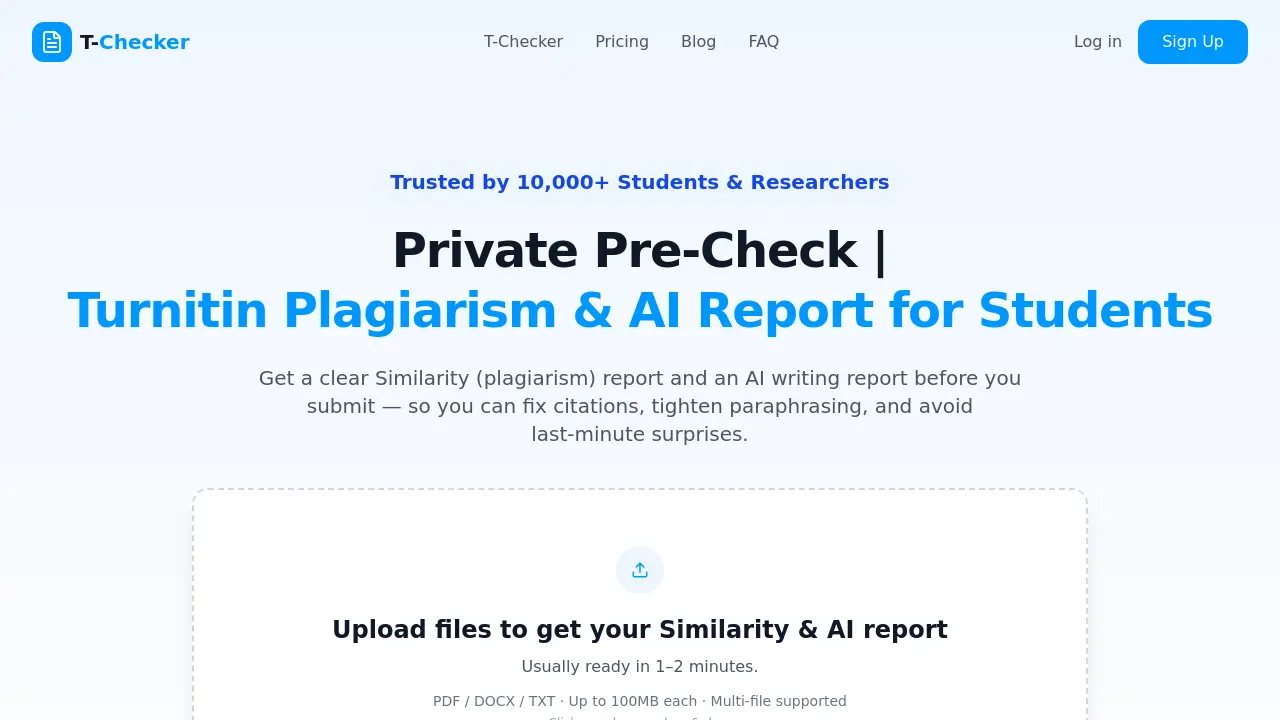
T-Checker is an independent online service that delivers plagiarism similarity reports and AI writing analyses for academic documents. Users upload PDF, DOCX, or TXT files up to 100 MB, and within one to two minutes receive downloadable reports that indicate text overlap, citation issues, and AI‑generated content indicators. The platform emphasizes privacy by storing no copies in external repositories, deleting files automatically after download, and encrypting transmissions with 256‑bit SSL. Pricing is subscription‑based, offering monthly and annual plans with varying credit counts, making it attractive for students, researchers, and academic staff who need quick, transparent checks before final submission. The service is noted for its simple three‑step workflow, bank‑level security, and third‑party verified data protection.
How does T-Checker work
T-Checker is an independent service that lets users upload PDF, DOCX, or TXT files to receive a similarity report and an AI writing report within one to two minutes. The platform processes documents in private mode, does not store files in its repository, and deletes them after download, employing AES‑256 encryption and 256‑bit SSL for security. It serves students, academic staff, and research assistants who need pre‑submission checks for plagiarism and AI‑generated content. Pricing starts at $3.59 per scan with credit‑based subscription tiers.
Benefits of T-Checker
The T‑Checker platform delivers rapid plagiarism and AI‑writing analysis, generating similarity and AI reports within one to two minutes after file upload. It supports PDF, DOCX, and TXT files up to 100 MB, and processes multiple files in a single batch. Users benefit from a private workflow that does not store documents in any repository, employs AES‑256 encryption, and enables immediate auto‑deletion after download. The service is tailored for students, academic staff, and research assistants seeking to verify citations, improve paraphrasing, and avoid unintended matches before final submission. Simple three‑step operation and transparent pricing further enhance its appeal.
Pros and Cons of T-Checker
Pros
- Fast results within 1–2 minutes.
- No repository storage ensures privacy.
- Secure 256‑bit SSL encryption.
- Supports PDF, DOCX, TXT multi‑file uploads.
- Affordable per‑scan pricing plans.
Cons
- Limited credits per subscription tier.
- Max 100MB file size per upload.
- No free tier or trial available.
- AI detection may miss subtle AI text.
- Requires internet connection for scanning.
Core Features of T-Checker
Plagiarism and AI Writing Reports
Provides detailed similarity analysis against sources and AI‑writing detection, helping users adjust citations and paraphrase before final submission to improve originality and avoid accidental overlap.
Secure Private Upload Process
Handles uploaded documents in a non‑stored, encrypted environment, ensuring no repository retention and full user control over deletion and access.
Automated Report Generation and Management
After scanning, delivers downloadable report links within minutes, enabling users to review, manage history on the Result page, and delete files instantly.
Use Cases of T-Checker
- Students: Submit drafts for AI detection and plagiarism reports, fixing citations before final submission to ensure originality.
- Academic staff: Upload manuscripts for plagiarism detection, receive AI writing analysis, and provide rapid feedback on source attribution.
- Research assistants: Scan literature reviews for similarity, validate citation integrity, and protect privacy during preliminary manuscript checks.
- Thesis writers: Perform bulk file uploads, generate combined plagiarism and AI reports, and manage deletion to maintain submission security.
FAQs of T-Checker
Is it really safe? Will my school know?
T‑Checker processes each upload in private mode, does not store papers in any repository, and uses AES‑256 encryption combined with 256‑bit SSL, ensuring that the document remains unseen by external parties including the institution.
How long does the scan take?
The platform typically generates both similarity and AI writing reports within one to two minutes after the file has been uploaded, providing users with rapid feedback before submission deadlines.
Why does the AI report flag writing even I typed myself?
AI detection evaluates linguistic patterns, stylistic markers, and structural cues; even user‑generated text may match statistical profiles associated with AI‑generated content, prompting a flag despite original authorship.
What does *% mean in the Turnitin AI report?
The asterisk‑prefixed percentage indicates the proportion of the submitted text that the system classifies as exhibiting AI‑like characteristics, relative to recognized AI writing models.
What languages does T‑Checker support?
T‑Checker currently processes documents in major languages such as English, Spanish, French, German, Portuguese, and Mandarin, allowing users from diverse academic contexts to receive accurate reports.
Why can sections that weren’t flagged before become flagged as AI after revisions?
Revisions may alter phrasing, synonym usage, or sentence structure, which can shift statistical patterns that the AI detector monitors, potentially causing previously non‑flagged sections to register as AI‑like.
Do unused credits roll over?
Credits purchased under monthly or yearly subscription plans generally expire at the end of the billing cycle; they do not automatically transfer to subsequent periods unless a specific rollover policy is outlined in the plan details.
Can I cancel my subscription any time?
Subscribers may cancel auto‑renewal through their account settings; cancellation takes effect at the end of the current billing period, after which no further charges are applied.
How does Bulk Upload work?
Users can select multiple PDF, DOCX, or TXT files up to individual size limits, upload them simultaneously, and the system will process each file to generate separate similarity and AI reports.
What security certifications does T‑Checker employ?
The service is verified by third‑party audits and utilizes bank‑level 256‑bit SSL encryption for data in transit, AES‑256 encryption for storage, and maintains a no‑repository policy to protect user confidentiality.
What happens to my file after I download the report?
Once a download is completed, users can delete the file and its associated report instantly; the system also supports automatic deletion after a predefined idle period for added privacy.
Can I share my report with collaborators?
Report links generated after download can be shared via a secure URL; however, access is restricted to anyone possessing the link, and the owner retains control to revoke or delete the link at any time.
Is there a free trial or demo version?
T‑Checker offers a limited introductory scan using a single credit, allowing new users to experience the similarity and AI reporting features before committing to a paid subscription.
How to use T-Checker
- The user selects T‑Checker as a plagiarism and AI detection service designed for students, researchers, and academic staff to obtain similarity and AI writing reports before submission.
- The user uploads a supported file (PDF, DOCX, TXT) up to 100 MB via drag‑and‑drop or click‑to‑select, ensuring private handling without repository storage.
- The system processes the document within one to two minutes, generating a similarity score and an AI‑writing analysis report that includes source match percentages and stylistic indicators.
- The user downloads the generated reports from the Result page, where links can be accessed, managed, or deleted after review, allowing control over data retention.
- The user interprets the similarity percentage to adjust citations or paraphrasing, and reviews the AI writing breakdown to improve authenticity and avoid unintended AI‑generated phrasing.
- Throughout the workflow, relevant SEO keywords such as plagiarism detection, AI writing report, similarity analysis, and private document scanning are naturally integrated to enhance discoverability for academic users seeking reliable checks.
