
AI Image Detector
AI Image Detector with Four Independent Detection Models

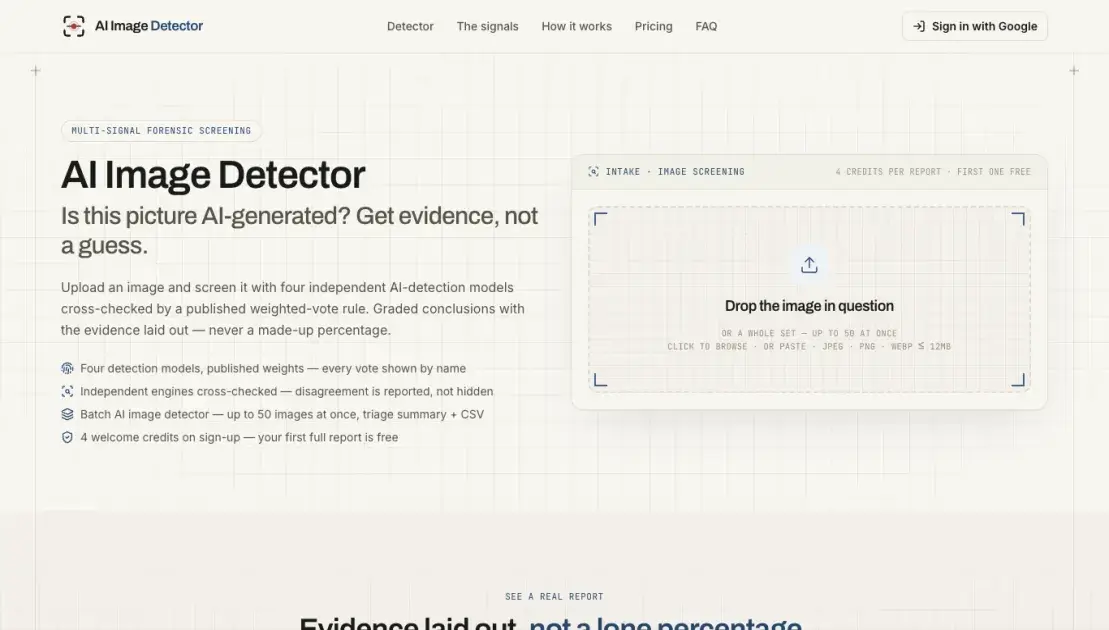
What is AI Image Detector
AI Image Detector is a forensic screening tool that determines whether an image was generated by artificial intelligence. The platform cross-checks uploads against four independent detection models — Sightengine GenAI, Winston AI, Was It AI, and an open-source SAFE engine — under a published weighted-vote rule. When C2PA credentials or generator self-tags are present and certain, they override every model. Each report shows every engine's vote by name, with disagreement reported honestly rather than hidden behind a single percentage. The tool supports JPEG, PNG, and WebP formats, with batch screening for up to 50 images at once. New accounts receive four welcome credits, enough for one full report. Conclusions span five grades from AI-generated to real, backed by deterministic file evidence where available.
How does AI Image Detector work
When an image is uploaded, the AI image detector first checks for C2PA credentials and generator self-tags. If present and certain, these deterministic signals decide the conclusion outright. Otherwise, four independent detection models — Sightengine GenAI, Winston AI, Was It AI, and SAFE — run in parallel, each casting a weighted vote. The votes combine under a published rule into one of five grades: AI-generated, likely AI, inconclusive, likely real, or real. The SHA-256 hash is recorded for chain-of-custody. Every engine's contribution is named in the report, and disagreement is reported honestly rather than blended into a single score.
Benefits of AI Image Detector
The AI image detector provides evidence-based conclusions rather than single-percentage guesses, making results defensible in professional contexts. Four independent engines cross-check each other, so disagreement surfaces as an honest "inconclusive" result instead of being hidden. The tool covers every major generator — Midjourney, DALL·E, Flux, Stable Diffusion, and more — across four independent models. Batch screening with CSV export streamlines moderation queues, while shareable report links and forensic PDFs support collaborative workflows. The free tier runs the full detector without feature restrictions, and dead engines automatically refund credits. For trust and safety teams, the shared workspace history and priority support on the Team plan add operational efficiency.
Pros and Cons of AI Image Detector
Pros
- Four independent engines with published weights — every vote attributed by name
- C2PA credentials override model votes for deterministic results
- Free tier runs the full detector without feature restrictions
- Batch screening up to 50 images with CSV export
- Dead engines automatically refund credits
Cons
- Free tier limited to one full report (4 credits)
- Per-report cost may increase as new engines are added
- No mobile app — web-based only
- Some social platform links return verification failures
Core Features of AI Image Detector
Four Independent Detection Models
The AI image detector runs Sightengine GenAI, Winston AI, Was It AI, and an open-source SAFE engine in parallel, each casting a weighted vote under a published rule.
C2PA Credentials Trump Card
C2PA credentials and generator self-tags are checked first. When certain, they override every model vote, providing deterministic file-level evidence.
Published Weighted-Vote Rule
Every report attributes results by name. The weighted-vote combination produces one of five grades, with engine disagreement reported honestly.
Batch Screening
Pro and Team users can screen up to 50 images at once, receiving a triage summary and CSV export for efficient moderation workflows.
Shareable Report Links
Each analysis generates a shareable report link with forensic PDF download, useful for moderators, educators, and editorial teams requiring documented evidence.
SHA-256 Chain of Custody
The AI image detector records the SHA-256 hash of each uploaded image, supporting chain-of-custody documentation for research and editorial purposes.
Credit Refund on Engine Failure
When a detection engine fails, its credit automatically refunds. The report still runs with the remaining engines, ensuring users only pay for successful analyses.
Use Cases of AI Image Detector
- Dating and marketplace safety: Verify profile photos before trusting them, with shareable report links for moderators.
- Educators: Carry integrity conversations with graded AI detector reports rather than bare percentages.
- Artist communities: Screen submissions to keep human-made galleries human, with batch triage for mod queues.
- Editorial and research: Document image provenance before publishing, with SHA-256 hashes for chain-of-custody notes.
- News verification: Check viral images through the AI image detector before sharing on social media.
FAQs of AI Image Detector
Can any AI image detector be 100% accurate?
No AI image detector achieves perfect accuracy. This tool cross-checks four independent detection models and reports disagreement instead of hiding it, providing a more honest assessment than single-model approaches.
Why doesn't this AI image detector show a single percentage?
A single number hides the real story. When four independent engines disagree, that disagreement is the most important finding. This AI image detector shows every engine's vote so you can see exactly where the consensus comes from — and where it doesn't.
How is the conclusion decided?
Four independent detection models vote with published weights. A weighted-vote rule combines their scores into one of five grades. When C2PA credentials or generator self-tags are present and certain, they override every model.
What does 'Inconclusive' mean?
It means the engines couldn't reach a clear consensus. Some said AI, some said real, and the weighted rule didn't land far enough from the middle to call it. That's an honest answer — and it's more useful than a fake percentage.
Can the AI image detector check images in bulk?
Yes. Pro and Team users can screen up to 50 images at once. Each image runs through the same four-engine pipeline. You get a triage summary and CSV export.
What happens to uploads?
Uploaded images are analyzed and then deleted. The platform doesn't store, share, or train on images. The SHA-256 hash is recorded for chain-of-custody, but the image itself is gone after processing.
What's actually free?
New accounts receive four credits, enough for one full AI image detector run. After that, each report costs four credits. The per-report cost tracks the engine pool — as new detection engines are added, it may increase with advance notice, never retroactively.
How to use AI Image Detector
- Sign up for a free account to receive four welcome credits, enough for one full AI image detector report without entering payment information.
- Upload an image in JPEG, PNG, or WebP format (up to 12 MB) by dragging, browsing, or pasting into the detector.
- Wait a few seconds while the four detection models run in parallel, each casting an independent weighted vote.
- Review the graded conclusion, which shows every engine's vote by name, with disagreement reported transparently.
- Download the forensic PDF report or share the report link with moderators, educators, or editorial teams.
- For bulk screening, upgrade to Pro or Team and upload up to 50 images at once with CSV export.
