
Image to STL FAQs
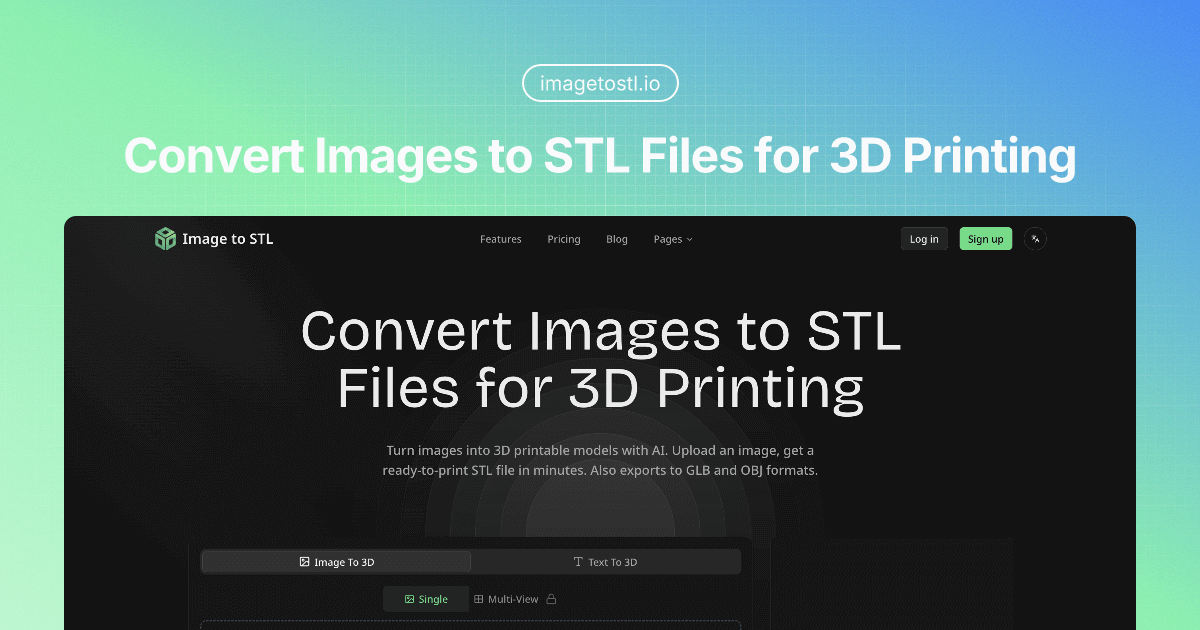
This AI-powered online converter transforms images into 3D printable STL files in minutes, supporting GLB and OBJ exports for various applications.

FAQs of Image to STL
How does the credit system work for Image to STL conversion?
Image to STL utilizes a credit-based system for its services, allowing users to convert images to STL files. Free plan users receive 20 monthly credits, while Pro and Max subscribers receive 500 and 1000 credits, respectively, for generating 3D models. Additional credit packages are available for purchase if more conversions are needed.
What formats can Image to STL export?
The Image to STL converter supports multiple universal export formats for your 3D models. Users can download their generated models in GLB, STL, and OBJ formats. This versatility ensures compatibility with various 3D printing software, game engines, AR/VR platforms, and other 3D applications.
What is the difference between Standard and Pro mode for Image to STL?
The primary difference between Standard and Pro mode in Image to STL lies in the quality and complexity of the generated 3D meshes. Standard mode generates models with approximately 80,000 triangles, suitable for general use. Pro mode, however, can generate high-quality 3D meshes with up to 1,500,000 triangles, offering accurate geometry and clean topology for detailed work and close-up renders when converting images to STL.
Can I use the models generated by Image to STL commercially?
The commercial use of models generated by Image to STL depends on the subscription plan. Under the Free plan, assets are released under a CC BY 4.0 license, which typically allows for commercial use with attribution. For Pro and Max plans, assets are private and customer-owned, providing full commercial rights to the user for their image to STL creations.
How long does Image to STL generation take?
The generation time for Image to STL conversion can vary based on factors such as image complexity and selected quality mode. While the platform advertises getting a ready-to-print STL file in minutes, specific times may differ. The AI processing aims for efficient conversion from image to STL, providing a preview for refinement before export.
What types of input does the Image to STL converter accept?
The Image to STL converter supports multiple input modes. Users can upload a 2D image directly or describe their desired 3D model using text. For enhanced accuracy and higher quality 3D meshes, the platform also supports uploading multiple image angles, particularly beneficial for complex objects when converting an image to STL.
What are the main applications for models created with Image to STL?
Models created with Image to STL offer diverse applications across various industries. They are ideal for 3D printing of prototypes and custom objects, generating game-ready assets in GLB format, and building immersive AR/VR experiences. Additionally, the service assists in architectural visualization, transforming 2D artwork into 3D sculptures, and creating interactive 3D product previews for e-commerce, making the image to STL tool versatile.
Does Image to STL offer PBR materials?
Yes, Image to STL supports Physically Based Rendering (PBR) materials, particularly for users on the Pro and Max plans. PBR materials enable the generation of 3D models with realistic textures and lighting properties, enhancing the visual quality and fidelity of the converted image to STL file. This feature is crucial for professional applications requiring high-fidelity renderings.
How to use Image to STL
Image to STL is an AI-powered tool that converts 2D images into 3D models, specifically STL files, suitable for 3D printing, game asset creation, and AR/VR applications. This image to STL converter also supports GLB and OBJ exports.
- Navigate to the Image to STL platform and locate the designated upload area to begin your image to STL conversion.
- Upload your desired 2D image file or provide a text description for AI-driven 3D model generation.
- Select the preferred quality setting, choosing between Standard (80K triangles) or Pro (1500K triangles) for your 3D model.
- Initiate the AI processing; the system will analyze your input to generate a high-quality 3D mesh for your image to STL file.
- Preview the generated 3D model in the interactive viewer, allowing for rotation and zoom to inspect the detailed geometry.
- Refine the model by regenerating it with different settings if necessary, ensuring optimal results for your image to STL file.
- Export your 3D model in the desired format, such as STL, GLB, or OBJ, making it ready for 3D printing or other applications.
- Utilize the downloaded STL file for 3D printing, integrating into game engines, or developing immersive AR/VR experiences.
