
Truessay AI Essay Generator with Verifiable Citations
| Added on: | Mar 11, 2026 |
| Monthly Visits: | -- |
| Social & Email: | -- |

What is Truessay
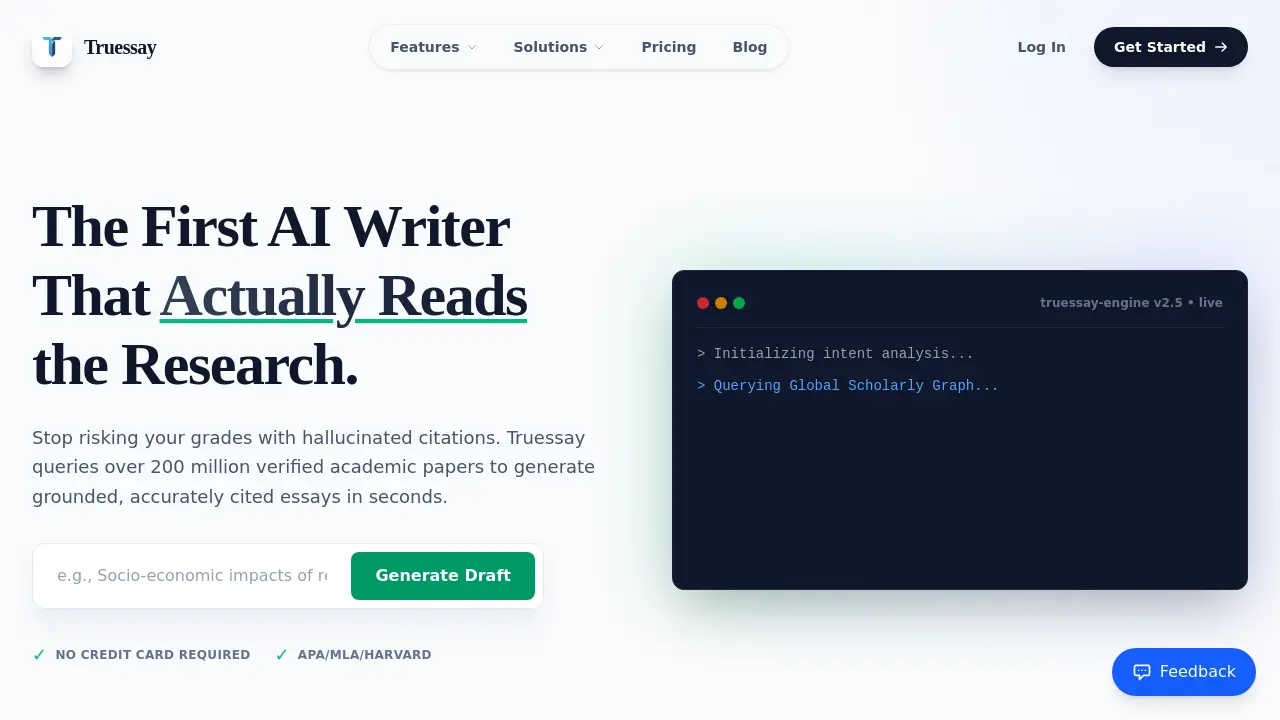
Truessey is an AI-powered academic research assistant that generates essays and literature reviews with real, verifiable citations. Unlike standard language models, it employs a "search-first" methodology, querying live academic databases like CrossRef and Semantic Scholar before writing. This ensures every claim is grounded in peer-reviewed sources, with all references linking to actual DOIs or PDFs. Key benefits include eliminating hallucinated sources, accessing up-to-date research, and supporting multilingual synthesis—reading English papers and outputting drafts in over 12 languages. Users can export directly to Word, LaTeX, or Markdown. The tool targets students and researchers needing citation accuracy for term papers, theses, and literature reviews, providing a structured first draft to overcome the "blank page" challenge while maintaining academic integrity through transparent source lists.
How does Truessay work
Truessay is an AI academic writing assistant that operates through a search-first methodology. It begins by analyzing a user's prompt to formulate scholarly queries, then interrogates a global graph of over 200 million verified academic papers from repositories like CrossRef and Semantic Scholar. The system verifies each reference's DOI for authenticity before synthesizing evidence-based content using relevant abstracts. Final drafts are assembled with precise in-text citations automatically formatted in styles such as APA, MLA, or Chicago. This process ensures all claims are grounded in peer-reviewed literature, supporting multilingual output and direct export to Word, LaTeX, or Markdown for students and researchers.
Benefits of Truessay
Truessay is an AI academic assistant that generates research-backed essays with verifiable citations. It queries live scholarly databases to find real sources, avoiding the hallucinated references common in other AI tools. The system synthesizes evidence from over 200 million papers, supports multiple languages for drafting, and exports to common formats like Word and Markdown. Its "search-first" methodology helps students overcome the blank page by providing structured outlines and authentic source lists, while researchers can automate literature reviews with DOI-linked references. This approach prioritizes academic integrity through transparent, evidence-based writing assistance.
Pros and Cons of Truessay
Pros
- Generates essays with real, verifiable citations.
- Queries live academic databases for current research.
- Supports 12+ languages for multilingual synthesis.
- One-click export to Word, LaTeX, Markdown.
- Search-first methodology grounds content in evidence.
Cons
- Free tier restricted to one daily draft.
- Generated drafts require human review.
- Potential academic integrity misuse risk.
- Limited utility outside academic writing niche.
- Premium plans cost $9/month minimum.
Core Features of Truessay
Verified Citation Generation
Generates academic essays with real, verifiable citations by querying live scholarly databases like CrossRef and Semantic Scholar. Each reference includes a valid DOI, eliminating hallucinated sources.
Multilingual Research Synthesis
Reads source materials in English and generates essay drafts in over 12 target languages. This functionality breaks language barriers for non-native English-speaking researchers and students.
Export and Formatting Ready
Provides one-click export of completed drafts into common academic formats including Word (.docx), LaTeX, and Markdown. This saves users significant manual formatting time.
Structured Outline Generation
Produces a detailed essay outline and a curated list of core sources. This helps students overcome initial research hurdles and establish a clear paper structure quickly.
Use Cases of Truessay
- Undergraduate students: Generate structured essay drafts with verifiable DOI citations from peer-reviewed sources to overcome initial research hurdles.
- Academic researchers: Automate literature review synthesis by querying live academic databases for relevant papers and key findings.
- International students: Produce research papers in native language by synthesizing English source material using multilingual support.
- Graduate students: Draft thesis chapters with evidence-based arguments and correctly formatted APA/MLA citations from verified references.
FAQs of Truessay
What is a literature review generator?
A literature review generator is an AI-powered tool that automatically searches academic databases, synthesizes findings from multiple research papers, and creates a structured summary with proper citations. Truessay's literature review generator queries live scholarly databases to find relevant peer-reviewed papers, analyzes their abstracts and key findings, and generates a comprehensive review with verifiable DOI references in formats like APA, MLA, or Chicago style.
How does Truessay ensure citation accuracy?
Truessay ensures citation accuracy through a three-step verification process: (1) Query live academic databases including CrossRef, Semantic Scholar, and OpenAlex; (2) Verify DOI existence and accessibility; (3) Format citations according to official style guides (APA 7th edition, MLA 9th edition, etc.). Every citation includes a clickable DOI link for immediate verification, unlike AI tools that generate fictional references.
Is Truessay free to use?
Truessay offers a free tier that allows users to generate one research draft per day with full citation support. Premium plans starting at $9/month offer unlimited drafts, priority processing, export to Word/LaTeX, and advanced features like bulk citation management. All plans include access to the same high-quality academic database and citation engine.
What citation styles does Truessay support?
Truessay supports all major academic citation styles: APA (7th edition), MLA (9th edition), Chicago (17th edition), Harvard, IEEE, Vancouver, and AMA. Citations are automatically formatted with proper italicization, capitalization, and punctuation according to each style's official manual. Users can switch between citation styles instantly without regenerating content.
Can Truessay help with thesis and dissertation writing?
Yes, Truessay is designed to support graduate-level research including thesis and dissertation literature reviews. The tool can analyze hundreds of papers simultaneously, identify research gaps, synthesize conflicting findings, and generate comprehensive chapter drafts. However, Truessay output should be treated as a structured first draft that requires human review, editing, and integration with your original research.
How is Truessay different from ChatGPT for academic writing?
The fundamental difference is source verification: ChatGPT generates text based on patterns in training data and often invents fake citations, while Truessay queries live academic databases before writing and only cites papers that exist with verifiable DOIs. ChatGPT's knowledge has a training cutoff date, while Truessay accesses current research. For academic work requiring real citations, Truessay eliminates the risk of citation fabrication that makes ChatGPT unsuitable for scholarly writing.
Does Truessay work in languages other than English?
Yes, Truessay supports over 12 languages including English, Spanish, French, German, Chinese (Simplified and Traditional), Arabic, Portuguese, Japanese, Korean, Italian, Dutch, and Russian. The system can read English research papers and generate essays in your preferred language, making academic content accessible to non-native English speakers. All citation formatting works correctly across different languages.
What is the difference between APA and MLA citation styles?
APA (American Psychological Association) and MLA (Modern Language Association) differ in author presentation, publication dates, and title formatting. APA uses author-date format (Smith, 2023) with publication year immediately after author name, preferred in social sciences. MLA uses author-page format (Smith 45) with publication year at the end, preferred in humanities. APA italicizes book titles and article titles use sentence case; MLA italicizes book titles and article titles use title case.
Which academic databases does Truessay access for research?
Truessay queries multiple reputable academic databases including CrossRef, Semantic Scholar, and OpenAlex to access metadata from millions of peer-reviewed journals. This multi-database approach ensures comprehensive coverage across disciplines and that all citations link to real DOIs and accessible PDFs, providing a robust foundation for evidence-based writing.
How current is the research data used by Truessay?
Truessay provides real-time access to the latest research by querying live academic repositories. Unlike AI tools with static training data cutoffs, it retrieves current publications and pre-prints, ensuring your draft reflects the most recent scholarly findings and avoids outdated information commonly found in predictive language models.
Can I export my essay in PDF format?
Truessay supports direct export to Word (.docx), LaTeX, and Markdown formats. While PDF export isn't a native option, users can easily convert exported files to PDF using standard software like Microsoft Word or online converters, maintaining all formatting, citations, and document structure without additional manual adjustment.
How does Truessay handle conflicting research findings in literature reviews?
When synthesizing literature, Truessay identifies and presents conflicting findings from different studies, highlighting areas of consensus and disagreement. This balanced approach helps users understand the research landscape and formulate nuanced arguments based on evidence, rather than oversimplifying complex academic debates.
Does using Truessay count as plagiarism?
Truessay reduces plagiarism risk by generating content with verifiable citations to real, accessible sources. However, proper academic use requires users to review, edit, and integrate the draft with their own analysis and original thought. Always follow your institution's specific guidelines on AI-assisted writing and ensure final submissions reflect your own work.
How to use Truessay
Truessay is an AI academic writing tool that generates essays with real citations by querying live scholarly databases, ensuring evidence-based content for students and researchers.
- Users begin by visiting Truessay.com and selecting the free tier, which does not require credit card details for initial drafts.
- They enter a detailed research prompt or essay topic, including specific keywords and academic field to guide the scholarly search process.
- Preferred citation style (APA, MLA, Chicago, etc.) and output language are chosen from dropdown menus to customize formatting.
- Upon clicking generate, the engine queries live academic databases such as Crossref and Semantic Scholar for relevant, peer-reviewed papers.
- A transparent list of sourced papers appears with DOIs and abstracts; users review these to verify relevance and accuracy.
- The AI synthesizes a draft by incorporating evidence from vetted sources, applying proper in-text citations and bibliography per the selected style.
- The completed essay can be exported directly in Word, Markdown, or LaTeX formats for further editing or submission purposes.
- To interpret results, users cross-reference draft arguments with the source list, ensuring every claim is backed by a verifiable citation.
- Each citation includes a clickable DOI link, directing users to the original paper for verification and additional context.
- For multilingual projects, the tool translates English sources into over 12 languages while maintaining correct citation formatting throughout.
