
SBTI Personality Test – Discover Your 15‑Dimension Profile
| Added on: | Apr 23, 2026 |
| Monthly Visits: | -- |
| Social & Email: | -- |

What is SBTI
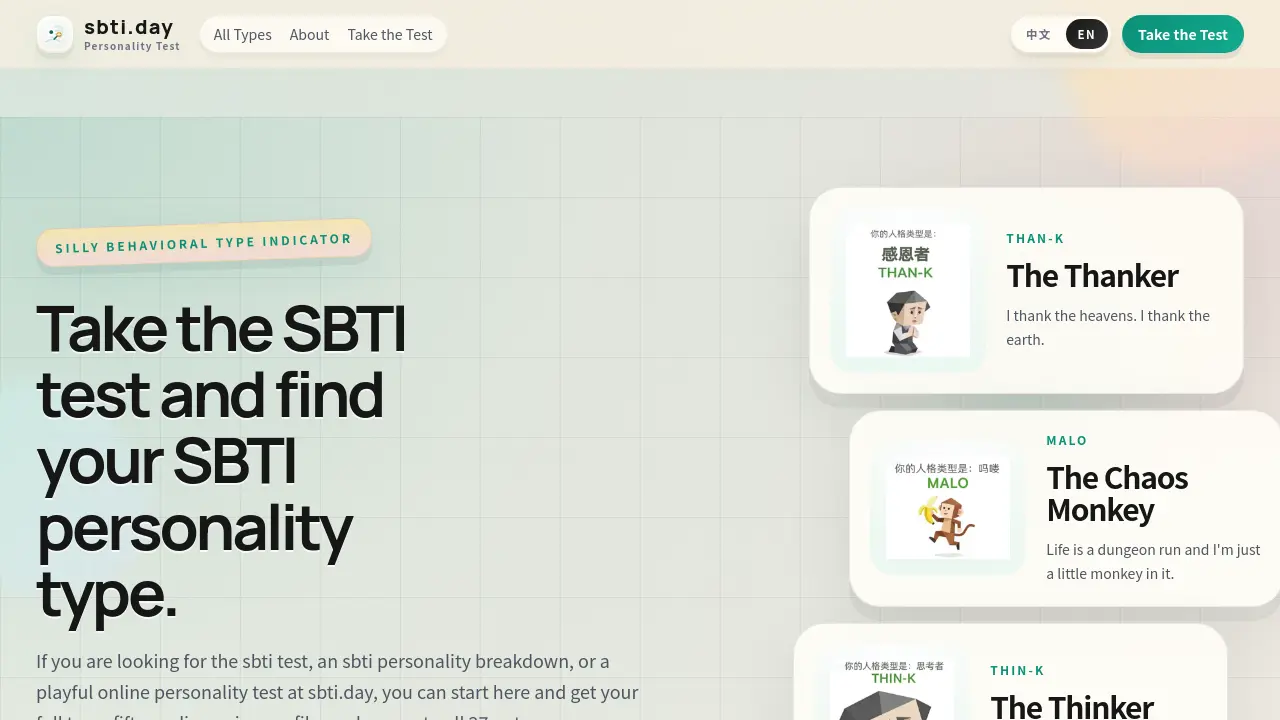
SBTI (Silly Behavioral Type Indicator) is an online personality assessment that evaluates users across five distinct models—Self, Emotion, Attitude, Action, and Social—producing a fifteen‑dimension fingerprint and one of 27 detailed outcome types. The test consists of 32 prompts, including a hidden “drink” branch that activates under specific responses, and delivers results that combine a concise label with in‑depth explanations of behavioral patterns, attachment styles, decision‑making tendencies, and social boundaries. Designed for quick entry, the platform lets visitors start the quiz without registration, complete the prompts, and view a readable result page that also offers nearby‑type comparisons and FAQs. While not a clinical tool, SBTI serves as an entertaining, self‑observation resource that distinguishes itself from traditional MBTI frameworks by focusing on everyday internet‑native behavior.
How does SBTI work
The SBTI platform delivers a brief, web‑based personality assessment that maps users onto a fifteen‑dimension profile across five model groups—Self, Emotion, Attitude, Action, and Social. After entering the test from the homepage, participants answer 32 prompts, including a conditional hidden branch, which the system evaluates against predefined scales (S1‑S3, E1‑E3, etc.). The algorithm then generates a single type label among 27 outcomes, accompanied by a detailed fingerprint and comparative type suggestions. Results are presented instantly on a dedicated page, offering a readable summary, FAQ, and links to explore other personalities, positioning SBTI as an entertainment‑focused, internet‑native alternative to traditional MBTI tests.
Benefits of SBTI
SBTI offers a quick, web‑native personality assessment that goes beyond a single label by mapping users across fifteen dimensions within five behavioral models (self, emotion, attitude, action, social). After completing a short series of 32 prompts, participants receive a readable result page featuring a 15‑dimension fingerprint, a concise type summary, and comparisons to nearby types. The platform emphasizes entertainment and self‑observation while clearly differentiating itself from traditional MBTI frameworks, making it a useful tool for casual insight, online sharing, and exploring nuanced habit patterns.
Pros and Cons of SBTI
Pros
- Immediate test start without account creation.
- Provides 15‑dimension personality fingerprint.
- Offers 27 distinct outcome pages.
- Structured FAQ addresses common search intent.
- Free, web‑based entertainment tool.
Cons
- Not a clinically validated assessment.
- Meme‑style tone may reduce perceived seriousness.
- Hidden test branch can confuse users.
- Limited guidance beyond brief result readout.
- Lacks mobile app or offline access.
Core Features of SBTI
Immediate Test Access
Enables users to begin the SBTI quiz directly from the homepage or dedicated test page, eliminating account creation and navigation delays.
Fifteen‑Dimension Profile Generation
Processes responses across five model groups to produce a detailed 15‑dimension fingerprint that reflects thinking, emotional, attitudinal, action, and social patterns.
Comprehensive Result Pages
Displays the final SBTI type, a concise read, the 15‑dimension breakdown, FAQs, and nearby‑type comparisons for deeper self‑observation.
Five Personality Model Evaluation
Analyzes Self, Emotion, Attitude, Action, and Social models, each with three sub‑dimensions, to capture nuanced everyday behaviors and preferences.
Conditional Prompt Branching
Includes a hidden “drink” branch that appears only under specific answer patterns, adding an adaptive element to the questionnaire.
Use Cases of SBTI
- University students: Use the SBTI test to obtain a 15‑dimension personality fingerprint for self‑reflection and academic counseling.
- Career advisors: Apply SBTI results to compare nearby types, aiding students in identifying suitable internship or job environments.
- Online community managers: Leverage the SBTI framework to segment members by behavior models, improving engagement strategies.
- Content creators: Reference SBTI type descriptions when designing relatable memes or narratives for a internet‑native audience.
- Researchers in digital sociology: Analyze aggregated SBTI data to study contemporary behavioral patterns across the five model groups.
FAQs of SBTI
What is SBTI and what does the SBTI personality mean?
SBTI (Silly Behavioral Type Indicator) is a playful, internet‑native personality framework that evaluates everyday habits, attachment patterns, decision styles, and social boundaries. The result consists of a type label, a fifteen‑dimension profile, and a brief description that helps users observe their behavior in a light‑hearted manner.
How is SBTI different from MBTI?
While MBTI classifies personality based on four dichotomies rooted in Carl Jung’s theory, SBTI focuses on five distinct models—Self, Emotion, Attitude, Action, and Social—each split into three sub‑dimensions. This yields fifteen dimensions rather than a single four‑letter code, providing a more granular, behavior‑first snapshot rather than a typological taxonomy.
Where can I take the SBTI test?
The SBTI test is hosted directly on sbti.day. Visitors can start from the homepage or click the “Take the Test” link, answer 32 prompts (including a hidden drink branch), and receive an instant result page without needing to create an account.
What do I get after finishing the SBTI test?
After completing the prompts, users receive a personalized result page that includes the type name (one of 27 outcomes), a quick read, a fifteen‑dimension fingerprint, and links to nearby type comparisons. The page also contains an FAQ and guides for interpreting the dimensions.
Is SBTI a clinical assessment?
No. SBTI is intended for entertainment, self‑observation, and casual comparison. It does not replace professional psychological evaluation, and its interpretations should be considered illustrative rather than diagnostic.
How are the fifteen dimensions organized?
The dimensions are grouped into five models: Self (S1‑S3) assesses self‑evaluation stability; Emotion (E1‑E3) measures anxiety, investment, and independence in relationships; Attitude (A1‑A3) examines worldview orientation; Action (So1‑So3) looks at risk approach and decisiveness; and Social (Ac1‑Ac3) evaluates interpersonal boundaries and authenticity.
Can I compare my result with other SBTI types?
Yes. Each result page provides direct links to nearby types, allowing users to explore similarities and differences across the 27 outcomes. The site also offers a full directory of all types for broader comparison.
Is there a hidden branch in the test?
A hidden “drink” branch appears only for certain answer patterns. It adds an extra prompt that subtly influences the final type, contributing to the test’s playful, internet‑style design.
How to use SBTI
The SBTI (Silly Behavioral Type Indicator) provides a playful online personality assessment, delivering a 15‑dimension profile and one of 27 detailed outcome types.
Begin by clicking Take the Test on the homepage or directly navigating to test; no registration is required, and the interface loads the first prompt instantly.
Answer each of the 32 prompts, which are grouped into five model clusters (Self, Emotion, Attitude, Action, Social); a hidden “drink” branch appears only for specific response patterns.
After submitting the final answer, the platform redirects to a result page showing your SBTI type, a concise description, and a fifteen‑dimension fingerprint with nearby‑type comparisons.
Review the dimension scores to identify strengths and behavioral tendencies, then use the provided FAQs and type directory to explore how the SBTI framework differs from MBTI and to inform personal reflection or informal self‑analysis.
