
KeyAPI FAQs
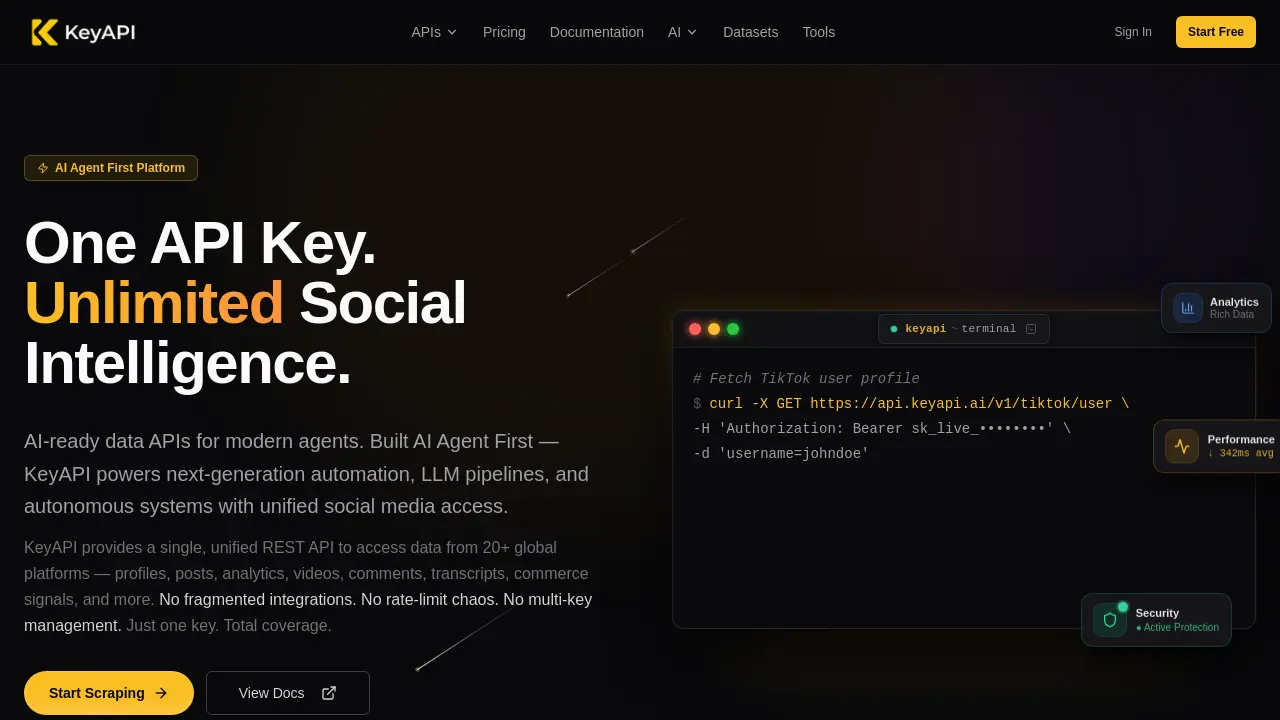
KeyAPI is an AI‑ready unified social media API platform that gives developers, AI builders and automation engineers single‑key access to 20+ networks, real‑time and historic data, sub‑500 ms latency and auto‑scaling infrastructure.

FAQs of KeyAPI
How do credits work?
KeyAPI operates on a credit‑based system where each API call consumes a predefined number of credits depending on the endpoint and data volume. Credits are allocated to an account according to the selected subscription plan and are automatically deducted when a request is successfully processed. Users can monitor credit usage in real‑time through the dashboard, ensuring they stay within their allocated quota.
Do unused credits expire?
Unused credits are retained until the end of the current billing cycle; they do not carry over to the next period. At the start of each 31‑day cycle, any remaining credits are reset, and the account receives a fresh credit allowance based on the subscribed tier. This policy encourages regular usage while providing a predictable budgeting model for developers.
Is this compliant with platform policies?
KeyAPI adheres to the terms of service and data usage policies of each integrated social platform. The service employs authorized endpoints, respects rate limits, and implements data handling practices that align with platform guidelines and privacy regulations. Compliance documentation is available upon request for enterprise customers who require audit trails.
Can I use this for AI model training?
Yes, the unified API is explicitly designed for AI‑ready data ingestion. Users can retrieve historical and real‑time social media content, including posts, comments, transcripts, and engagement metrics, which can be fed directly into machine‑learning pipelines or large‑language‑model training workflows. The structured JSON responses simplify preprocessing and feature extraction.
Do you support MCP integrations?
KeyAPI offers native support for Multi‑Channel Publishing (MCP) integrations, enabling developers to route data from multiple social sources into a single processing layer. The platform’s AI‑Agent First architecture provides pre‑built endpoints and SDKs that facilitate seamless connection with MCP frameworks, automation tools, and custom orchestration services.
What happens if I exceed rate limits?
If a request surpasses the allocated rate limit for the current plan, KeyAPI returns a standard HTTP 429 “Too Many Requests” response along with information about the reset window. Users can upgrade to a higher tier (e.g., Pro or Ultra) to obtain increased rate‑limit caps, or they may implement exponential back‑off logic in their client code to retry after the specified cooldown period.
Is enterprise pricing available?
Enterprise pricing is offered through a customized quote that matches the specific data volume, SLA requirements, and support needs of large‑scale organizations. The Ultra plan provides a baseline for high‑usage scenarios, but dedicated sales engineers can tailor contract terms, credit bundles, and dedicated support levels to fit enterprise workloads and compliance mandates.
How to use KeyAPI
- KeyAPI delivers a unified REST API that aggregates profiles, posts, analytics, and media from 20+ social platforms, enabling AI agents and automation pipelines to retrieve social intelligence with a single API key.
- Register on the KeyAPI website, verify the account, and generate an API token; the token appears in the dashboard and will be used for all subsequent requests.
- Construct a request by setting the
Authorization: Bearer <token>header, choosing the desired endpoint (e.g.,/v1/tiktok/user) and appending required query parameters such asusernameorlimit. - Execute the request using any HTTP client (curl, Postman, Python requests); the service responds within ~500 ms with a JSON payload containing structured fields like
id,name,metrics, andmedia. - Parse the returned JSON to extract relevant attributes—followers count, engagement rates, video URLs, or sentiment scores—and feed them into your LLM workflow, analytics dashboard, or autonomous agent.
- Monitor usage via the KeyAPI dashboard, adjust credit plans as needed, and iterate by combining multiple platform endpoints to enrich models, improve recommendation accuracy, or generate comprehensive social reports.
