
ImagesToText.ai FAQs
ImagesToText.ai offers free, unlimited AI text extraction from images including documents, photos, screenshots, and handwritten notes with 99%+ accuracy.

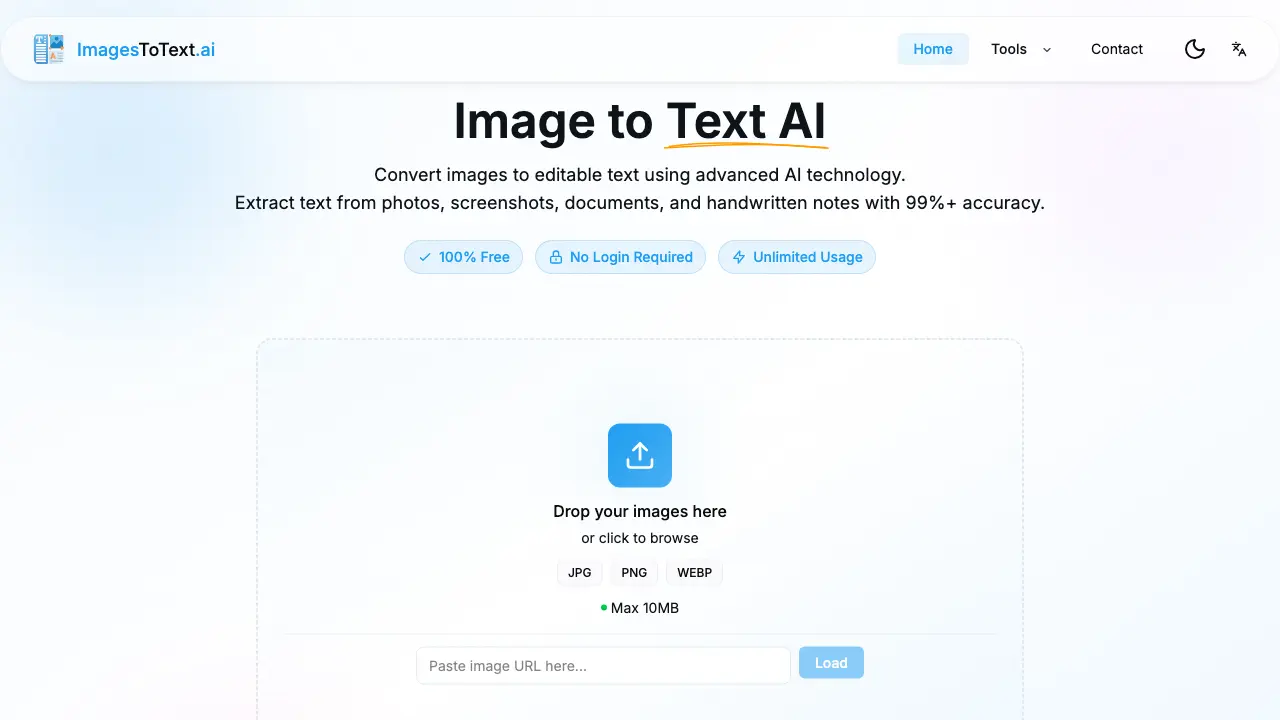
FAQs of ImagesToText.ai
How does image to text conversion work?
ImagesToText.ai employs advanced optical character recognition (OCR) technology powered by artificial intelligence. When a user uploads an image, the AI analyzes pixel patterns, identifies text regions, and converts recognized characters into editable digital text. This process handles various fonts, layouts, and backgrounds to produce accurate results without manual intervention.
What image formats are supported?
The tool supports common image formats including JPG, PNG, WEBP, and PDF files. Users can upload images with a maximum file size of 10MB per image. This range covers most everyday photo, screenshot, and document scanning scenarios, ensuring broad compatibility for text extraction tasks.
Is my data safe and private?
Yes, data privacy is a core feature. The service is 100% privacy protected, meaning uploaded images are not stored, shared, or used for any other purpose. All processing occurs securely in transient memory, and no personal data is collected, providing confidentiality for user content.
Can it recognize handwritten text?
The AI includes specialized handwriting recognition capabilities. It is trained to interpret diverse handwriting styles from notes, letters, and personal documents. This allows accurate conversion of handwritten class notes or informal text into searchable and editable digital format, though results may vary with extreme cursive or stylistic variations.
What languages are supported?
ImagesToText.ai supports over 50 languages for text extraction. This includes major languages like English, Spanish, French, German, Chinese, and many others. The multilingual capability enables users to extract text from images containing mixed or non-Latin scripts effectively.
Is there a limit on image size or number of conversions?
Each uploaded image must be 10MB or smaller. There are no restrictions on the total number of conversions; users can process unlimited images without creating an account or encountering usage caps. This unlimited policy applies to both single and batch uploads for consistent accessibility.
How does ImagesToText.ai achieve high accuracy with low-resolution images?
The AI incorporates low-resolution support algorithms that enhance blurry or pixelated images before text detection. It uses image upscaling and noise reduction techniques to improve clarity, maintaining a 99%+ accuracy rate even with old scans, poor-quality photos, or compressed screenshots where traditional OCR might fail.
Can mathematical equations and formulas be extracted from images?
Yes, the tool features mathematical equation detection. It can accurately identify and extract complex expressions, formulas, and scientific notations from images. This is particularly useful for converting textbook excerpts, research papers, or problem sets containing algebraic, calculus, or symbolic content into editable text.
What are the details of the batch processing feature?
Batch processing allows users to upload and convert multiple images in a single session. There is no specified limit on the number of images per batch, enabling efficient handling of large document sets like multi-page receipts, photo collections, or scanned archives without repetitive individual uploads.
How long does image processing typically take?
The AI is designed for instant processing, with most images converted in under 3 seconds as indicated by service metrics. Processing time depends on image complexity, size, and content density, but the system is optimized for speed to provide immediate text output for both single and batch operations.
Does the tool handle all document types like receipts and forms?
Yes, it is versatile for various document structures including receipts, invoices, forms, and printed reports. The AI adapts to different layouts, tables, and segmented information, extracting relevant text accurately whether from standardized templates or free-form documents.
What options are available after text extraction?
Once text is extracted, users can directly copy it to the clipboard or download it as a plain text file. This allows immediate pasting into other applications or saving for later editing, providing flexible integration into workflows without requiring additional software or manual transcription.
How to use ImagesToText.ai
ImagesToText.ai is a web-based OCR tool that uses artificial intelligence to convert images containing text into editable digital formats. It supports various image types including photos, screenshots, and scanned documents, with emphasis on accuracy and user privacy.
- The user navigates to the ImagesToText.ai website, where the OCR tool is immediately accessible without any registration or login requirements.
- An image file is uploaded via drag-and-drop or the file browser; supported formats include JPG, PNG, PDF, WEBP, with a maximum size of 10 megabytes per file.
- The user selects an extraction mode, choosing between all text, common information, or specific content such as handwritten notes or mathematical equations.
- The AI processes the image automatically within seconds, employing advanced algorithms to achieve a stated accuracy rate exceeding 99% for many document types.
- The extracted text is displayed in an output panel, allowing the user to review and perform minor manual edits if necessary before finalizing.
- The final text can be copied directly to the clipboard or downloaded as a plain text file for integration into other software or storage systems.
- Batch processing enables the simultaneous upload of multiple images, streamlining the conversion of large document sets or collections efficiently.
- Users apply the extracted text to tasks like digitizing handwritten class notes, converting screenshots to searchable text, or archiving scanned receipts and forms.
