
EnsembleData FAQs
EnsembleData provides real-time social media scraping APIs for TikTok, Instagram, YouTube and more. Extract posts, profiles and analytics at scale.

FAQs of EnsembleData
What is EnsembleData and who is it for?
EnsembleData is a real-time social media scraping API service that lets developers and businesses extract public data from platforms like TikTok, Instagram, YouTube, Threads, Reddit, Twitch, Twitter (X), and Snapchat. It is built for influencer marketing platforms, content creator agencies, social listening companies, and any organization that needs structured social media data at scale without maintaining their own scraping infrastructure.
What social media platforms does EnsembleData support?
EnsembleData currently supports eight major platforms: TikTok, Instagram, YouTube, Threads, Reddit, Twitch, Twitter (X), and Snapchat. For each platform, the API offers platform-specific endpoints such as profile lookups, post and comment retrieval, hashtag and keyword search, and analytics data. Coverage continues to expand as new platforms are added over time.
Do I need social media account credentials to use the API?
No. EnsembleData's APIs access publicly available data only and do not require users to provide social media login credentials, cookies, or any form of user authentication. This design simplifies integration, eliminates account management overhead, and avoids the security risks associated with storing third-party credentials on your end.
How does pricing work under the Freemium model?
EnsembleData operates on a Freemium model, meaning there is a free tier that allows you to test endpoints and run low-volume integrations before committing to a paid plan. Paid plans provide higher rate limits, priority support, and access to bulk endpoints. Exact pricing is listed on the EnsembleData website, and the free tier is sufficient for evaluating whether the API meets your data needs.
Is EnsembleData compliant with data privacy regulations?
Yes. EnsembleData is designed to be GDPR-compliant by restricting its APIs to publicly available data only. The service does not collect, store, or process private user information on behalf of customers. As with any data aggregation tool, users are responsible for ensuring their own usage complies with applicable laws and platform terms of service in their jurisdiction.
How reliable is the API for production use?
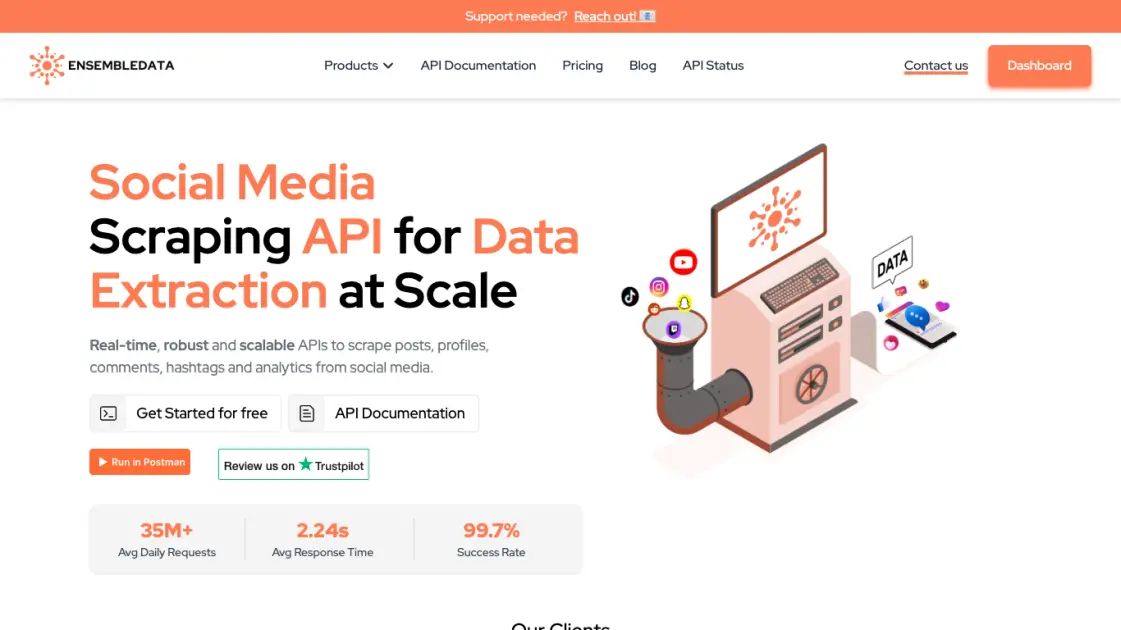
EnsembleData processes over 35 million requests daily with a reported average response time of 2.24 seconds and a 99.7 percent success rate. These metrics indicate a service that can sustain enterprise-level traffic volumes. That said, reliability can vary by endpoint and platform, so running your own benchmarks against the endpoints you intend to use is always recommended.
What programming languages and tools can I use with EnsembleData?
EnsembleData exposes a standard REST API that works with any programming language capable of making HTTP requests. The quick start guide demonstrates usage with Python and the requests library, but you can just as easily use JavaScript, TypeScript, Go, Ruby, Java, PHP, or any other language or tool that supports HTTP clients and JSON parsing.
How to use EnsembleData
Sign up on the EnsembleData website to obtain an API token. The token is required for every request and identifies the account to the service.
Choose the target platform and endpoint from the available APIs, such as TikTok user info at
/apis/tt/user/info. Each platform has its own set of endpoints.Construct an HTTP GET request with the required parameters for the chosen endpoint, including the API token. Parameters vary by endpoint but typically include a username or post ID.
Send the request using any HTTP client, such as Python's
requestslibrary or cURL. EnsembleData returns a JSON response containing the requested social media data.Parse the JSON response to extract fields like follower count, video metadata, comments, or engagement stats. The response structure is consistent per endpoint.
Handle error codes and rate limits in the application logic. The API returns standard HTTP status codes and error messages to indicate issues like invalid tokens or exceeded limits.
Scale up by integrating the API token into automated data pipelines. Multiple concurrent requests can be made, each authenticated with the same token.
