
AstroChart FAQs
AstroChart is a free online astrology tool that generates personalized astrocartography maps using Swiss Ephemeris; users enter birth data to locate optimal places for love, career and personal growth.

FAQs of AstroChart
What are MC lines in astrocartography?
MC (Midheaven) lines mark the points on the world map where a planet was at the highest point in the sky at the moment of birth. When a person lives near an MC line, the planetary energy expressed through that line tends to influence career, public reputation, and overall life direction, making it a useful tool for identifying locations that support professional achievement.
Which astrocartography line is best for love?
Venus lines are generally considered the most favorable for romantic and social connections because Venus governs love, beauty, and harmony. Additionally, Moon lines can enhance emotional intimacy and nurturing bonds, while the Descendant (DSC) line of any planet may also highlight relationship opportunities, depending on the specific planetary influence involved.
How accurate is astrocartography?
Astrocartography calculations on AstroChart are based on the Swiss Ephemeris, a highly regarded astronomical engine used by professional astrologers. Accuracy depends primarily on the precision of the birth time and location provided; with exact data, the generated planetary lines are reliable within the limits of astrological interpretation, which is intended for self‑exploration rather than deterministic prediction.
How far from a line do I need to be to feel its effects?
The influence of a planetary line gradually diminishes with distance. Most practitioners suggest that being within 500–1,000 kilometers of a line allows the energy to be perceptible, while stronger effects are often reported when residing directly on or very near the line. Personal sensitivity and the specific planet involved also affect the perceived impact.
Can I use astrocartography for vacation planning?
Yes, astrocartography can help identify short‑term destinations that align with a traveler’s goals, such as relaxation, creativity, or adventure. By selecting a location near a Venus, Jupiter, or Mars line, a user may enhance enjoyment, luck, or energetic activity during a holiday, though results are subjective and intended for entertainment purposes.
What is the difference between ASC and DSC lines?
ASC (Ascendant) lines indicate where a planet was rising on the eastern horizon at birth, influencing personal identity, self‑expression, and how others initially perceive you. DSC (Descendant) lines mark where the same planet was setting on the western horizon, affecting partnerships, collaborations, and the qualities you attract in relationships. Together they provide a balanced view of individual and relational dynamics.
Are the locked planets necessary for a complete analysis?
While the free version of AstroChart displays six planetary lines, unlocking all ten planets—including Uranus, Neptune, and Pluto—offers a more comprehensive picture. Outer planets introduce generational themes, subconscious patterns, and deep transformation, which can be valuable for long‑term planning and self‑understanding beyond the more immediate influences of the inner planets.
How often are the planetary positions updated on AstroChart?
AstroChart uses real‑time calculations based on the Swiss Ephemeris, ensuring that planetary positions are refreshed instantly whenever a user submits birth data. The system reflects the current UTC time stamp, so the displayed chart always corresponds to the most accurate astronomical data available at the moment of generation.
How to use AstroChart
AstroChart generates a personalized astrocartography map by projecting the user's birth chart onto the world, highlighting planetary lines that influence career, love, health, and personal growth.
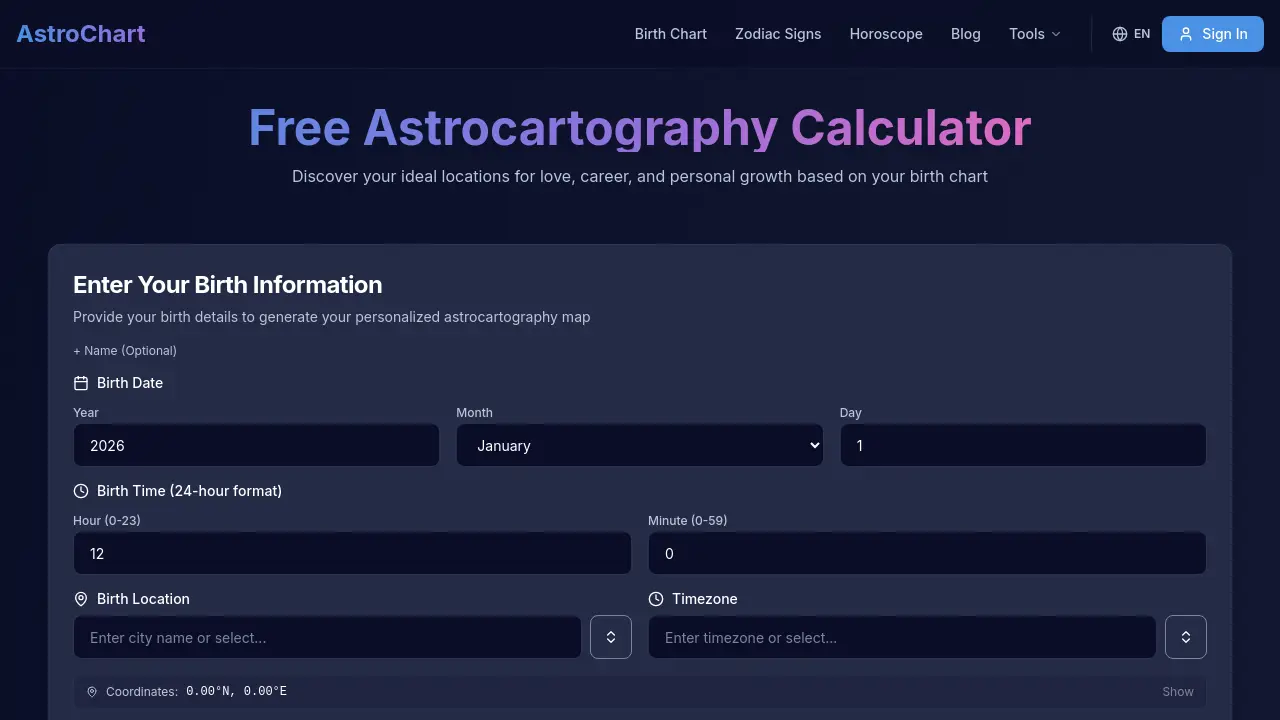
Input the exact birth date, 24‑hour birth time, and geographic coordinates; precise time ensures accurate calculation of Ascendant, Midheaven, IC, and Descendant angles.
Optionally enter a name, select the desired planets (Sun, Moon, Venus, etc.), and confirm the time‑zone; locked planets remain unavailable without a premium upgrade.
Click “Generate My Astrocartography Map”; the system uses the Swiss Ephemeris to compute planetary positions and draws MC, IC, ASC, and DSC lines across the interactive world map.
Hover or click any point on the map to view a tooltip that explains which planetary line is nearest, its angle, and a brief interpretation of its influence at that location.
Review the legend to distinguish MC (career), IC (home), ASC (self‑expression), and DSC (relationships) lines, noting the associated planet’s energy such as Sun for visibility or Venus for romance.
Compare multiple locations by moving the cursor; the interface highlights distance from each line, helping assess which areas best match specific goals like professional advancement or emotional security.
Record the identified optimal regions, then cross‑reference with external resources (e.g., cost of living, visa requirements) before planning relocation, travel, or long‑term settlement.
For deeper insight, consider upgrading to Premium to unlock all planetary lines, enabling a more comprehensive astrocartography analysis and refined location recommendations.
